Afonso I, Duke of Braganza
Duke of Braganza
Years: 1377 - 1461
Dom Afonso I of Braganza (Portuguese pronunciation: [ɐˈfõsu]; 10 August 1377 - 15 December 1461) was the first Duke of Braganza and the eighth Count of Barcelos.
He would start a dynasty, the House of Braganza, that would end up being the most powerful and wealthy in all of Portugal.
His descendents would go on to become high-ranking nobles, imperial officials, and even the Kings of Portugal and the Emperors of Brazil.

Related Events
Filter results
Showing 10 events out of 11 total
The Rise of the House of Bragança: A State Within a State (15th Century)
While King João I of Portugal (r. 1385–1433) secured the future of the House of Avis through his five legitimate sons, he also ensured prosperity and power for his illegitimate children, mirroring how his own father, Peter I of Portugal, had provided for him.
The Creation of the House of Bragança (1442)
- João’s illegitimate son, Afonso, was granted vast estates and bestowed with the hereditary title of Duke of Bragança in 1442.
- This was the first ducal title ever created in Portugal, and it marked the beginning of one of the most powerful noble houses in Iberia.
- Afonso’s lands were so extensive that the House of Bragança essentially formed a "state within a state,"rivaling the Portuguese Crown in both wealth and military strength.
The House of Bragança: Wealth and Influence
- The duchy controlled vast regions, amassing landholdings, castles, and economic resources across Portugal.
- The Braganças maintained a large military force of armed retainers, making them a political force capable of challenging royal authority.
- Over time, the Bragança family became the leaders of the old aristocracy, frequently opposing the centralizing efforts of the House of Avis.
The Long-Term Conflict with the Crown
- As Portugal expanded overseas, the monarchy sought to consolidate power and prevent rival noble factionsfrom gaining influence.
- The Bragança family often clashed with the Avis kings, resisting efforts to limit their autonomy and control their wealth.
- This rivalry eventually culminated in the Duke of Bragança’s execution under King João II in 1483, when the monarchy took drastic steps to curb noble power.
The House of Bragança’s Ultimate Rise to the Throne (1640)
- Despite its struggles against the Crown, the House of Bragança survived and continued to accumulate power.
- In 1640, after decades of Spanish rule (1580–1640), Portugal revolted against Spain, and the Bragança family led the rebellion.
- The Duke of Bragança, João IV, was proclaimed King of Portugal, officially ending the Iberian Union and establishing the House of Bragança as Portugal’s ruling dynasty, which would reign until 1910.
Conclusion: A Rival to the House of Avis
- João I’s decision to grant Afonso the Duchy of Bragança inadvertently created a noble house powerful enough to challenge the monarchy itself.
- The Braganças would grow to rival the Avis dynasty, eventually overthrowing it and ruling Portugal for nearly three centuries.
- The foundation of the House of Bragança not only reshaped Portuguese aristocracy but also played a decisive role in the future of the Portuguese monarchy.
The Battle of Alfarrobeira (1449): The Fall of Infante Pedro and the Rise of the House of Bragança
Following Afonso V’s assumption of full power in 1448, the Duke of Bragança successfully turned the young king against his uncle, Infante Pedro, Duke of Coimbra, claiming that Pedro was plotting to seize the throne. This manipulation led to Pedro’s dismissal from the regency and his exile to his estates.
Pedro’s Attempt to Regain Power
- As rumors of a plot against him spread, Pedro decided to resist rather than submit.
- He marched on Lisbon, where he enjoyed strong support from the merchants and populace.
- Afonso V, under the influence of the House of Bragança, declared Pedro a traitor and gathered an army to confront him.
The Battle of Alfarrobeira (May 24, 1449)
- Pedro’s army met the royalist forces, led by Afonso V and the Duke of Bragança, near Alfarrobeira, north of Lisbon.
- The battle was swift and decisive—Pedro was killed on the field, and his forces were crushed.
- The defeat eliminated the greatest advocate for strong royal authority, leaving Afonso V heavily influenced by the Bragança family.
Consequences of Pedro’s Defeat
-
The Rise of the House of Bragança
- The House of Bragança emerged as the dominant noble house in Portugal, vastly increasing its land, wealth, and political influence.
- The Braganças became "a state within a state", controlling vast territories and challenging the power of the monarchy.
-
Afonso V Becomes a Puppet of the Nobility
- Without Pedro’s guidance, the pliable Afonso V fell under the control of the nobility, particularly the Braganças.
- His reign was characterized by military adventures in Morocco and Castile, often influenced by aristocratic ambitions.
-
Weakening of Royal Centralization
- Pedro’s defeat marked a victory for the aristocracy over royal authority.
- The monarchy remained dependent on noble factions until later kings, such as John II (r. 1481–1495), took steps to curb noble power.
Legacy: The Path to Future Conflict
- The Battle of Alfarrobeira (1449) ensured the dominance of the House of Bragança, but it also set the stage for future confrontations between the Crown and the nobility.
- By the time John II ascended the throne in 1481, he saw the Braganças as a direct threat to the monarchy and took drastic measures to reduce their influence, culminating in the execution of the 3rd Duke of Bragança in 1483.
Thus, the Battle of Alfarrobeira was a turning point in Portuguese history, reinforcing aristocratic power at the expense of the Crown, but also laying the groundwork for future monarchical reforms and conflicts.
The Regency Struggle and the Afonsine Ordinances (1433–1446)
Following the death of King João I of Portugal in 1433, the crown passed to his eldest son, Duarte I, whose brief five-year reign (1433–1438) was cut short by the plague. His death left the kingdom in political uncertainty, as his heir, Afonso V, was only six years old.
Duarte I’s Reforms and the Afonsine Ordinances
- Before his death, Duarte had convened a Cortes to begin the compilation of Portuguese royal law.
- This legal work would not be completed until the reign of Afonso V, when it was published as the Afonsine Ordinances (Ordenações Afonsinas).
- Duarte also declared that the land grants given by his father João I must be confirmed at the start of each reign, ensuring royal authority over noble holdings.
The Struggle for the Regency (1438–1446)
Upon Duarte’s death in 1438, his widow, Queen Eleanor of Aragon, assumed the regency, but she faced strong opposition from the nobility and the populace, who refused to accept a woman as sole ruler.
The Rival Factions
-
Infante Pedro, Duke of Coimbra (Duarte’s brother)
- Popular in Lisbon and supported by the merchants and middle class.
- A skilled administrator and advocate for strong royal authority over the nobility.
- Sought to strengthen his influence by marrying his daughter Isabel to the young King Afonso V.
-
Afonso, Duke of Bragança (João I’s eldest illegitimate son)
- Leader of the old nobility, including those who had gained extensive land grants under João I.
- Opposed Pedro’s regency, as he feared it would curb noble privileges.
- Attempted to secure power by marrying his own daughter to Afonso V.
Pedro’s Victory and Regency (1439–1448)
- The Lisbon populace strongly favored Infante Pedro, and he was officially recognized as regent after convening the Cortes of Évora in 1439.
- To secure his position, he arranged for his daughter, Isabel of Coimbra, to marry Afonso V once the young king reached his majority.
- When Afonso V turned 14 in 1446, he upheld the marriage agreement and requested Pedro to continue governing.
Aftermath and Future Conflicts
- Although Pedro remained in power, tensions with Afonso, Duke of Bragança, did not subside.
- When Afonso V fully assumed power in 1448, Bragança’s faction maneuvered to have Pedro removed.
- This power struggle would ultimately lead to the Battle of Alfarrobeira in 1449, where Pedro was killed, marking the triumph of the nobility over royal centralization.
The Afonsine Ordinances, the Lisbon merchants’ support for Pedro, and the ducal rivalry between Pedro and Bragança all shaped the political structure of Portugal for decades, reinforcing tensions between royal authority and aristocratic power.
The Marriage of Beatriz Pereira de Alvim and Afonso, First Duke of Bragança (c. 1399)
Around 1399, Beatriz Pereira de Alvim, daughter of Nuno Álvares Pereira, Portugal’s greatest military commander, married Afonso, the illegitimate son of King John I of Portugal. This marriage united two of the most powerful families in Portugal, setting the foundation for the House of Bragança, which would later play a pivotal role in Portuguese history.
Beatriz Pereira de Alvim: A Heiress of Great Wealth
- Beatriz was the only child and heir of Nuno Álvares Pereira, the hero of the Battle of Aljubarrota (1385) and one of the wealthiest and most influential figures in Portugal.
- Upon her marriage, she brought an enormous dowry, including vast landholdings, reinforcing her husband’s political and economic power.
Afonso of Bragança: Royal Illegitimacy and Noble Influence
- Afonso of Bragança was the illegitimate son of King John I of Portugal, born to Inês Pires Esteves.
- His father legitimized him through royal favor, granting him titles, land, and influence.
- By 1442, Afonso became the first Duke of Bragança, establishing the most powerful noble house in Portugal.
Legacy of the Marriage: The House of Bragança
- The union of Beatriz and Afonso created a dynasty that would eventually challenge royal authority and later ascend to the Portuguese throne.
- Their descendants, the Braganças, would become rivals to the monarchy due to their vast wealth and autonomous power.
- In 1640, a member of this lineage, John IV of Portugal, led the Restoration War against Spain and became King of Portugal, establishing the Bragança dynasty, which ruled until 1910.
The marriage of Beatriz Pereira de Alvim and Afonso of Bragança was a key moment in Portuguese aristocratic history, marking the beginning of one of the most powerful noble houses in Iberia.
The Introduction of the Ducal Title in Portugal by John I (1415–1432)
King John I of Portugal (r. 1385–1433) introduced the title of duke into Portugal as part of his reward system for his sons and key supporters, consolidating noble power while maintaining royal authority.
The First Portuguese Dukedoms (1415): Coimbra and Viseu
- After the successful conquest of Ceuta in 1415, John I created the first Portuguese duchies for his sons, establishing the title of "Duke" in Portugal for the first time.
- The newly created titles were:
- Duke of Coimbra – Granted to Infante Peter, John I’s second legitimate son.
- Duke of Viseu – Given to Infante Henry the Navigator, John I’s third legitimate son.
- These duchies strengthened the role of the royal family in governance, ensuring that John I’s sons remained powerful but loyal to the Crown.
The Creation of the Duchy of Bragança (1432): A New Noble Powerhouse
- In 1432, John I created the Duchy of Bragança for his illegitimate son, Afonso, marking the beginning of one of the most powerful noble houses in Portugal.
- Afonso, as the first Duke of Bragança, received vast landholdings, castles, and privileges, making his family a dominant force in Portuguese politics.
- Unlike the duchies given to his legitimate sons (Coimbra and Viseu), Bragança was created as a hereditary title, ensuring its long-term influence.
Impact on Portuguese Nobility and Politics
- Elevated the nobility – The creation of duchies formalized the power of the aristocracy, giving them greater autonomy and prestige.
- Secured loyalty – By granting ducal titles to family members, John I ensured that power remained within the royal circle.
- Strengthened Portugal’s feudal structure – These duchies played a key role in governance, military campaigns, and economic administration.
Legacy of the Ducal System in Portugal
- The House of Bragança would grow into the most powerful noble house in Portugal, eventually challenging the monarchy.
- In 1640, the 8th Duke of Bragança, João IV, led the Portuguese Restoration War against Spain and became King of Portugal, establishing the Bragança dynasty, which ruled until 1910.
Thus, John I’s introduction of the ducal title in Portugal was a pivotal moment in the kingdom’s noble and political structure, shaping the balance between royal power and aristocratic influence for centuries to come.
Afonso, Count of Barcelos and the First Duke of Bragança: Founder of a Dynasty
Afonso, Count of Barcelos (later 1st Duke of Bragança) was a key figure in 15th-century Portugal, playing a central role in aristocratic politics and establishing the House of Bragança, which would become Portugal’s most powerful noble family.
Birth and Early Life
- Born in Veiros, Estremoz, Alentejo, Afonso was a natural son of King John I of Portugal and Inês Pires Esteves.
- Despite his illegitimacy, Afonso was raised in the royal court and became an influential noble.
- He married Beatriz Pereira de Alvim, daughter of Nuno Álvares Pereira, Portugal’s greatest military leader and its wealthiest landowner, greatly increasing his wealth and status.
Military and Political Career
- Afonso was present at the 1415 conquest of Ceuta, a pivotal event in Portugal’s overseas expansion.
- As a cultivated and well-traveled noble, he gained considerable influence at court.
- When his half-brother, King Edward I (Duarte), died in 1438, a political struggle emerged over the regency of the young Afonso V:
- The Queen Mother, Eleonor of Aragon, was initially chosen as regent, but she was deeply unpopular due to her Aragonese origins.
- The Portuguese Cortes, convened by Afonso’s half-brother John, Lord of Reguengos de Monsaraz, selected Infante Peter, Duke of Coimbra, as regent, a choice favored by the burghers and lower nobility.
- However, Afonso and his aristocratic allies preferred Eleonor, fearing that Peter’s reformist policies would curtail noble privileges.
The Struggle for Power and the Creation of the Duchy of Bragança
- Afonso maneuvered to gain influence over Afonso V, competing with Peter of Coimbra for the young king’s favor.
- In 1443, in a gesture of reconciliation, Peter granted Afonso the title of Duke of Bragança, making him the first duke in Portugal.
- This new duchy, along with the Duchy of Coimbra (Peter’s) and the Duchy of Viseu (Henry’s), became one of Portugal’s first three noble duchies.
The Rise of the House of Bragança
- The House of Bragança quickly became the most powerful noble family in Portugal, accumulating immense landholdings and wealth.
- Over time, the Braganças became so powerful that they often rivaled the monarchy itself.
- In 1640, the 8th Duke of Bragança, João IV, led the Portuguese Restoration War against Spain and became King of Portugal, establishing the Bragança dynasty, which ruled Portugal until 1910.
Legacy
- Afonso’s strategic marriage and political maneuvering made the House of Bragança the most influential aristocratic family in Portugal.
- His descendants would challenge kings, amass vast fortunes, and eventually ascend to the throne.
- His creation as Duke of Bragança in 1443 shaped Portuguese politics for centuries, reinforcing the balance of power between monarchy and nobility.
Thus, Afonso’s legacy as the founder of the House of Bragança ensured that his lineage would play a dominant role in Portuguese history, ultimately ruling the nation for nearly three centuries.
Afonso, First Duke of Braganza: Power, Politics, and Rivalry in 15th-Century Portugal
Afonso of Braganza, the illegitimate son of King John I of Portugal and Inês Pires, played a pivotal role in Portuguese aristocratic politics during the mid-15th century. A powerful noble, Afonso became the founder of the House of Braganza, which would eventually rule Portugal.
Early Life and Marriage
- Born in Veiros, Estremoz, Alentejo, Afonso was raised in the royal court despite his illegitimacy.
- He married Beatriz Pereira de Alvim, the daughter of Nuno Álvares Pereira, the kingdom’s greatest military commander and wealthiest noble.
- This marriage made him one of the richest men in Portugal, securing his influence among the aristocracy.
Military and Political Rise
- Afonso was present in the 1415 conquest of Ceuta, Portugal’s first overseas expansion, proving his military prowess.
- Under King John I and his legitimate half-brothers, he remained a trusted nobleman, growing in status and landholdings.
The Regency Crisis After King Edward’s Death (1438–1439)
- After King Edward I died in 1438, his son Afonso V was still an infant, requiring a regency.
- The Queen Mother, Eleonor of Aragon, was chosen as regent, but she was deeply unpopular, particularly among the merchant class and lower nobility.
- The Portuguese Cortes of 1439, convened by John, Lord of Reguengos de Monsaraz, awarded the regency to Infante Peter, Duke of Coimbra (Afonso’s half-brother and uncle to the young king).
- The commoners and bourgeoisie supported Peter, while Afonso and the higher nobility preferred Eleonor, seeing Peter’s reformist tendencies as a threat to noble privileges.
Afonso vs. Peter: A Struggle for Influence Over Afonso V
- Over time, Afonso outmaneuvered Peter and became Afonso V’s favored uncle.
- In 1443, Peter attempted reconciliation by granting Afonso the title of "Duke of Braganza," making him the first duke in Portugal.
- For a time, their relations appeared stable, but tensions resurfaced in 1445 when:
- Afonso was offended that Afonso V was to marry Isabella of Coimbra, Peter’s daughter, instead of one of his own granddaughters.
- This marriage solidified Peter’s influence over the young king, further alienating Afonso.
The Growing Divide and the Fall of Peter
- While Peter focused on governing efficiently, Afonso cultivated influence over Afonso V.
- In 1448, when Afonso V came of age, he ended Peter’s regency and fully assumed the throne.
- Under Afonso’s manipulation, Afonso V turned against Peter, leading to the Battle of Alfarrobeira (1449), where Peter was killed.
- Afonso, Duke of Braganza, emerged victorious, securing his family’s dominance over the Portuguese nobility.
Legacy: The Rise of the House of Braganza
- Afonso’s dynasty, the House of Braganza, became the wealthiest and most powerful in Portugal, rivaling even the monarchy.
- His descendants would later challenge royal authority, and in 1640, the 8th Duke of Braganza, John IV, would overthrow Spanish rule and become King of Portugal, establishing the Braganza dynasty, which ruled until 1910.
Thus, Afonso’s maneuvering and rivalry with Peter shaped Portuguese history, cementing the Braganzas as the leading noble family and ultimately paving the way for their ascent to the throne.
The First Atlantic Exploration Subsidies and the Political Shift Under Afonso V (1448)
During the mid-15th century, Portugal was making its first major investments in Atlantic exploration, largely driven by Prince Henry the Navigator. Meanwhile, a political power struggle unfolded between Infante Peter, Duke of Coimbra, and Afonso, Duke of Braganza, as King Afonso V came of age.
The First Subsidies for Atlantic Exploration (1440s)
- Prince Henry the Navigator, another half-brother of Afonso of Braganza, supervised the first state-sponsored voyages of exploration in the Atlantic.
- The Portuguese Crown began officially financing expeditions, recognizing the economic and strategic potential of overseas expansion.
- These funds supported:
- Explorations of the West African coast to access gold, ivory, and slaves.
- The continued search for a route around Africa to Asia.
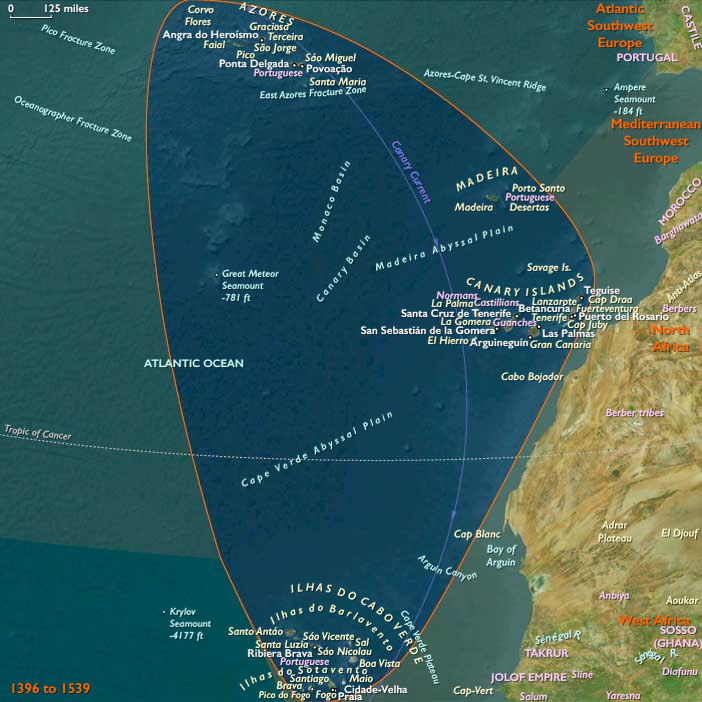
- The discovery and settlement of Atlantic islands, such as Madeira and the Azores.
Henry’s vision of maritime expansion was strongly supported by Infante Peter, Duke of Coimbra, who had served as regent for the young Afonso V since 1439.
Afonso V Comes of Age and the Fall of Peter (1448–1449)
- On June 9, 1448, Afonso V turned 16 and officially assumed the throne.
- Following tradition, Peter handed over full control of the country to the king.
- However, Afonso of Braganza, who had long opposed Peter, quickly gained influence over the young king.
- Under Braganza’s influence, Afonso V nullified all of Peter’s edicts, reversing his reforms and weakening the power of the middle class and royal bureaucracy.
- This move deepened the division between the two noble factions, setting the stage for the Battle of Alfarrobeira (1449), where Peter was killed in battle, marking the final victory of Braganza over Coimbra.
Impact of These Events
-
Strengthening of the House of Braganza
- With Peter eliminated, Afonso, Duke of Braganza, became the most powerful noble in Portugal, virtually controlling the monarchy.
-
Continuation of Maritime Expansion
- Despite the political turmoil, Henry the Navigator continued to receive Crown support for exploration.
- This led to further Portuguese advancements along the West African coast, bringing Portugal closer to establishing a global maritime empire.
-
A Shift Toward Military Expansion
- With Braganza’s influence, Afonso V later focused on military campaigns in North Africa, shifting resources away from exploration for a time.
Thus, while Portugal’s maritime ambitions remained strong, the political power struggle between Peter and Braganza shaped the future direction of the kingdom, leading to a nobility-dominated monarchy under Afonso V.
Henry, King John's fifth son, is now the first and only of the House of Aviz.
Mistrusted by King Afonso V and the Duke of Braganza's sons as a member of the House of Aviz, and mistrusted by his dead brother's friends who have never accepted his betrayal (and rejected by his old sister Isabella, in Burgundy), Henry retreats to his land in Sagres, the southernmost and westernmost tip of Portugal—and Europe.
Here, living a secluded and religious life, he will concentrate his efforts on the sailing expeditions of his men, becoming worldly renowned as discoverer of never before seen oceans and coasts (Madeira, Azores, the African coast to Guinea, and, after his death, Cape Hope, India, Japan, Canada, Brazil, etc.).
Following the ascension of Afonso V in 1448, the kingdom of Portugal fell into civil war, as tensions between Infante Peter, Duke of Coimbra, and Afonso, Duke of Braganza, erupted into armed conflict.
The Civil War: The Rival Factions
-
Infante Peter, Duke of Coimbra
- Former regent of Portugal (1439–1448) and uncle of Afonso V.
- Favored strong royal authority, centralization, and continued overseas expansion.
- Supported by Lisbon’s merchants, the lower nobility, and the commoners.
-
Afonso, Duke of Braganza
- Another uncle of Afonso V, representing the old, landowning aristocracy.
- Opposed Peter’s policies, seeking to increase noble privileges.
- Manipulated Afonso V into declaring Peter a traitor based on false accusations.
The First Engagement: Victory for Peter at Penela
- Peter’s forces initially defeated Braganza’s army at Penela, showing that he still commanded strong military support.
- However, Afonso V, siding with Braganza, mobilized a massive royal army of 30,000 troops, determined to eliminate Peter as a political threat.
The Battle of Alfarrobeira (May 20, 1449)
- The two armies met near the Alfarrobeira River, at Alverca, north of Lisbon.
- Peter’s forces were vastly outnumbered but fought fiercely.
- The battle was short, and Peter was killed early on—
- Some sources say he died fighting.
- Others claim he was assassinated by one of his own men.
Aftermath: The Triumph of the House of Braganza
- Afonso V consolidated power under Braganza’s influence, granting the duke new lands, privileges, and political authority.
- The House of Braganza became the most powerful noble family in Portugal, rivaling even the monarchy.
- Portugal shifted towards a government dominated by the aristocracy, slowing the Crown’s ability to centralize authority.
Long-Term Consequences
- Weakened Royal Authority – The monarchy remained under noble control, delaying later reforms.
- Braganza’s Dominance – The House of Braganza amassed vast wealth and influence, eventually challenging the Crown itself.
- A Prelude to Future Conflicts – The battle set a precedent for noble interference in royal affairs, a trend later reversed by King John II (r. 1481–1495).
The Battle of Alfarrobeira (1449) marked a turning point in Portuguese history, securing the aristocracy’s dominance while eliminating one of Portugal’s most capable leaders, Infante Peter.