Adil Shah
Afsharid Shah of Iran
Years: 1700 - 1749
Adil or Adel Shah Afshar, born ʿAlī-qolī Khan (died 1749) is the Afsharid Shah of Iran from 1747 to 1748, a nephew and successor of Nader Shah, the founder of the Afsharid dynasty.
Related Events
Filter results
Showing 10 events out of 10 total
Following the slow disintegration of the Safavid state at the beginning of the eighteenth century, there were uprisings in the Northeast Caucasus against the Persian rule.
The Russian and Ottoman Empire, both imperial rivals of the Persians, had exploited these.
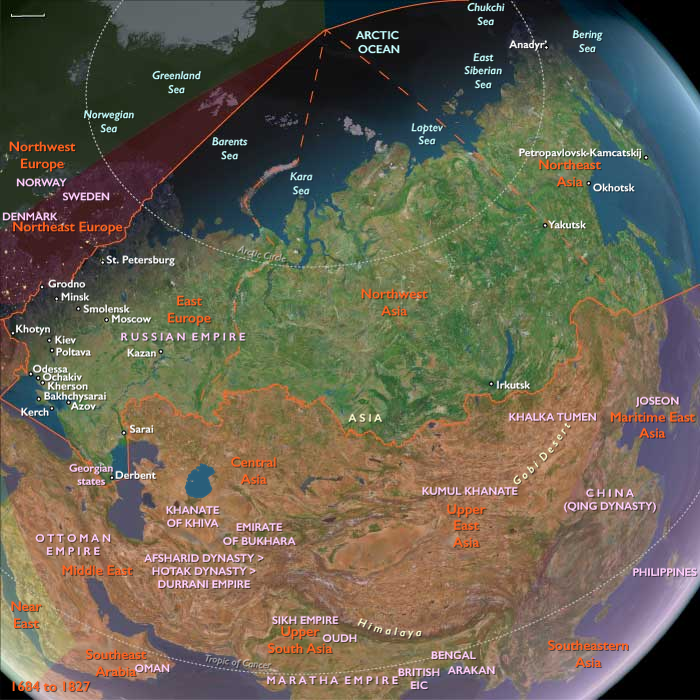
Peter the Great declared war on Persia in 1722 and started the Russo-Persian War, in which the Russians for the first time make an expedition for the capture of Derbent and beyond down to the Caucasus.
During and before the occupation of Derbent by Peter I, the naib of city had been Imam Quli Khan and was naturally a Shiite like the rest of the Safavid Empire.
He offered the Russian emperor the keys to the city gates.
Peter I had reappointed Imam Quli Khan as the head of Derbent and its "native" troops by assigning him the rank of Major-General.
Following the Treaty of Saint Petersburg, the Safavid Shah Sultan Husayn, whose empire was for years already in disarray and crumbling, had in September 1723 been forced to cede Derbent alongside the many other Iranian territories in the Caucasus.
However, some years later in connection with the aggravation of Russian-Turkish relations, and the new rise of Persia now led by the brilliant military general Nader Shah, Russia had found itself forced to cede all territories back by March 1735 in the Treaty of Ganja in order to deter itself from a costly war against Persia, and to construct an alliance against the common neighboring foe; the Ottoman Empire.
Most of the other territories had already been given back in the Treaty of Resht in 1732 for similar reasons.
After the death of Nadir Shah in 1747 his huge empire disintegrates and the former Persian provinces in the Caucasus (Beylerbeyis) form two dozen semi-independent and dependent khanates, one of which is the Derbent Khanate.
Starting from 1747 with the title of Khan, the first ruler of the Derbent Khanate is the son of Imam Kuli Khan, Muhammad Hassan (also mentioned as Magomed-Hussein or Mohammed Hussein).
...a group of Nader Shah's officers assassinates him in June 1747 while he is attempting to crush an uprising in Khorasan.
The officers now offer the crown to Ali-qoli.
Ali-qoli khan is the eldest son of Nader's brother, Ebrahim Khan.
Nader had appointed him governor of Mashad in 1737.
In the same year he married Princess Ketevan, daughter of the Georgian king Teimuraz II, Nader's ally.
In 1740 he was also married to a daughter of Abu'l-Fayz, ruler of the recently subdued Bukhara.
From 1743 to 1747, Ali-qoli khan has commanded Nader's troops against the Yazidis of Kurdistan, the Karakalpaks and Uzbeks of Khwarazm and in Sistan.
He had then run in trouble with his increasingly suspicious uncle over the latter's decision to levy one hundred thousand tomans on him.
In April 1747, in conjunction with the rebels of Sistan, Ali-qoli khan had occupied Herat and had induced the Kurds to enter into a rebellion.
On arriving at Mashad, Ali-qoli sends a loyal force to the fortress of Kalat, where they kill all of Nader's issue with the exception of his fourteen-year-old grandson Shahrukh.
On July 6, 1747, Ali-qoli is declared the shah under the name of Adil Shah, "the just king".

Adil Shah had sent his brother Ebrahim Mirza as a governor to Isfahan, while he remained in Mashad with his unpopular Georgian favorite, Sohrab Khan.
Later this year, he defeats his erstwhile Kurdish allies, who had refused to supply grain for his famine-stricken army and capital, and has several of his supporters put to death on suspicion of conspiracy.
The collapse of Afsharid rule over Iran with the death of Nader Shah has given the chieftain of the Qoyunlu clan, Mohammad Hasan Qajar, the opportunity to try to seize Astarabad, capital of Mazandaran, for himself.
Adil Shah now marches against Mazandaran in a futile attempt to bend the Qajar tribe into submission.
Although he fails to capture Mohammad Hasan, he manages to capture the latter's eldest son, five-year-old Mohammad Khan, whom at first he plans to kill, but whose life he later chooses to spare and instead has him castrated and thereafter freed, which is why he is known by the title of "Agha", a common title among eunuchs who serve at the court.
His childhood and early teens coincided with the occupation of Kakheti by the Ottomans from 1732 until 1735, when they were ousted from Georgia by Nader Shah of Iran, in his two successive campaigns of 1734 and 1735, by which the latter had quickly reestablished Persian rule over Georgia.
Teimuraz had sided with the Persians and was installed as a Persian wali (governor) in neighboring Kartli.
Teimuraz and Heraclius had remained loyal to the shah, partly in order to prevent the comeback of the rival Mukhrani branch, whose fall early in the 1720s had opened the way to Teimuraz's accession in Kartli.
From 1737 to 1739, Heraclius had commanded a Georgian auxiliary force during Nader’s expedition in India and gained a reputation of an able military commander.
He then served as a lieutenant to his father and assumed the regency when Teimuraz was briefly summoned for consultations in the Persian capital of Isfahan in 1744.
During his father's absence, Heraclius defeated a coup attempt by the rival Georgian prince Abdullah Beg of the Mukhrani dynasty, and helped Teimuraz suppress the aristocratic opposition to the Persian hegemony led by Givi Amilakhvari.
As a reward, Nader had granted the kingship of Kartli to Teimuraz and of Kakheti to Heraclius in 1744, and arranged the marriage of his nephew Ali-Qoli Khan, who eventually would succeed him as Adil Shah, to Teimuraz’s daughter Kethevan, yet, both Georgian kingdoms had remained under heavy Persian tribute until Nader was assassinated in 1747.
Teimuraz and Heraclius tske advantage of the ensuing political instability in Persia to assert their independence and expel Persian garrisons from all key positions in Georgia, including Tbilisi.
In close cooperation with one another, they manage to prevent a new revolt by the Mukhranian supporters fomented by Ebrahim Khan, brother of Adil Shah, in 1748.
They conclude an anti-Persian alliance with the khans of Azerbaijan, who are particularly vulnerable to the aggression from Persian warlords and agree to recognize Heraclius's supremacy in eastern Transcaucasia.
Ebrahim, blinded on September 24, 1748, soon dies, while ...