Abu Bakr
1st Muslim Caliph
Years: 573 - 634
Abu Bakr as-Șiddīq (Abdullah ibn Abi Quhafa) (c. 573 CE – 23 August 634 CE) also known as Abū Bakr (meaning Father of the Virgin) is a senior companion (Sahabi) and the father-in-law of the Islamic prophet Muhammad.
He rules over the Rashidun Caliphate from 632–634 CE when he becomes the first Muslim Caliph following Muhammad's death.
As Caliph, Abu Bakr succeeds to the political and administrative functions previously exercised by Muhammad, since the religious function and authority of prophethood ends with Muhammad's death according to Islam.
He is called Al-Siddiq (The Truthful) and is known by that title among later generations of Muslims.
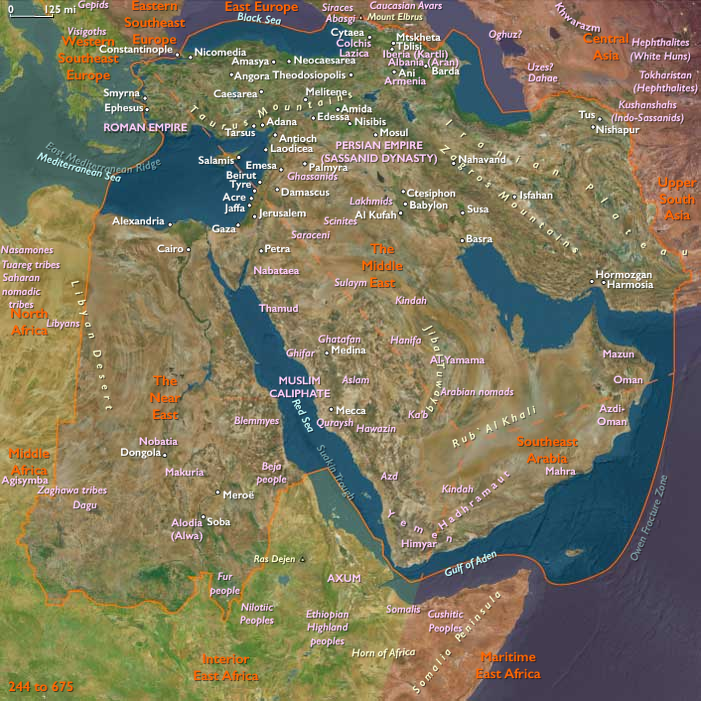
As a young man, Abu Bakr becomes a merchant and he travels extensively in Arabia and neighboring lands in the Middle East, through which he gains both wealth and experience.
He eventually comes to be recognized as the chief of his clan.
On his return from a business trip to Yemen, he is informed that in his absence Muhammad had openly declared his prophethood.
Not long after, Abu Bakr accepts Islam and is the first person outside the family of Muhammad to openly become a Muslim.
He is instrumental in the conversion of many people to the Islamic faith and early in 623, Abu Bakr's daughter Aisha is married to Muhammad, strengthening the ties between the two men.
Abu Bakr serves as a trusted advisor and close friend to Muhammad.
During the lifetime of Muhammad, he is involved in several campaigns such as the Battle of Uhud, the Battle of the Trench, the Invasion of Banu Qurayza, Battle of Khaybar, the Conquest of Mecca, the Battle of Hunayn, the Siege of Ta'if, and the Battle of Tabuk where he is reported to have given all of his wealth for the preparation of this expedition.
He also participates in the Treaty of Hudaybiyyah and is made one of the witnesses over the pact.
Abu Bakr's Caliphate lasts for a little over two years (or 27 months), ending with his death after an illness.
Though the period of his caliphate is not long, it includes successful invasions of the two most powerful empires of the time, a remarkable achievement in its own right.
He sets in motion a historical trajectory that in few decades will lead to one of the largest empires in history.