Abdul Rahman bin Faisal
ruler of the Second Saudi State
Years: 1850 - 1928
Abdul Rahman bin Faisal Al Saud (1850–1928) is the last ruler of the Second Saudi State.
He is the youngest son of Faisal bin Turki and the father of King Abdulaziz, who founds the modern Saudi Arabia.
Related Events
Filter results
Showing 10 events out of 10 total
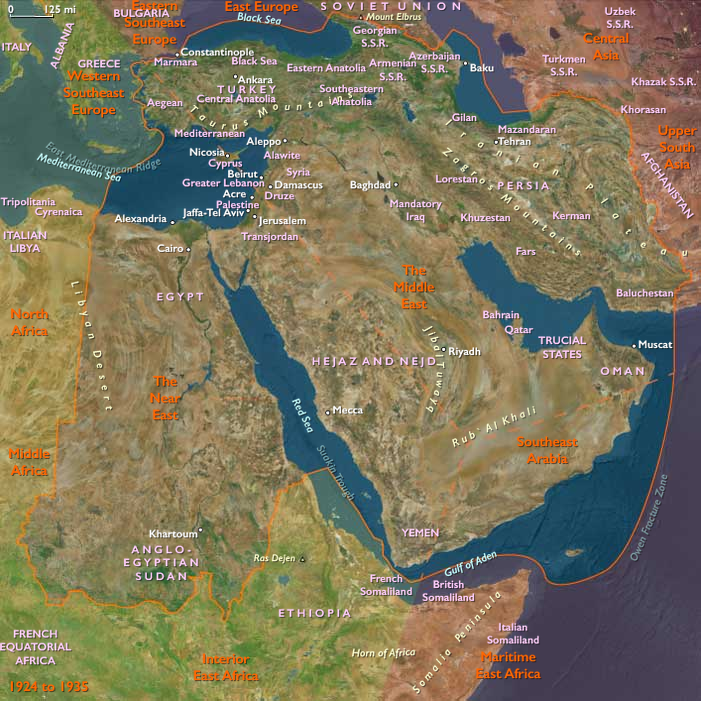
The Middle East: 1864–1875 CE
Consolidation and International Influence in Lebanon
Between 1864 and 1875, Lebanon experiences stability under the new administrative structure known as the Mutasarrifate of Mount Lebanon, established after the sectarian violence of 1860. Governed by a non-Lebanese Christian mutasarrif appointed by the Ottoman sultan with approval from European powers, Lebanon benefits from a relatively peaceful era. This governance, characterized by an administrative council representing Lebanon's diverse religious communities, provides a temporary cessation of internal strife. Many Lebanese emigrants continue to support their homeland economically through remittances from abroad, notably from Egypt, Africa, the Americas, and East Asia.
Lebanon also emerges as an intellectual hub during this period. Foreign missionaries establish educational institutions throughout the country, notably the American University of Beirut in 1866 and the French St. Joseph's University in 1875. A revitalized Arabic literary movement develops, supported by a prolific press and numerous publications.
Despite general calm, tensions simmer beneath the surface, exacerbated by ongoing European interference, particularly French backing of Christians and British interests in Druze regions, which continues to define Lebanon's political landscape.
Al Saud Authority and Regional Dynamics
Faisal ibn Turki Al Saud maintains firm control over central Arabia, continuing his strategic diplomacy with both Ottoman and British powers. Faisal’s rule sees the strengthening of Wahhabi principles, consolidating loyalty across Najd. Nonetheless, internal and external challenges persist, notably after Faisal's death in 1865, when power struggles among his sons Abd Allah, Abd ar Rahman, and Saud, along with Saud’s own sons, intermittently destabilize Riyadh. Faisal’s earlier establishment of alliances, such as the strategic marriage between his son Talal and Nura, daughter of the powerful Abd Allah ibn Rashid, helps manage these conflicts, preserving some stability and reinforcing the Al Saud dynasty's authority.
Qajar Iran under Foreign Pressure
Under Naser ad-Din Shah, Persia (Iran) continues facing significant pressure from British and Russian geopolitical ambitions, severely limiting Persian sovereignty. Russia solidifies its control over Iranian northern territories, compelling Iran to renounce claims on Central Asian regions through treaties like the Treaty of Paris in 1857. Britain actively safeguards its interests in Afghanistan and the Persian Gulf. Internally, Naser ad-Din Shah attempts modest modernization efforts, encouraged by reform-minded officials like Malkam Khan and prime minister Mirza Hosain Khan Moshir od Dowleh. These reforms, however, largely fail due to entrenched opposition from the bureaucracy, religious leadership, and ongoing external interference, resulting in persistent internal vulnerabilities.
Prosperity and British Influence in Oman
Said bin Sultan al-Busaidi sustains Oman's maritime prosperity and strategic significance, particularly through commerce in Zanzibar and other East African territories. Following Said’s death in 1856, his territories are divided between his sons, with Thuwaini bin Said ruling Muscat and Oman, and Majid bin Said becoming Sultan of Zanzibar. Despite this division, British influence ensures continuity in commerce and stability within Oman itself. British-imposed maritime truces also remain effective, reducing piracy and fostering safer trade conditions along the Trucial Coast.
Stability and Growth in the Persian Gulf
The Al Thani family consolidates its authority in Qatar, bolstered by Wahhabi ideological alignment, strengthening independence from Bahraini influence. Simultaneously, the Al Nahyan in Abu Dhabi solidify control, benefiting from alliances with both Britain and Oman. The Persian Gulf emirates continue to prosper under British maritime protections, with distinct political and economic identities developing due to the region's improved stability.
Ottoman Reforms and Societal Changes in Iraq
Ottoman rule in Iraq experiences significant modernization under governor Midhat Pasha starting in 1869. His Tanzimat reforms reorganize administration, secularize education, and introduce new legal codes, helping create a more centralized and efficient governance structure. The TAPU land laws inadvertently transform tribal sheikhs into wealthy landowners, altering traditional tribal dynamics and fostering the growth of an urban-based Iraqi intelligentsia. The introduction of steamboats, telegraph lines, and the opening of the Suez Canal in 1869 further integrates Iraq economically into global markets.
Russian Consolidation and Rising Nationalism in the Caucasus
Russia continues to consolidate its authority throughout the Caucasus, profoundly influencing Armenian and Georgian societies. Armenians benefit from educational and economic reforms, fostering heightened national awareness and cultural identity. Conversely, Georgian society faces intensified Russification, spurring resistance and nationalist movements among intellectuals and emerging urban classes. These divergent experiences underscore the complexities and tensions inherent in Russian rule.
Legacy of the Era
The years 1864 to 1875 witness transformative developments across the Middle East. Lebanon experiences stability under international oversight and intellectual renaissance; the Al Saud navigate complex internal dynamics; Persia struggles under persistent foreign pressure despite attempts at modernization; Oman maintains maritime prosperity through strategic divisions; Gulf emirates grow under British protection; Iraq undergoes significant Ottoman-led modernization; and Russian influence continues to shape nationalism in the Caucasus. These events collectively define the region's enduring cultural, economic, and political trajectories.
Faisal rules until 1865, lending some stability to Arabia.
Upon his death, however, fighting starts again, and his three sons—Abd Allah, Abd ar Rahman, and Saud—as well as some of Saud's sons each hold Riyadh on separate occasions.
The political structure of Arabia is such that each leader has to win the support of various tribes and towns to conduct a campaign.
In this way, alliances are constantly formed and reformed, and the more often this occurs, the more unstable the situation becomes.
Faisal bin Turki bi Abdullah Al Saud, his power now an acknowledged factor in Arabian politics, has named his oldest son, Abdallah, the designated heir and chief military commander while sending his second son, Saud, to al-Kharj in southern Najd as governor, partly to reduce the developing friction between the two brothers.
However, Saud has proved outstandingly successful and his reputation had soon eclipsed that of his brother, whose claim to the succession is not validated by any great success or ability in politics, whereas Saud has developed a strong power base in the area of al-Kharj and a following among the Ajman tribe of his mother.
The mother of Saud and his much younger full-brother Abdul-Rahman are part of the Ajman, a Bedouin tribe inhabiting the desert to the southeast of Riyadh.
The mother of Saud’s half-brothers, Abdullah and Muhammad, comes from the Saud family.
Faisal, having governed with great success until his death in 1865, is succeeded by his eldest son as Abdallah II, but the new ruler is immediately challenged by the ambitious Saud, who has left Riyadh and gathered supporters among the tribes of al-Hasa in the east.
Infighting among Faisal’s four sons will eventually destroy the Second Saudi State.
Abdallah II has maintained himself for six years against the rebellion of his brother Saud.
The succession dispute continues as a drought that had begun in 1870 exacerbates the civil war's effects.
Abdallah and his loyal brother Muhammad had at first proved too strong for Saud, but in December 1870, Saud, aided by the rulers of Oman, Abu Dhabi and Bahrain, defeats the forces of Abdallah at the Battle of Judah and captures Muhammad.
Abdallah appeals to the Ottomans in Baghdad, who come to his assistance but take advantage of the situation to occupy—more or less permanently—the province of Al-Hasa for themselves in 1871.
Abdallah flees Riyadh and Saud proclaims himself Imam in May 1871.
Another rebellion soon shakes the kingdom, and Saud is forced out by his uncle Abdullah bin Turki, who takes the capital.
Saud has also estranged the population by his reliance on tribes from the east.
The Middle East: 1876–1887 CE
Ottoman Decline and International Competition
Between 1876 and 1887, the Ottoman Empire faces intensified internal strife and international pressure. The death of reformer Sultan Abdülaziz in 1876 is followed by short-lived reigns, ultimately bringing Abdul Hamid II to power. Abdul Hamid initially promises constitutional reform and establishes a parliament in 1876; however, he suspends it in 1878, inaugurating an era of increased centralization and autocratic governance. Internationally, the empire endures significant territorial losses following the Russo-Turkish War (1877–1878), finalized by the Treaty of Berlin (1878), diminishing its European territories and influence. The treaty cedes the territories of Ardahan, Batum, and Kars to Russia, while the sultan guarantees increased security for Christian subjects.
Reforms, Unrest, and Intellectual Growth in Lebanon
Lebanon continues to benefit from relative stability under the Mutasarrifate system. Nonetheless, religious and political tensions beneath the surface remain sensitive to external influences, particularly French and British interference. Educational and cultural institutions founded previously flourish significantly, highlighted by the founding of the American University of Beirut (1866) and St. Joseph’s University (1875), which become central to Lebanon's intellectual renaissance. An intellectual guild stimulates a revival of Arabic literature, fostering numerous publications and an active press. The harsh rule of Abdul Hamid II prompts increased clandestine political activity among both Christian and Muslim Arab nationalists in Beirut and Damascus. This period sees the crystallization of differing political visions: some Maronites advocate secession fearing pan-Islamic policies; Greek Orthodox Christians support an independent Syria with Lebanon as an autonomous province; Sunni Muslims generally prefer maintaining ties with the Ottoman caliphate; while Druze and Shia groups tend toward independence or status quo.
Internal Struggles in the Al Saud Domain
In Arabia, continued internal strife among the Al Saud family weakens central authority after the death of Faisal ibn Turki. Conflicts among Faisal’s sons—Abd Allah, Abd ar Rahman, and Saud—lead to intermittent control and further instability in Riyadh. These internal divisions challenge consistent authority, though alliances such as those with the influential Al Rashid family in Jabal Shammar remain crucial.
Qajar Iran: Concessions and Foreign Domination
Persia (Iran) under Naser ad-Din Shah further cedes sovereignty due to escalating pressure from British and Russian interests. Russian territorial gains in Central Asia solidify, and Britain extends its economic dominance. Increasingly unpopular economic concessions to foreigners provoke internal discontent. Reformist Persian officials like Malkam Khan and Prime Minister Mirza Hosain Khan Moshir od Dowleh advocate administrative, educational, and infrastructural reforms, emphasizing learning from advanced European states. However, resistance from bureaucratic and clerical factions hampers significant progress, laying foundations for later nationalist movements.
British Dominance and Maritime Prosperity in Oman
Under British oversight, Oman enjoys stability and maritime prosperity. The division between Muscat and Oman and Zanzibar functions effectively under British protection, facilitating regional commerce. Maritime truces significantly reduce piracy, ensuring the Persian Gulf remains a crucial and safe commercial route connecting Asia, Africa, and Europe.
Consolidation and Growth in the Persian Gulf
Qatar and Abu Dhabi solidify their respective positions under the rule of the Al Thani and Al Nahyan families, supported by continued British maritime protections. Qatar’s alignment with Wahhabi ideology distinguishes it from neighboring emirates. Economic prosperity from pearling and trade reinforces local autonomy, laying groundwork for future nation-building.
Modernization and Socioeconomic Shifts in Iraq
In Iraq, Ottoman reforms initiated by Midhat Pasha continue despite his removal. Infrastructure projects, including expanded telegraph networks, improved roads, and river transportation, integrate Iraq deeper into the global economy. The TAPU land laws foster an empowered class of wealthy sheikhs and landlords, significantly shifting tribal dynamics. Urban centers benefit from an influential educated class, which grows as secular education replaces traditional Islamic schooling. Increased Western presence, marked by the establishment of consulates and commercial advancements like steamboats and the Suez Canal, further integrates Iraq economically with Europe.
Rising National Consciousness in the Caucasus
Under Russian control, Armenia and Georgia experience intensified nationalist movements. Armenians develop robust national identity through educational and cultural revitalization, despite harsher Ottoman rule in Anatolian territories. Armenian appeals at the Congress of Berlin (1878) internationalize the "Armenian question," attracting attention from Russia and Britain. Georgian society faces intensified Russification, triggering nationalist resistance. The declining Georgian nobility leads to increased economic power for the Armenian merchant class, reshaping societal dynamics.
Legacy of the Era
From 1876 to 1887, the Middle East encounters profound transformations marked by Ottoman decline, Persian vulnerability, and increased British and Russian influence. Lebanon thrives culturally despite political tensions; the Al Saud face ongoing internal challenges; Oman and Persian Gulf emirates prosper under British oversight; Iraq modernizes economically and socially; and the Caucasus continues its path toward strengthened national identities. These shifts significantly influence the region’s subsequent political, cultural, and economic developments.
Abdul Rahman bin Faisal and his brother Muhammad had tended to align themselves with their elder brother Saud against their other elder brother, Abdullah, when the two were struggling for power in 1865.
Abdul Rahman had been sent to Baghdad in 1871 to negotiate with the Ottoman Empire for help after Saud had taken the capital Riyadh.
Saud, unsuccessful after two years, had tried to take Al-Hasa in the east where Abdullah had become based, but had eventually returned to Riyadh without success.
The unity of the Wahhabi community disintegrates as both drought and civil war continue, while the throne changes hands several times in favor of different members of the Saudi family.
The drought had ended in 1874, and Saud II had died the following year.
After a brief interval of chaos, Abdullah II returns to the throne in 1876, only to find himself powerless against the Rashidi emir of Jabal Shammar.
The Rashidis have ruled from their capital at Ha'il since 1836, initially as agents for the Saudis, and had subsequently become independent, with strong links to the Ottomans and growing wealth from the caravan trade.
Muhammad ibn Abdullah ar-Rashid, who had become emir in 1869, had dominated Arabian politics when Abdullah II ibn Saud returned to Riyadh for his third spell of authority.
The Rashidis, who had refrained, at first, from any overt action, soon intervene in the chaotic affairs of the Wahhabi state; Ibn Rashid “invites” Abdullah to be his guest at Ha'il.
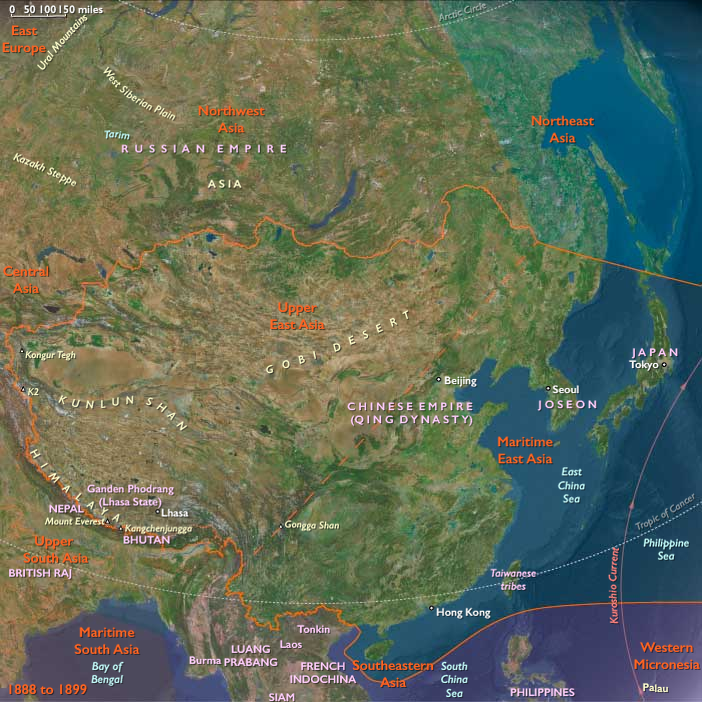
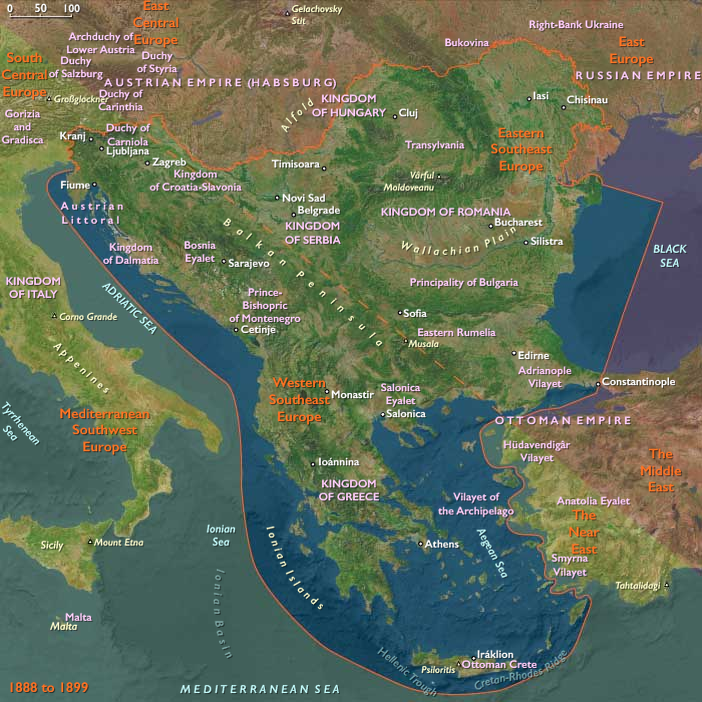
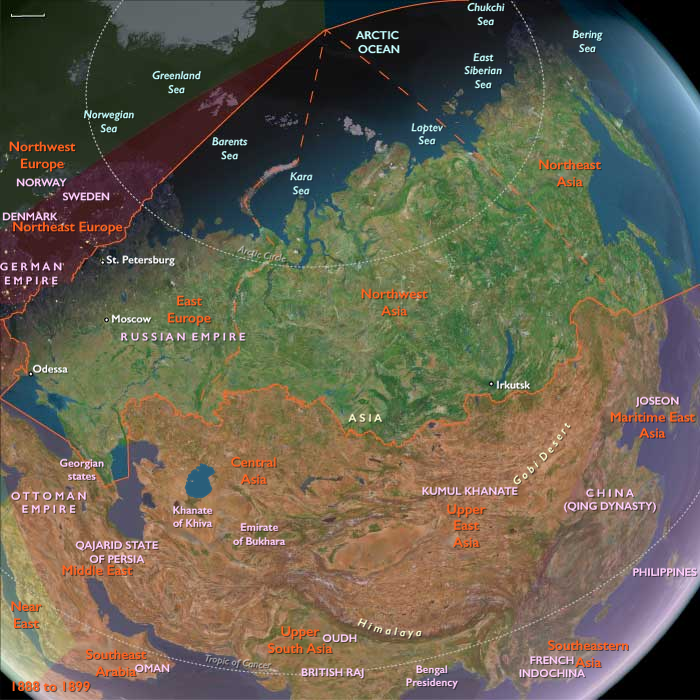
The Middle East: 1888–1899 CE
Ottoman Stagnation and Armenian Unrest
From 1888 to 1899, the Ottoman Empire experiences deepening stagnation under Sultan Abdul Hamid II, whose autocratic rule continues to suppress constitutional reform and centralize power. Armenian unrest significantly intensifies as nationalist movements demand greater autonomy and protection from Ottoman abuses. This unrest culminates in severe atrocities against Armenians, notably the Hamidian Massacres (1894–1896), during which approximately three hundred thousand Armenians are killed on direct orders from the Ottoman government. These atrocities provoke international condemnation, notably from Russia and Britain, highlighting the empire’s vulnerabilities and further eroding its international standing. Armenian revolutionary groups, particularly the Armenian Revolutionary Federation (Dashnak), grow stronger, advocating autonomy within both the Russian and Ottoman empires. Ethnic tensions are exacerbated by the rapid growth of the Kurdish population in Anatolia and the immigration of Muslims from the Balkans and Caucasus, making Armenians increasingly endangered.
Lebanese Cultural Renaissance and Political Ambivalence
Lebanon continues its intellectual and cultural renaissance, marked by the influential American University of Beirut (founded 1866) and St. Joseph’s University (1875). Lebanese intellectual and literary circles flourish, significantly impacting broader Arab intellectual movements. Despite these cultural advances, Lebanon’s political landscape remains fragmented. Sectarian tensions resurface, exacerbated by the harsh rule of Abdul Hamid II, prompting Arab nationalists in Beirut and Damascus to form clandestine political groups. Maronite Christians debate secession, Greek Orthodox Christians advocate integration within an independent Syria, Sunni Muslims uphold Ottoman unity, and Druze and Shia communities cautiously favor neutrality or independence. This period of political ambivalence sees no clear consensus emerge, setting the stage for future instability.
Al Saud Struggles and the Rise of Al Rashid
Internal dissension continues to weaken the Al Saud control over central Arabia. The rival Al Rashid family from Jabal Shammar capitalizes on this instability, displacing the Al Saud from Riyadh in 1891. Abd ar Rahman ibn Faisal, the last effective leader of the second Saudi state, flees with his family, including his son Abdul Aziz ibn Saud, to Kuwait. This marks a significant setback for the Al Saud, creating conditions that eventually enable their later resurgence and the formation of modern Saudi Arabia.
Persian Concessions and Nationalist Frustration
Under Naser ad-Din Shah, Persia experiences increasing frustration due to extensive foreign concessions. In 1888, the shah opens the Karun River in Khuzestan Province to foreign shipping and allows Baron von Reuter to establish Iran’s first bank, the Imperial Bank of Persia. In 1890, the shah grants a tobacco monopoly to British businessman G.F. Talbot, sparking the widespread Tobacco Protest (1891–1892). Clerics, merchants, and ordinary citizens unite against the concession, with a religious fatwa by cleric Mirza Hasan Shirazi leading to a successful boycott. The shah is forced to rescind the concession in 1892, significantly bolstering Iranian nationalism and the political influence of the clergy, though at considerable cost to an already depleted treasury.
British Influence and Maritime Stability in Oman
Under Faisal ibn Turki Al Sa'id, who succeeds peacefully as ruler, Oman continues to prosper under British protection, enjoying maritime stability and strengthened trade connections across the Indian Ocean. The separation between Muscat, Oman, and Zanzibar remains effective, with British naval power reinforcing regional security. Despite periodic tribal uprisings led by the Ibadi imamate, notably in 1895, the British effectively sustain the Al Bu Sa'id dynasty’s authority, preventing internal dissension from significantly disrupting commerce and governance.
Economic Prosperity in the Persian Gulf
Qatar and Abu Dhabi benefit economically from regional pearling and trade, sustained under stable rule by the Al Thani and Al Nahyan families. British maritime protection ensures continued prosperity and internal stability, allowing these emirates to consolidate their authority. Qatar remains culturally distinct due to its alignment with Wahhabism, setting it apart from neighboring emirates, while both states lay strong economic and political foundations for their eventual modern nationhood.
Iraq’s Integration into the Global Economy
Iraq continues its socioeconomic advancement, driven by ongoing infrastructure developments, including telegraph expansion, improved transportation networks, and trade facilitated by the Suez Canal. The implementation of the TAPU land laws strengthens tribal landlords, altering Iraq's socioeconomic landscape significantly. Secular education expands, fostering a burgeoning class of Western-educated Iraqis. Under the governorship of reform-minded leaders like Midhat Pasha, Iraq experiences enhanced urbanization and centralized administration, firmly integrating into global commerce.
Nationalist Awakening in the Caucasus
Nationalist sentiments among Armenians, Georgians, and Azerbaijanis intensify under Russian rule. Armenians, galvanized by the Hamidian Massacres, increasingly internationalize their cause, gaining global support. Armenian revolutionary parties, such as the Armenian Revolutionary Federation (Dashnak), send organizers to Turkey and advocate autonomy. In Azerbaijan, ethnic Russians dominate Baku's rapidly growing oil industry, dramatically altering its demographic and economic character. Armenians also gain prominence in commerce and local administration. Baku becomes the largest city in the Caucasus by 1897, with significant Russian and Armenian populations. Georgian resistance to Russification intensifies as local nobility declines, and Armenian merchant influence grows, prompting Russia to assert direct control over Armenian religious and political institutions by the end of the century.
Legacy of the Era
From 1888 to 1899, transformative developments significantly reshape the Middle East. The Ottoman Empire's internal weaknesses and atrocities against Armenians draw international condemnation; Lebanese cultural and intellectual advances contrast sharply with political instability; the Al Saud suffer major setbacks; Persian nationalism emerges strongly in response to foreign concessions; Persian Gulf emirates enjoy sustained economic prosperity; Iraq integrates deeply into the global economy; and nationalist fervor escalates across the Caucasus. Collectively, these developments profoundly influence the region's subsequent political, cultural, and economic trajectories.
Chronic instability after the death of Faisal accelerates the decline of the Al Saud.
While the Al Saud are bickering among themselves, however, the family of Muhammad ibn Rashid, who controls the area around the Jabal Shammar, has been gaining strength and expanding its influence in northern Najd.
In 1891 Muhammad ibn Rashid, the grandson of the leader with whom Turki had first made an alliance, is in a position to enhance his own power.
He removes the sons of Saud ibn Faisal from Riyadh and returns the city to the nominal control of their uncle, Abd ar Rahman.
Muhammad puts effective control of the city, however, into the hands of his own garrison commander, Salim ibn Subhan.
When Abd ar Rahman attempts to exert real authority, he is driven out of Riyadh.
Thus, the Al Saud, along with the young Abulaziz, are obliged to take refuge with the amir of Kuwait.