
Zhang Ling, a faith healer, traces his …
Years: 136 - 147
Zhang Ling, a faith healer, traces his ancestral home to Feng County, Jiangsu, and is said to be a descendant of Zhang Liang, a strategist and statesman of the early Han Dynasty.
Born during the reign of Emperor Guangwu of Han, he had begun reading the Tao Te Ching at a young age and studied in the Taixue (Imperial Academy), and had then served as a magistrate in Jiangzhou, Ba prefecture (present-day Chongqing) during the reign of Emperor Ming of Han.
He later retired to lead a reclusive life at Mount Beimang, where he practices ways of achieving longevity.
When invited to serve as a boshi (equivalent of a present-day professor) in the Imperial Academy, he claimed that he was ill. Emperor He of Han had thrice summoned him to serve as the Taifu (Imperial Tutor) but he refused each time.
According to tradition, in 142, Laozi appeared to Zhang on Mount Heming, and informed the hermit that the world was coming to an end, to be followed by an era of Great Peace.
Laozi explained that those following him would go on to another life, part of the "Orthodox One Covenant with the Powers".
Through this covenant, Zhang and his followers would have access to the assistance of celestial powers who control the fate of mankind.
Zhang goes on to found the first regular Taoist community.
A major change instituted by the new Covenant is the rejection of food and animal sacrifices.
Also, the teachings of Laozi as transmitted by Zhang include the first true Taoist religious pantheon as distinguished from the prior ancient religion of China.
Zhang also writes a 24-volume Taoist classic, said to be the Xiang'er, a commentary to the Tao Te Ching.
Zhang’s patients give him five pecks of rice annually in exchange for either cures or membership, causing the cult to become known as the Way of Five Pecks of Rice.
Locations
People
Groups
Topics
Subjects
Regions
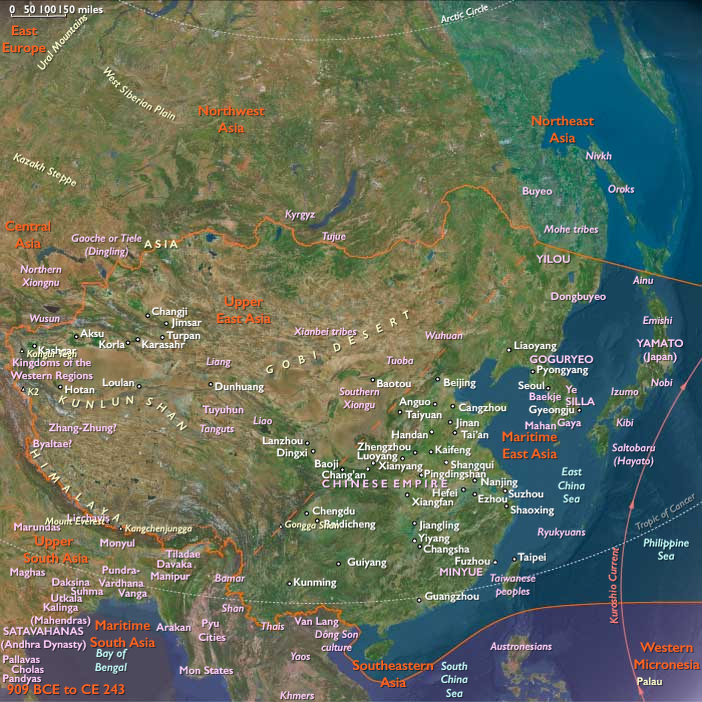
Subregions
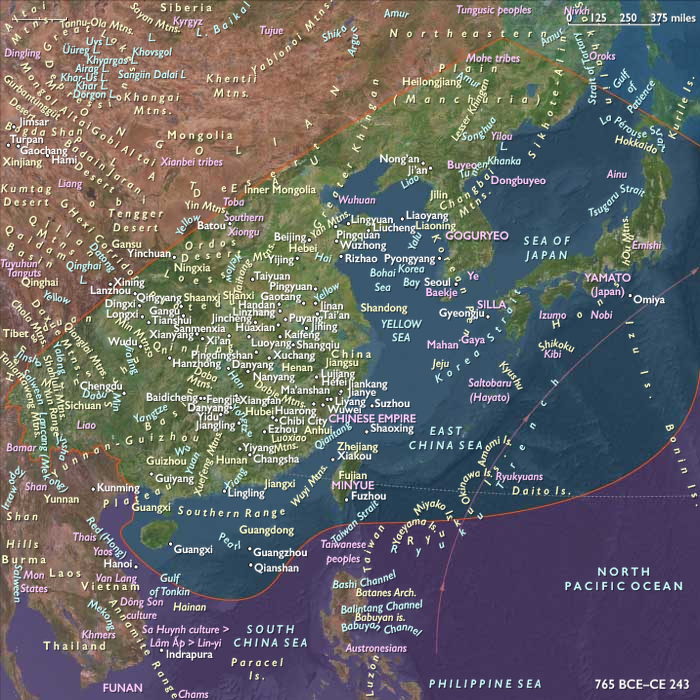
Related Events
Showing 10 events out of 61128 total
Years: 136 - 147
Locations
People
Groups
Topics
Subjects
Regions
Subregions