Zhai Yi, the governor of the prefecture …
Years: 6 - 6
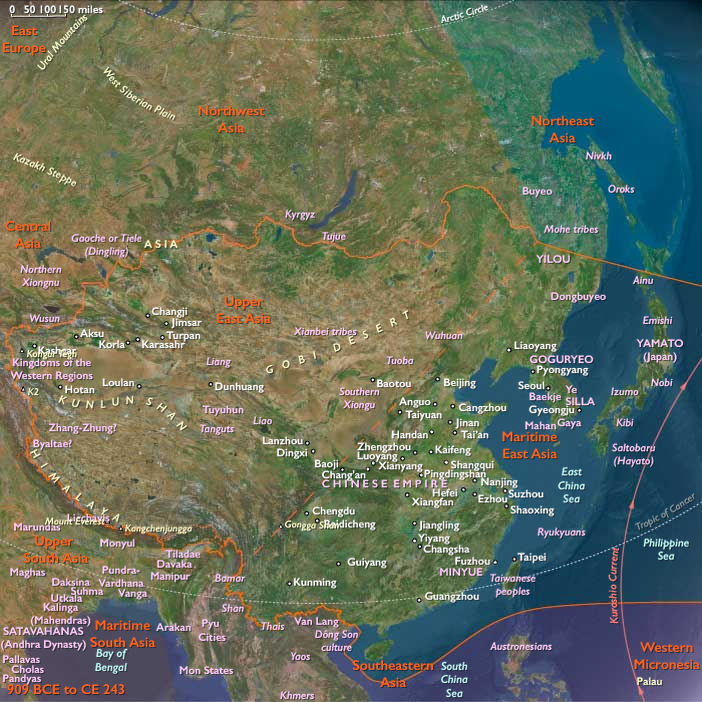
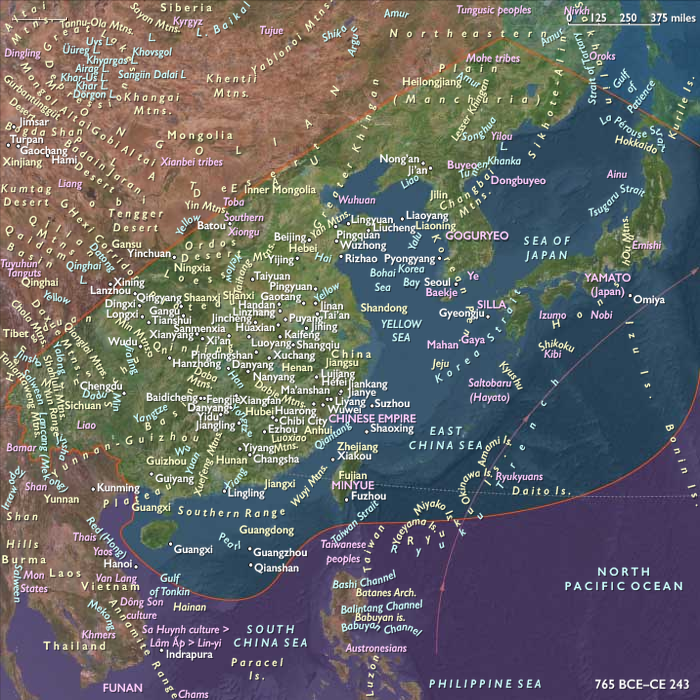
Zhai Yi, the governor of the prefecture of Dong (roughly modern Puyang, Henan) and Liu Xin, the Marquess of Yanxiang (and the father of Liu Kuang, the Prince of Dongping (roughly modern Tai'an, Shandong)) begin the largest of the anti-Wang Mang rebellion in 7—and they are joined by agrarian rebellion leaders Zhao Peng and Huo Hong from the area immediately west of the capital Chang'an.
They declare Liu Xin emperor.
Wang responds by sending messengers all around the nation to pledge that he will in fact return the throne to Emperor Ruzi once he is grown.
Wang's armies defeat Zhai and Liu's armies in winter 7, and Zhai is captured and executed by drawing and quartering.
Liu flees and is never captured.
Zhao and Huo are also eventually defeated and executed.
Locations
People
Groups
Topics
Commodoties
Subjects
Regions
Subregions
Related Events
Filter results
Showing 10 events out of 62050 total
Emperor Ping, who had had no children by his wife Empress Wang or any of his concubines, he has no heir.
Further, by this point, Emperor Ping's grandfather, Emperor Yuan, has no surviving male issue.
The progeny of Emperor Ping's great-grandfather Emperor Xuan are therefore examined as possible successors.
There are fifty-three great-grandsons of Emperor Xuan still living, but they were all adults, and Wang Mang dislikes this fact—he wants a child whom he can control.
Therefore, he declares that it is inappropriate for members of the same generation to succeed each other (even though Emperor Ping had succeeded his cousin Emperor Ai several years earlier).
He then examines the twenty-three great-great-grandsons of Emperor Xuan—all of whom are infants or toddlers.
While the examination process is proceeding, the mayor of South Chang'an submits a rock with a mysterious red writing on it—"Wang Mang, the Duke of Anhan, should be emperor."
Wang has his political allies force Grand Empress Dowager Wang to issue an edict granting him the title of "Acting Emperor", with the commission to rule as emperor until a great-great-grandson of Emperor Xuan can be selected and raised.
In the spring of 6, Acting Emperor Wang selects the child Ying—just one year old—as the designated successor to Emperor Ping, claiming that soothsayers have told him that Ying was the candidate most favored by the gods.
He gives Ying the epithet Ruzi—the same epithet that King Cheng of Zhou had when he was in his minority and under the regency of the Duke of Zhou—to claim that he is as faithful as the Duke of Zhou.
However, Emperor Ruzi does not ascend the throne, but is given the title of crown prince.
Empress Wang is given the title empress dowager.
As acting emperor, Wang reinstitutes the Zhou system of five grades of nobility—duke, marquess, earl, viscount and baron.
Several members of the imperial Liu clan are naturally suspicious of Acting Emperor Wang's intentions.
They start or assisted in several failed rebellions against Wang.
Liu Chong, the Marquess of Anzhong, makes an attack against Wancheng (in modern Nanyang, Henan)in 6.
His attack fails, but historians do not specify what happened to him, other than that as punishment, Wang has his house filled with filthy water.
Augustus plans in CE 6 to destroy the mighty kingdom of Maroboduus, which he considers to be too dangerous for the Romans.
Tiberius, commanding twelve legions, commences to attack the Marcomanni.
But the outbreak of the Great Illyrian revolt at the Romans’ back forces Tiberius to conclude a treaty with Maroboduus and to recognize him as king.
C. Scribonius Curio, proconsul of Macedonia, had in 75 BCE taken an army as far as the Danube and gained a victory over the inhabitants, who were finally subdued by M. Licinius Crassus, grandson of the triumvir and later also proconsul of Macedonia during the reign of Augustus c. 29 BCE.
The region, however, is not organized as a province until the last years of Augustus' reign; in 6 CE, mention is made of its governor, Caecina Severus (Cassius Dio lv. 29).
As a province, Moesia is under an imperial consular legate (who probably also had control of Achaea and Macedonia).
Bounded on the north by the lower Danube River, on the west by the Drinus (now Drina) River, by the Haemus (Balkan) Mountains on the south, and by the Black Sea on the east, Moesia includes territories of modern-day Southern Serbia (Moesia Superior), Northern Republic of Macedonia, Northern Bulgaria, Romanian Dobrudja, Southern Moldova, and Budjak (Lower Moesia).
Orodes III, raised to the throne of the Parthian Empire around CE 4 by the magnates after the death of Phraates V of Parthia, is killed after a short reign "on account of his extreme cruelty" (Josephus).
After the assassination of Orodes III in about the year CE 6, the Parthians apply to Augustus for a new King from the house of Arsaces.
Augustus sends them Phraates V's brother Vonones I, the eldest son of Phraates IV.
Jewish riots and insurrections against the Herodians and their Roman masters have characterized the dozen years since the death of Herod the Great.
Judea, nominally independent, is actually in bondage to Rome; Augustus has permitted Herod's sons less authority than he had given their father.
Glaphyra, princess of Cappadocia, had during her second marriage—to Juba II, Roman client-king of Mauretania; the first had been to Alexander of Judea, son of Herod, executed in about 7 BCE by his father—become reacquainted with Herod Archelaus (half-brother of her first husband), and now the Roman Ethnarch of Samaria, Judea, and Idumea.
Apparently, the two fell in love with each other and determined to marry.
Archelaus’s first wife is given by Josephus simply as Mariamne, perhaps his cousin Mariamne III (Mariamne bint Aristobulus), whom he has divorced to marry Glaphyra, who likewise has evidently divorced her second husband, Juba II of Mauretania.
Archelaus is half Idumaean and half Samaritan and, like his father Herod the Great, is considered an alien oppressor by his Jewish subjects.
Moreover, the marriage of a widow to her former brother-in-law violates Jewish laws of Levirate marriage.
It is considered immoral by the Jews and causes a major religious scandal in Judaea.
This violation of the Mosaic law, together with Archelaus' continued cruelty, has roused the ire of the Jews, who complain to Augustus.
Glaphyra shortly after the wedding allegedly dreamed that her first husband stood at her side and reproached her for not being faithful to him.She had not only made a second marriage but had even come back and married her brother-in-law.
Alexander in the dream said to Glaphyra he would now reclaim her as his own.
She told her friends of the dream and died two days later.
About the time of Glaphyra’s death, Augustus accedes to the delegation from Judea; he deprives Archelaus of his throne and banishes him to Vienne in Gaul.
It is uncertain if Glaphyra died before or during his exile.
Her death reputedly gratified the women of the Judaean court.
Augustus now transforms Judaea, Idumaea and Samaria from a client kingdom into the imperial province of Syria Palestina.
Accordingly, he sends a prefect to govern this province, with his seat at Caesarea Maritima.
A small Roman army of approximately three thousand men supports this minor Roman aristocrat, later called a procurator.
The soldiers, however, come not from Italy but from nearby Gentile cities, especially Caesarea and Sebaste; the officers are (presumably) from Italy.
Rome does, however, grant the Jews religious autonomy and some judicial and legislative rights through the Sanhedrin, headed by a Roman-appointed high priest.
The Romans in the second century BCE had subjugated various parts of Illyria, such as Histria in 177 BCE and the Ardaeian kingdom in 168 BCE, when they defeated the army of king Gentius.
Southern Illyriafrom 167 BCE had become a formally independent protectorate of the Romans, for whom the region has considerable strategic and economic importance.
It possesses a number of important commercial ports along its coastline, and has gold mines in its interior regions.
Illyria is also the starting point of the Via Egnatia, the great Roman road that runs from Dyrrachium (modern Durazzo), on the Adriatic, to Byzantium in the east.
Next came the interior of the western Balkans, accumulating in the wars with the Dalmatae in 156BCE and 78 BCE, and in 129 BCE against the Iapydes.
Illyricum in 59 BCE after the Lex Vatinia had been assigned as provincia together with Cisalpine Gaul (zone of responsibility rather than the province as is understood today) to Caesar.
No province had been established until Octavius's wars in Illyricum during 35-33 BCE.
Caesar's assassination had encouraged the Illyrians to regain their liberty.
They refused to pay taxes and destroyed five cohorts of the army commanded by P. Vatinius, also killing the senator Bebius.
The Roman senate had charged Marcus Junius Brutus, one of the assassins of Caesar, to lead the army in Illyria and Macedonia.
He had marched in the winter of 42 BCE from Greece at the head of the army, through roads covered by snow, doubtless coming along the Via Egnatia in order to appear by surprise before the walls of Dyrrhachian, sick with exhaustion and the cold.
Brutus after this took Apollonia and Byllis, pursuing and breaking the power of Gaius Antonius, who withdrew to Buthrotum.
Octavius in 35 BCE had been compelled to revisit Illyrian lands yet again, this time Dalmatia.
At the head of ten legions, he had marched from the north and subjugated the Iyapedes, Liburnians and Pannonians.
The most difficult war proved to be with the Dalmatians, in which the young future emperor was wounded twice, as Suetonius writes, first in the knee with a stone from a slingshot and later when a bridge fell during the siege of the Iapydian city of Metulum.
Octavian in that siege had seen with his own eyes the bravery of the Illyrians.
After managing to conquer the upper part of the city, Octavian had asked the inhabitants to surrender their weapons, but they collected their women and children and locked them in the council building, putting guards around it and ordering them to set the building on fire if the men were to suffer any harm.
After taking these measures they assailed the Romans in desperation, but since they were down below and the Romans above, they were badly broken and all were killed.
The assembly guards then set the building on fire, as they had been ordered, and many women and children were burned to death; and even more threw themselves on the fire, along with their children.
Together with them the city was burned so completely, that although it had been a very large city, not a trace of it remains.
The first mention of the province of Illyricum had occurred in the context of the Augustan settlement of 27 BCE.
The province was subsequently enlarged as the Romans expanded their power in the region through a series of wars known as Pannonian wars (Bellum Pannonicum), fought from 12 BCE -9 BCE against group of peoples known as the Pannonians.
The taxes imposed by the Romans are greatly resented by the native Illyrians, who are frustrated by this new shift of power.
The Romans often treat the their subjects terribly, selling the women and children as slaves and destroying their settlements.
The turn of the millennium has also seen the recruitment of many Illyrian soldiers into the Roman army to fight against the Germanic tribes in the north.
The widening gap between the Roman government and its subjects in Illyricum leads ultimately to the great revolt that begins in the spring of CE 6, when several regiments of Daesitiates, natives of the area that now comprises central Bosnia and Herzegovina, are gathered in one place to prepare to join Augustus's stepson and senior military commander Tiberius in a war against the Germans.
Instead, the Daesitiates, led by Bato the Daesitiate (Bato I), mutiny and defeat a Roman force sent against them.

The Daesitiates are soon joined in their revolt against Rome by the Breuci, led by Bato of the Breuci (Bato II), another community inhabiting the region between the rivers Sava and Drava in modern Croatia.
Bato the Daesitiate unsuccessfully attempts to take Salona, and after he is defeated by Messallinus, he withdraws north to join forces with the other Bato (Bato II), the leader of the Breuci.
The two centers of resistance unite in autumn 6 CE, and the two Batos become war-leaders of an allied rebel army.
The rebels give battle to a second Roman force from Moesia led by Caecina Severus (the governor of Moesia).
Despite their defeat, they inflict heavy casualties at the Battle of Sirmium.
The rebels are now joined by a large number of other communities.
The Roman invasion of Boiohaemum (Latin for "the home of the Boii"; present Bohemia), planned by Tiberius, has already been launched from two directions when news comes in CE 6 that Pannonia and Illyricum have revolted, posing the gravest threat to Italy since Hannibal's invasion.
At risk is the strategic province of Illyricum, recently expanded to include the territory of the Pannonii, the indigenous communities inhabiting the region between the rivers Drava and Sava, who had been subjugated by Rome in 12-9 BCE.
Illyricum is on Italy's eastern flank, exposing the Roman heartland to the fear of a rebel invasion.
Augustus accordingly orders Tiberius to break off operations in Germany and move his main army to Illyricum.
Tiberius sends Marcus Valerius Messalla Messallinus (the governor of Dalmatia and Pannonia) ahead with troops.
Other natives are recruited to fight against the Marcomanni as the rebellion swiftly overtakes enormous areas of the western Balkans and the Danube region.