Zhai Liao is defeated in late 384 …
Years: 384 - 384
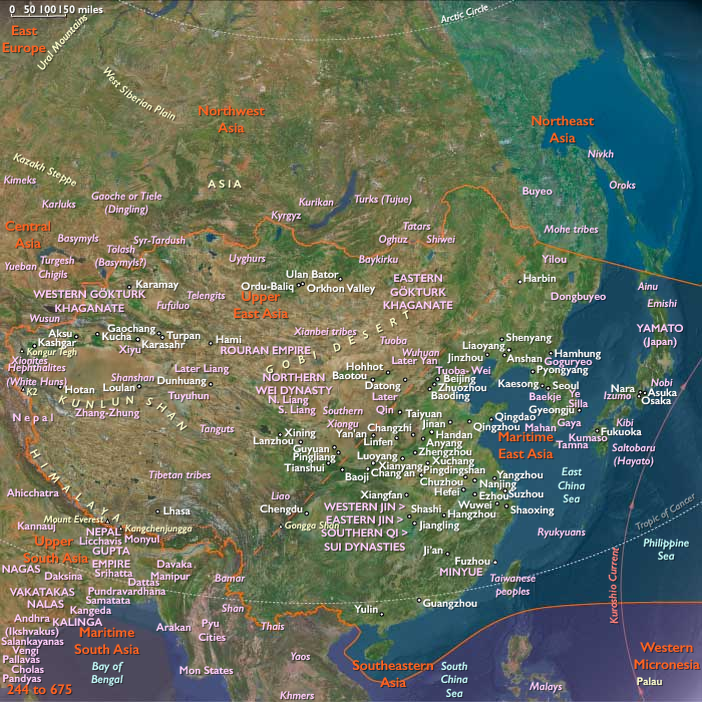
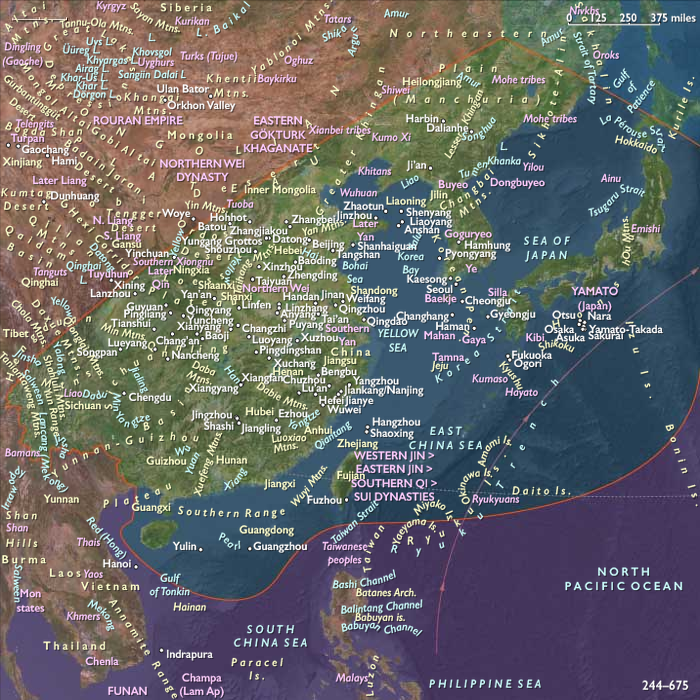
Zhai Liao is defeated in late 384 by Murong Chui's sons Murong Lin and Murong Nong and forced to flee to his cousin Zhai Zhen.
Locations
People
Groups
Topics
- Six Dynasties Period in China
- Sixteen Kingdoms Period in China
- Civil Wars in China triggered by the Wu Hu Invasion
Commodoties
Subjects
Regions
Subregions
Related Events
Filter results
Showing 10 events out of 26 total
Prussia reenters the war against France in 1806, but its forces are badly beaten at the Battle of Jena this same year.
Prussia is abandoned by its ally Russia and loses territory as a result of the Treaty of Tilsit in 1807.
These national humiliations motivate the Prussians to undertake a serious program of social and military reform.
The most noted of the reformers—Karl vom Stein, Karl August von Hardenberg, Wilhelm von Humboldt, and Gerhard von Scharnhorst, along with many others—improve the country's laws, education, administration, and military organization.
Scharnhorst, responsible for military reforms, emphasizes the importance to the army of moral incentives, personal courage, and individual responsibility.
He also introduces the principle of competition and abandons the privileges accorded to nobility within the officer corps.
A revitalized Prussia joins with Austria and Russia to defeat Napoleon at the Battle of Leipzig in late 1813 and drive him out of Germany.
Prussian forces under General Gebhard von Blucher are essential to the final victory over Napoleon at the Battle of Waterloo in 1815.
Beyond that, the king is obliged to pay a large indemnity, to cap his army at forty-two thousand men, and to allow French troops to be garrisoned throughout Prussia, effectively making the Kingdom a French satellite.
In response to this defeat, reformers such as Heinrich Friedrich Karl vom und zum Stein and Karl August von Hardenberg set about modernizing the Prussian state.
Among their reforms are the liberation of peasants from serfdom, the Emancipation of Jews, and making full citizens of both groups.
The Prussians, reeling from Napoleon’s near annihilation of their state in 1806—07, draw from the principles expounded by Locke and Rousseau and set about the creation of a new three-tiered education system.
Leading Prussian thinkers, contemplating their defeat at Jena, attribute their military loss to soldiers’ thinking only of themselves during the stress of battle.
Prussian transcendentalist idealist philosopher Johann Gottlieb Fichte, in his Addresses to the German Nation, delivered before crowded audiences over the winter of 1807—08 at the Prussian Academy of Sciences in Berlin, expresses his belief that the state is a necessary instrument of social and moral progress, and declares that the children should be taken over and told what to think and how to think it.
Heinrich Friedrich Karl, Freiherr vom und zum Stein, chief minister of Prussia from 1807, drives the Prussian reform movement.
His own estates absorbed into the duchy of Nassau, Stein views a dynamic Prussia as the means to overthrow Napoleon and restore the rights of the imperial knights, whence he originates, within a revitalized German empire.
In his fourteen months as head of government, Stein has created a council of capable ministers protected from royal machinations, abolished serfdom, lifted restrictions on choice of occupation and property ownership, introduced home rule for the cities, and promoted the military reforms suggested by General Gerhard von Scharnhorst.
Under pressure from Napoleon, Stein is dismissed from his post in November 1808 and flees to Austria.

Austria seeks another confrontation with France to avenge the recent defeats, and the developments in Spain have only encouraged its attitudes.
Austria cannot count on Russian support because the latter is at war with Britain, Sweden (which means Austria cannot count on Swedish support either), and the Ottoman Empire in 1809.
Some in the government of Frederick William III of Prussia had initially wanted to help Austria, but their hopes had been dashed when Stein's correspondence with Austria, planning such a move, had been intercepted by the French and resulted in Prussia being compelled to sign the crushing Convention of September 1808.
The British have been at war with the French Empire for six years.
A report from the Austrian finance minister suggests that the treasury will run out of money by mid-1809 if the large army that the Austrians have formed since the Third Coalition remains mobilized.
Although Archduke Charles warns that the Austrians are not ready for another showdown with Napoleon, a stance that lands him amid the so-called "peace party", he dies not want to see the army demobilized.
On February 8, 1809, the advocates for war finally succeed when the Imperial Government secretly decides to make war against France.
Berthier, the French marshals, and the rank-and-file are all evidently frustrated at the seemingly pointless marches and counter marches.
On the 16th, the Austrian advance guard had beaten back the Bavarians near Landshut and had secured a good crossing place over the Isar by evening.
Napoleon finally arrives in Donauwörth on the 17th after a furious trip from Paris.
Charles congratulates himself on a successful opening to the campaign and plans to destroy Davout's and Lefebvre's isolated corps in a double-pincer maneuver.
When Napoleon realizes that significant Austrian forces are already over the Isar and are marching towards the Danube, he insists that the entire French army deploy behind the Ilm River in a bataillon carré within forty-eight hours, all in hopes of undoing Berthier's mistakes and achieving a successful concentration.
His orders are unrealistic because he underestimates the number of Austrian troops that are heading for Davout; Napoleon believes Charles only has a single corps over the Isar, but in fact, the Austrians have five corps lumbering towards Regensburg, a grand total of eighty thousand men.
Napoleon needs to do something quickly to save his left flank from collapsing.
The Austrian attack occurs about a week before Napoleon's anticipations, and in his absence Berthier's role becomes all the more critical.
Berthier (whose fortè is staff work) proves to be an insufficient field commander, a characteristic made worse by the fact that several messages from Paris had been being delayed and misinterpreted when they finally arrived at headquarters.
Whereas Napoleon had written to Berthier that an Austrian attack before April 15 should be met by a general French concentration around Donauwörth and Augsburg, Berthier had focused on a sentence that called for Davout to station his III Corps around Regensburg and had ordered the Iron Marshal to move back to the city despite massive Austrian pressure.
The Austrian attacks are slow, uncoordinated, and easily repulsed by the experienced French III Corps.
Napoleon knows there is fighting in Davout's sector and has already devised a new strategy that he hopes will beat the Austrians: while the Austrians attack to the north, Masséna's corps, later augmented by Oudinot's forces, will strike southeast towards Freising and Landshut in hopes of rolling up the entire Austrian line and relieving the pressure on Davout.
Napoleon is reasonably confident that the joint corps of Davout and Lefebvre can pin the Austrians while his other forces sweep the Austrian rear.
Napoleon, however, is working under false assumptions that make his goals difficult to achieve.
Massena's advance towards Landshut requires too much time, permitting Hiller to escape south over the Isar.
The Danube bridge that provides easy access to Regensburg and the east bank has not been demolished, allowing the Austrians to transfer themselves across the river and rendering futile French hopes for the complete destruction of the enemy.
On the 20th, the Austrians suffer ten thousand casualties, lose thirty guns, six hundred caissons, and seven thousand other vehicles, but are still a potent fighting force.
Later in the evening, Napoleon realizes that the day's fighting has only involved two Austrian corps.
Charles still has a good chance of escaping east over Straubing if he wishes.
Years: 384 - 384
Locations
People
Groups
Topics
- Six Dynasties Period in China
- Sixteen Kingdoms Period in China
- Civil Wars in China triggered by the Wu Hu Invasion