
Zengi’s capture of Edessa, the northernmost Crusader …
Years: 1145 - 1145
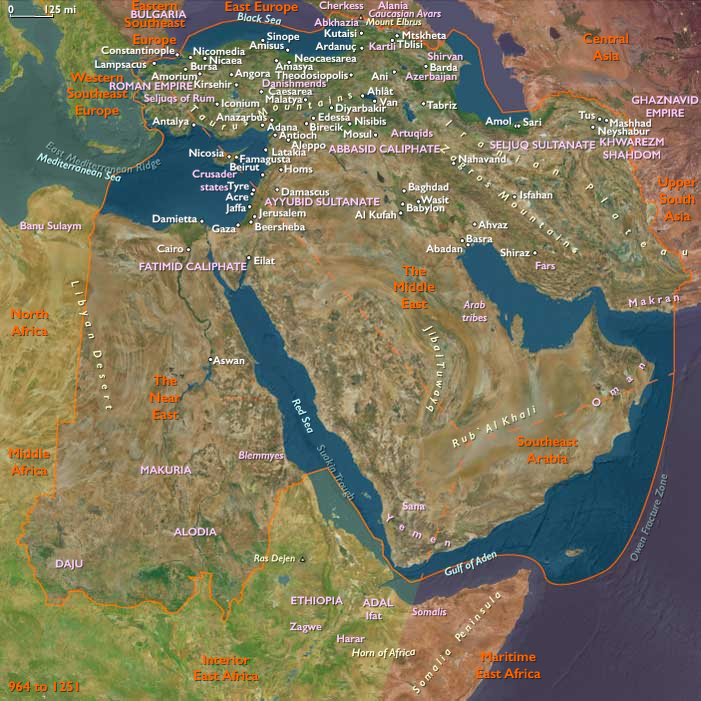
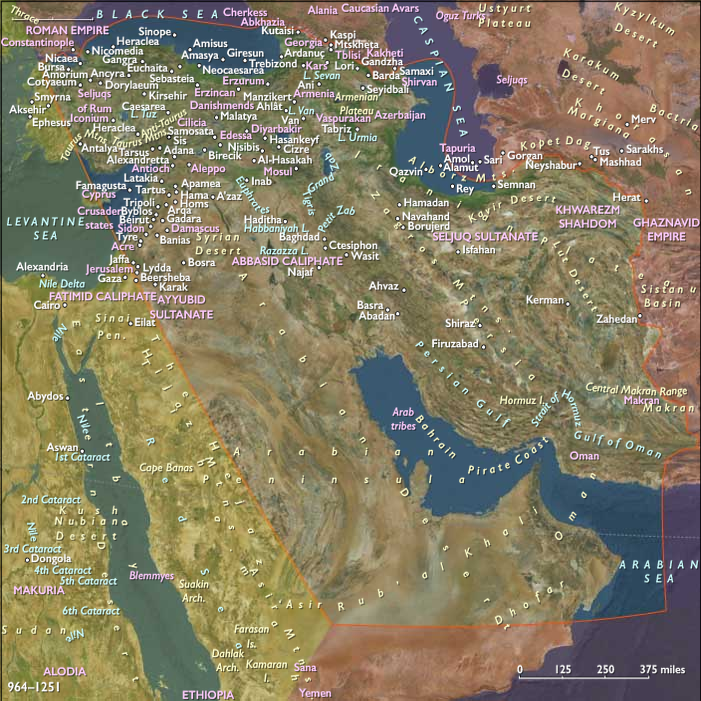
Zengi’s capture of Edessa, the northernmost Crusader state and an important focal point of Frankish authority, is the first effective check to the expansion of the crusaders' power.
Joscelin II continues to rule the remnants of his county from Turbessel, but little by little the rest of the territory will be captured or sold to Constantinople.
Locations
People
Groups
- Armenian people
- Jews
- Muslims, Sunni
- Turkmen people
- Seljuq Empire (Isfahan)
- Christians, Roman Catholic
- Aleppo, Seljuq Emirate of
- Roman Empire, Eastern: Komnenos dynasty, restored
- Antioch, Principality of
- Edessa, County of
- Jerusalem, Latin Kingdom of
- Damascus, Burid Emirate of
- Tripoli, County of
- Mosul, Zengi's Emirate of
Topics
Commodoties
Subjects
Regions
Subregions
Related Events
Filter results
Showing 10 events out of 48850 total
Khmer king Suryavarman II in 1144-45 sends his forces into Champa in retaliation for Champa’s abandonment of the Khmer campaign against Dai Viet in the 1130s.
Seizing the Cham capital of Vijaya (Binh Dinh), Suryavarman overthrows King Jaya Indravarman III and installs a new king, Harideva, said to be the younger brother of the Khmer ruler's wife.
Kim Busik, an official and a scholar during Korea's Goryeo period, is best known for compiling the Samguk Sagi, the oldest extant record of Korean history.
Written in Classical Chinese (the written language of the literati in traditional Korea), its compilation had been ordered by Goryeo's King Injong (r. 1122-1146) and undertaken by Kim and a team of junior scholars, it is completed in 1145.
The work’s fifty volumes form the historical record of the Three Kingdoms of Korea: Goguryeo, Baekje and Silla.
Zhang Zeduan, a native of Dongwu (present Zhucheng, Shandong), had been a court painter of the Northern Song Dynasty, and in the aftermath of that dynasty's fall, his paintings often convey criticisms of the social circumstances of the time.
Zhang’s most famous painting is Along the River During the Qingming Festival, a wide handscroll which depicts life in a city.
It reveals much about life in China during the eleventh and twelfth centuries.
Its myriad depictions of different people interacting with one another reveals the nuances of class structure and the many hardships of urban life as well.
It also displays accurate depictions of technological practices found in Song China.
For example, it depicts one river ship lowering its bipod mast before passing under the prominent bridge of the painting.
It shows ships in two major types, yet all of which have slung rudders for steering; the painting depicts freighters with narrow sterns or passenger boats and smaller craft with broad sterns, sailing upriver or docked along the banks while loading and unloading goods.
Large stern sweeps and bow sweeps can be seen on at least three of the river ships, worked by up to eight men each.
It also shows how personal gardens had begun to take root in China—in addition to the immense walled garden on the far left of the scroll, for example, one sees several private gardens with their man-made mountains and rockery (for example, the small private garden close to the city gate, squeezed between a chemist's shop and a large building selling furniture, consisting of a small pond surrounded by trees and bamboo).
The original painting is celebrated as the most famed work of art from the Song Dynasty, and will be a pride of the personal imperial collections of emperors for centuries.
Due to its high artistic reputation, it will inspire several works of art that revive and update the style of the original.
This painting will be made famous throughout China, as an emperor of the Yuan Dynasty (1279-1368) will feel compelled to write a poem in praise of the artwork.
A popular remake of the painting will be made in the eighteenth century, during the Qing Dynasty.
At Merv, a major Central Asian oasis-city on the historical Silk Road, located near today's Mary in Turkmenistan, the Tahirids had been in turn replaced by the Samanids and then the Ghaznavids.
In 1037, the Seljuqs, a clan of Oghuz Turks moving from the steppes east of the Aral Sea, had peacefully taken over Merv under the leadership of Toğrül Beg—the Ghaznavid sultan Masud being extremely unpopular in the city.
Toğrül’s brother Çagry had stayed in Merv as the Seljuq domains grew to include the rest of Khurasan and Iran, and it has subsequently become a favorite city of the Seljuq leadership.
Under Toğrül’s descendants, especially Sultan Ahmed Sanjar, who has made it his residence, Merv finds itself at the center of a large multicultural empire.
Alp Arslan is buried at Merv.
It is during this period that Merv has expanded to its greatest size—Arab and Persian geographers term it “the mother of the world”, the “rendezvous of great and small”, the “chief city of Khurasan” and the capital of the eastern Islamic world.
Written sources also attest to a large library and madrasa founded by the celebrated Persian scholar and vizier of the Seljuq Empire, Nizam al-Mulk, as well as many other major cultural institutions.
Perhaps most importantly, Merv is said to have a market that is “the best of the major cities of Iran and Khurasan” (Herrmann 1999).
With a population of two hundred thousand, Merv has become the largest city of the world, taking the lead from Constantinople.
Bishop Otto of Freising, having entered the Cistercian order, had convinced his father, Leopold III, margrave of Austria, to found Heiligenkreuz Abbey in 1133, thus bringing literacy and sophisticated agriculture (including wine making) to the region that will become Vienna.
Becoming abbot of the Cistercian monastery of Morimond in Burgundy about 1136, he had soon afterwards been elected bishop of Freising.
This diocese, and indeed the whole of Bavaria, is at this time disturbed by the feud between the Welfs and the Hohenstaufen, and the church is in a deplorable condition; but a great improvement has been brought about by the new bishop in both ecclesiastical and secular matters.
In 1145, Otto records accounts of the heroic struggles against the Muslims by the legendary Prester (or Presbyter) John, whose domain is believed to be somewhere in southwest Asia or northeast Africa, just beyond the Islamic empire.
The fall of Edessa to the Muslims has exposed Antioch to attack from the northeast.
Setting aside the recent bad blood between Antioch and Constantinople, Prince Raymond visits Constantinople in 1145 to conciliate Emperor Manuel.
Zengi, after conquering Edessa and the surrounding area, resettles three hundred Jewish families in place of the Armenians, who he suspects of having supported the Latin Christian crusaders.
Zengi himself is praised throughout Islam as "defender of the faith" and al-Malik al-Mansur, "the victorious king".
Although his capture of Edessa represents the crusaders' first serious setback, he cannot press his advantage.
He does not pursue an attack on the remaining territory of Edessa, or the Principality of Antioch, as is feared.
Henry of Lausanne: A Charismatic Heretic and His Challenge to the Church (c. 1121–1145 CE)
Henry of Lausanne, a controversial itinerant preacher, gained widespread influence in 12th-century Francethrough his ascetic lifestyle, rejection of Church authority, and calls for radical reform. His teachings and movement were seen as dangerous heresies by the established Church, drawing opposition from major figures like Peter of Cluny and Bernard of Clairvaux.
Early Ministry and Preaching at Le Mans (1121)
- Henry’s origins are obscure, but he may have been a Benedictine monk from Cluny before turning to an itinerant life of preaching and reform.
- He arrived in Le Mans in March 1121, likely from Lausanne, and began preaching while Bishop Hildebert was absent.
- His sermons attracted huge crowds, especially among women and the lower classes, urging penitence, personal piety, and a rejection of ecclesiastical corruption.
- He denounced the invocation of saints, extravagance, and second marriages.
- Women discarded their jewelry, and young men married prostitutes in an effort to reform them, acts that scandalized the clergy.
- His charismatic presence—described as tall, barefoot, with a beard, long hair, flashing eyes, and a sonorous voice—made him a powerful religious figure.
- Clergy in Le Mans became the targets of abuse, and Church authority was rejected, prompting concern from Hildebert upon his return.
Disputation with Bishop Hildebert and Expulsion from Le Mans
- Upon his return, Bishop Hildebert confronted Henry in a public disputation.
- According to the Acta Episcoporum Cenomannensium, Henry was found less guilty of heresy than of ignorancebut was still forced to leave the city.
- He traveled to Poitiers, Bordeaux, and later Arles, continuing his preaching and gathering followers.
Arrest and Trial Before Pope Innocent II (1134)
- By 1134, Henry was arrested by the Archbishop of Arles and brought before Pope Innocent II at the Council of Pisa.
- He was forced to abjure his errors and sentenced to imprisonment.
- St. Bernard of Clairvaux reportedly offered him asylum at Clairvaux, but it is unclear if Henry ever reached the monastery.
Resurgence of His Movement and Spread of Heresy (1139–1145)
- By 1139, Henry had resumed his preaching, particularly in southern France, where he gained a large following.
- His movement merged with the teachings of Peter of Bruys, whose followers rejected Church doctrine and sacraments.
- Peter of Cluny wrote a treatise (Epistola seu tractatus adversus Petrobrusianos) attacking the teachings of Henry and Peter of Bruys, accusing them of:
- Rejecting Church authority and discipline.
- Accepting only the Gospel, freely interpreted.
- Condemning infant baptism, the Eucharist, the Mass, prayers for the dead, and saintly intercession.
- Denying liturgical worship altogether.
St. Bernard of Clairvaux described Henry’s influence as devastating, writing:
"The churches are without flocks, the flocks without priests, the priests without honor; in a word, nothing remains save Christians without Christ." (Epistola 241)
Bernard of Clairvaux’s Mission Against Henry’s Followers (1145 CE)
- In 1145, at the request of Papal Legate Alberic, Cardinal Bishop of Ostia, Bernard traveled through the affected regions, including:
- Angoulême and Limoges,
- Bordeaux,
- Bergerac, Périgueux, Sarlat, Cahors, and Toulouse, all centers of heretical activity.
- Bernard’s mission aimed to debate, discredit, and convert Henry’s followers, reinforcing the authority of the Church.
Bernard of Clairvaux’s Crusade Against Heresy and the Rise of Eugenius III (1145 CE)
By 1145, Bernard of Clairvaux, the primary architect of the Cistercian monastic expansion, had spread his influence throughout Europe, founding new monasteries in Germany, Sweden, England, Ireland, Portugal, Switzerland, and Italy. His monastic movement was reshaping Christian spirituality and reinforcing papal authority through rigorous discipline and reformist zeal.
Bernard’s Influence in the Papacy: The Election of Eugenius III
- Several of Bernard’s monks had been sent to Rome at the command of Pope Innocent II, taking possession of Three Fountains Abbey in Rome, a center of monastic reform.
- One of these monks, Bernard of Pisa, was elected pope in 1145 as Eugenius III, marking Bernard’s deep influence in the Church’s highest office.
- Eugenius III, recognizing Bernard as his mentor, requested spiritual guidance from him.
- In response, Bernard wrote the "Book of Considerations," which emphasized:
- The sanctity of the Pope as the foundation of Church reform.
- The priority of piety and meditation over temporal matters.
- The idea that spiritual reflection must precede action, reinforcing the Pope’s moral and religious responsibilities.
This work shaped Eugenius III’s papacy, setting a spiritual framework for papal governance in a turbulent time.
Bernard’s Campaign Against the Henricians and Petrobrusians (1145 CE)
- After previously helping end the papal schism, Bernard was now called upon to combat heresy, particularly against the Henricians and Petrobrusians.
- Henry of Lausanne, a former Cluniac monk, had adopted and modified the teachings of Peter of Bruys, who rejected:
- Infant baptism
- The veneration of saints
- The Eucharist
- Ecclesiastical authority
- Henry’s followers, known as Henricians, were especially numerous in southern France, where anti-clerical sentiment was rising.
Bernard’s Anti-Heresy Preaching Campaign
- At the insistence of Alberic, Cardinal Bishop of Ostia, Bernard embarked on a preaching tour through heretical strongholds:
- Angoulême
- Limoges
- Bordeaux (where he stayed for some time)
- Bergerac, Périgueux, Sarlat, Cahors, and Toulouse
Impact of Bernard’s Mission
- At Bernard’s approach, Henry of Lausanne fled from Toulouse, leaving behind a significant number of adherents.
- Many converts returned to Roman orthodoxy, particularly in Toulouse and Albi, due to Bernard’s:
- Eloquent preaching
- Reputation for miracles
- Ascetic lifestyle and simplicity, which contrasted with the luxury of many prelates
- The Henrician and Petrobrusian sects began to decline rapidly, fading by the end of 1145.
Final Confrontation and Bernard’s Return to Clairvaux
- Bernard invited Henry of Lausanne to a disputation, which Henry refused to attend.
- With his mission accomplished, Bernard returned to Clairvaux, leaving a Church reinforced in its orthodoxybut still struggling with future waves of heretical movements, including the Cathars in later decades.
Legacy of Bernard’s 1145 Campaign
- Bernard’s combination of persuasive preaching, moral authority, and reported miracles made him one of the most effective anti-heretical figures of his time.
- His role in securing papal legitimacy through Eugenius III and his writings helped shape the moral vision of the papacy.
- His campaign against the Henricians and Petrobrusians set a precedent for future Church efforts to suppress heretical movements in medieval Europe.
Though Bernard’s personal efforts led to the decline of these particular sects, the underlying tensions between popular religious movements and the Catholic hierarchy would continue, leading to future conflicts such as the Cathar Crusade (1209–1229).
Final Fate of Henry of Lausanne
- After 1145, there are no clear records of Henry’s fate.
- He may have been captured and executed, imprisoned, or driven into obscurity.
- His radical ideas, however, did not die with him, influencing later heretical movements, including the Cathars and Waldensians.
Legacy and Impact
- Henry’s movement was part of a broader wave of 12th-century heretical reforms, challenging Church authority and advocating a return to a more primitive Christian life.
- His ideas anticipated elements of later reformist and heretical movements, including the Protestant rejection of Church hierarchy and sacramental theology.
- The Church’s aggressive response to Henry and his followers set a precedent for future crackdowns on heresy, ultimately leading to the Albigensian Crusade (1209–1229).
Despite his condemnation and suppression, Henry of Lausanne embodied the rising challenge to Church orthodoxy in the High Middle Ages, a struggle that would continue to shape European religious history for centuries.
Years: 1145 - 1145
Locations
People
Groups
- Armenian people
- Jews
- Muslims, Sunni
- Turkmen people
- Seljuq Empire (Isfahan)
- Christians, Roman Catholic
- Aleppo, Seljuq Emirate of
- Roman Empire, Eastern: Komnenos dynasty, restored
- Antioch, Principality of
- Edessa, County of
- Jerusalem, Latin Kingdom of
- Damascus, Burid Emirate of
- Tripoli, County of
- Mosul, Zengi's Emirate of
