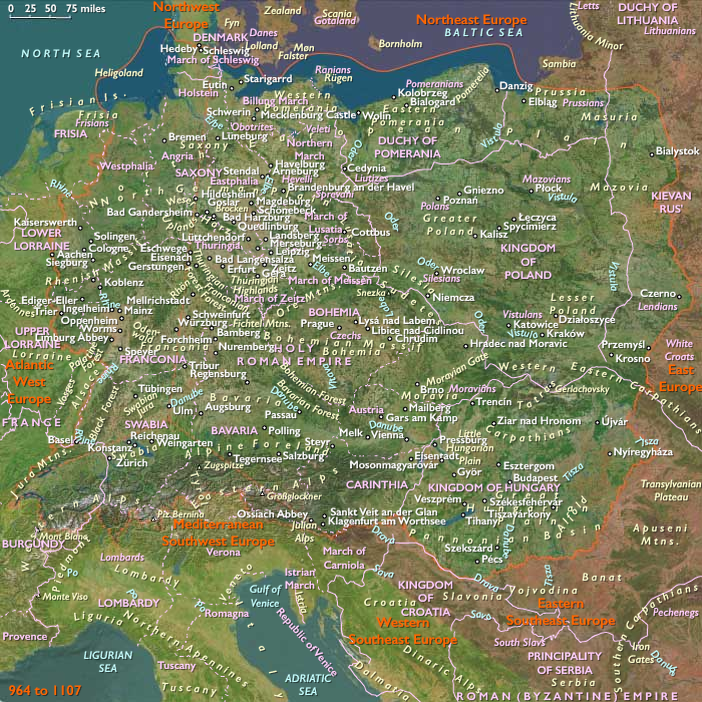
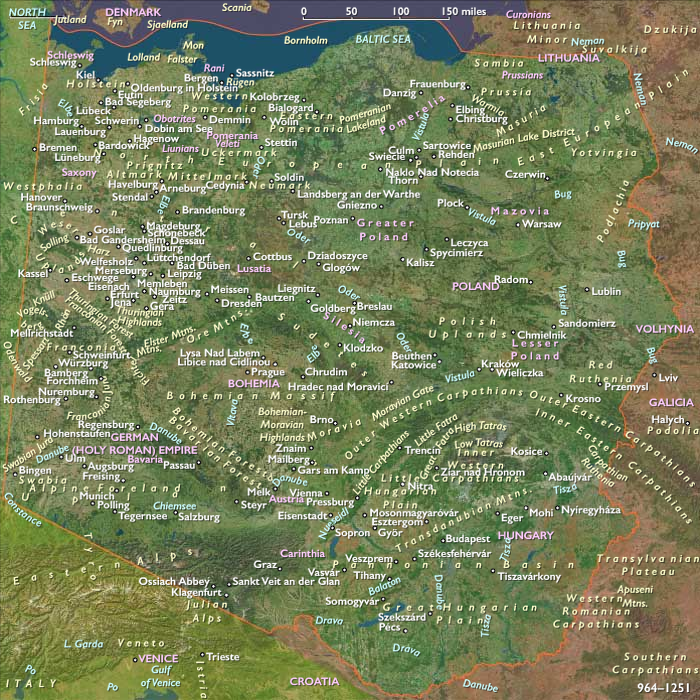
…Zeitz (from 1029: Naumburg), all suffragan dioceses …
Years: 966 - 966
…Zeitz (from 1029: Naumburg), all suffragan dioceses of the Archbishopric of Magdeburg.
Locations
People
Groups
- Polabian Slavs (West Slavs)
- Wends, or Sorbs (West Slavs)
- Christianity, Chalcedonian
- Papal States (Republic of St. Peter)
- German, or Ottonian (Roman) Empire
Subjects
Regions
Subregions
Related Events
Filter results
Showing 10 events out of 52524 total
The nascent Polish state is born in vassalage to the German Empire with Prince Mieszko’s acceptance of Christianity from Rome in 966.
The reign of Mieszko, the first historically known Piast duke of the Polans, who gave their name to the country that would later be called "Poland," had begun around 962 in Greater Poland, Kuyavia, and possibly in eastern Pomerania.
In the 960s, he probably at least partially conquers western Pomerania.
He had married Dubrawka, daughter of Boleslaus the Cruel, Duke of Bohemia, in 965.
The Bishopric of Merseburg is formed in Saxony, with Boso of Merseburg as its first bishop, as part of a plan by Otto I to bind the Slavic ("Wendish") lands in the Saxon Eastern March beyond the Saale river more closely to the Holy Roman Empire.
The bishopric at this time covers a considerable small territory between the Saale and Mulde rivers.
At the same time and in the same manner are founded the sees of …
…Meissen and …
A forty thousand-man army led by Emperor Nikephoros from 964 to 966 has conquered Cilicia and has conducted raids in Mesopotamia and Syria, while …
…the patrician Niketas Chalkoutzes has recovered Cyprus.
Alquerque, the earliest known military game, is a two-player, twelve-piece game played on a board marked with five diagonal lines.
The game does not appear in literature until late in the tenth century when the author Abu al-Faraj al-Isfahani mentions Qirkat in his twenty-four-volume work Kitab al-Aghani ("Book of Songs").
This work, however, made no mention of the rules of the game.
Abu al-Faraj al-Iṣbahānī was born in Isfahan, but spent his youth and made his early studies in Baghdad.
He is a direct descendant of the last of the Umayyad caliphs, Marwan II, and is thus connected with the Umayyad rulers in Spain, and seems to have kept up a correspondence with them and to have sent them some of his works.
He becomes famous for his knowledge of early Arabian antiquities.
His later life is spent in various parts of the Islamic world, in Aleppo with its governor Sayf ad-Dawlah (to whom he dedicates the Book of Songs), in Ray with the Buyid vizier Ibn 'Abbad, and elsewhere.
Although he writes poetry, also an anthology of verses on the monasteries of Mesopotamia and Egypt, and a genealogical work, his fame rests upon his Book of Songs, a collection of poems and songs with the stories of the composers and singers in many volumes from the oldest epoch of Arabic literature down to the ninth century.
The poems are put to music, but the musical signs are no longer readable today.
Because of the accompanying biographical annotations on the authors and composers, the work is an important historical source.
It contains a mass of information as to the life and customs of the early Arabs, and is the most valuable authority we have for their pre-Islamic and early Islamic days.

Word of all these disturbances in Italy had eventually reached Otto, who crosses the Alps in late summer of 966 at the head of an enormous army.
In the meantime, John has managed to escape from Campagna, and made his way to Capua, placing himself under the protection of Pandulf Ironhead.
In thanks for Pandulf’s aid, John converts Capua into a Metropolitan see, and consecrates as its first archbishop Pandulf’s brother John, on August 14, 966.
Pope John XIII leads a Roman-Tuscan-Spoletan army against Landulf III of Benevento and his brother Pandulf Ironhead in autumn 966, but Prince Gisulf of Salerno comes to his rescue and no battle is given.
The pope and Gisulf make a treaty at Terracina.
It is this act which buys Gisulf later assistance from the powerful Ironhead.
The pope’s supporters in Rome rise up, and Rofred and Stephen are killed by John Crescentius, the pope’s nephew.
Pope John leaves Capua, and crosses into Sabina, where he is met by his brother-in-law, Benedict, who also offers John his support.
With Rome effectively back in his hands, John returns and is welcomed back into the city on November 14, 966.
Although he is initially lenient towards the rebels, the arrival of Otto sees a change in approach.
The emperor banishes to Germany the two men appointed consul; the twelve principal militia leaders (the Decarcones, one appointed to each of the city’s twelve regions) are hanged.
Other plotters are either executed or blinded.
The Prefect of the City, Peter, is handed over to John, who orders him to be hung by his hair from the Equestrian Statue of Marcus Aurelius, after which he is taken down, placed naked and backwards on an ass.
A bag of feathers is placed upon his head and two more at his thighs.
With a bell fastened round its neck, Peter is driven through the city, and after being thus exposed to the ridicule of the people, Peter is cast into a dungeon before finally being sent by the emperor into Germany.
In gratitude for the emperor’s intervention, John lauds him by declaring him to be the liberator and restorer of the Church, the illustrious guest, and three times blessed emperor.
Banteay Srei or Banteay Srey, a Cambodian temple consecrated on the 22nd of April, 967, is the only major temple at Angkor not built by a monarch; its construction is credited to a courtier named Yajnavaraha / Yajñavarāha, who serves as a counselor to king Rājendravarman II.
The foundational stela says that Yajñavarāha, a grandson of king Harṣavarman I, was a scholar and philanthropist who helped those who suffered from illness, injustice, or poverty.
His pupil is the future king Jayavarman V, who will reign between about 968 to about 1001.
At this time, the temple is surrounded by a town called Īśvarapura.
Yajñavarāha's temple, primarily dedicated to the Hindu god Shiva, originally carries the name Tribhuvanamaheśvara—great lord of the threefold world—in reference to the Shaivite linga that serves as its central religious image.
However, the temple buildings appear to be divided along the central east-west axis between those buildings located south of the axis, which are devoted to Shiva, and those north of the axis, which are devoted to Vishnu.
The temple's modern name, Bantãy Srĕi—citadel of the women, or citadel of beauty—is probably related to the intricacy of the bas relief carvings found on the walls and the tiny dimensions of the buildings themselves.
Some have speculated that it relates to the many devatas carved into the red sandstone walls.
Years: 966 - 966
Locations
People
Groups
- Polabian Slavs (West Slavs)
- Wends, or Sorbs (West Slavs)
- Christianity, Chalcedonian
- Papal States (Republic of St. Peter)
- German, or Ottonian (Roman) Empire