
Zaharije, who has been persuaded by Constantinople …
Years: 924 - 924
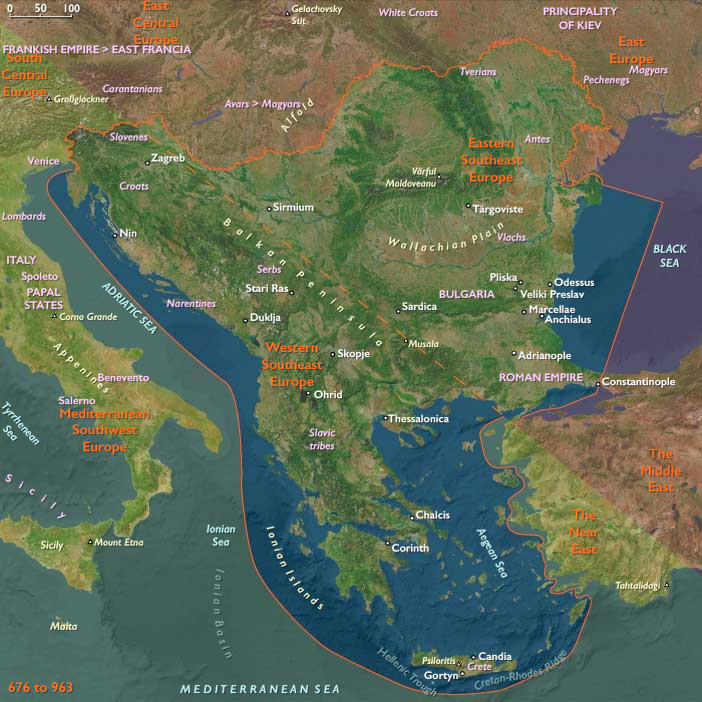
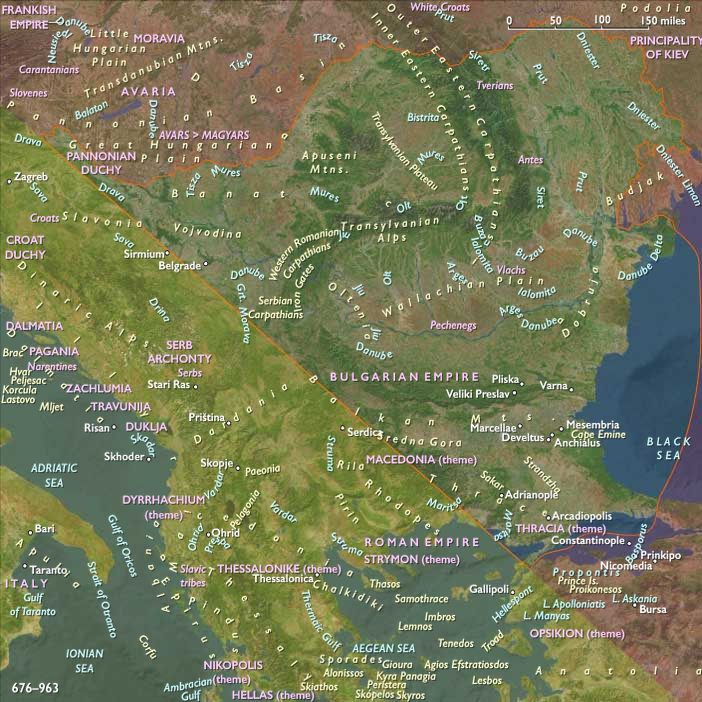
Zaharije, who has been persuaded by Constantinople to revolt against Simeon, is supported by many Bulgarians exhausted from Simeon's endless campaigns against the Empire.
The Bulgarian emperor sends a punitive force under Sigrica and Marmais, but they are routed and the two commanders beheaded, which forces Simeon to conclude an armistice with Constantinople in order to concentrate on the suppression of the uprising.
Simeon sends an army led by Časlav Klonimirović in 924 to depose Zaharije.
He is successful, as Zaharije flees to Croatia.
The Serbian zhupans are then summoned to recognize Caslav as the new Prince.
When they come, however, they are all imprisoned and taken to Bulgaria, as is Časlav.
Much of Serbia is ravaged, and many people flee to Croatia, Bulgaria and Constantinople.
Simeon makes Serbia into a Bulgarian province, so that Bulgaria now borders Croatia and Zahumlje.
He then resolves to attack Croatia, because it is an ally of the Empire and had sheltered the Serbian prince.
Locations
People
Groups
- Greeks, Medieval (Byzantines)
- Bulgarians (South Slavs)
- Serbian Principality
- Croatia (Pannonian), Principality of
- Croatia (Dalmatian, or Littoral), Principality of
- Croats (South Slavs)
- Serbs (South Slavs)
- Roman Empire, Eastern: Macedonian dynasty
- Bulgarian Empire (First)
- Hungary, Principality of
Topics
- Byzantine-Bulgarian Wars
- Bulgarian-Serbian Wars
- Croatian–Bulgarian wars
- Bulgarian–Hungarian wars
- Bulgarian-Byzantine War of 913-27
Commodoties
Subjects
Regions
Subregions
Related Events
Filter results
Showing 10 events out of 18 total
Atlantic Southwest Europe (1000–1011 CE): Almanzor’s Legacy, Leónese Recovery, and Regional Reorganization
Between 1000 and 1011 CE, Atlantic Southwest Europe—including Galicia, northern and central Portugal, Asturias, Cantabria, and northern Spain south of the Franco-Spanish border (43.05548° N, 1.22924° W)—entered a crucial phase marked by the death of the formidable Almanzor (Al-Mansur) in 1002 CE and subsequent shifts in regional dynamics. With Córdoba’s power waning after Almanzor’s passing, Christian kingdoms began cautiously recovering and reorganizing. The Kingdom of León, under Alfonso V (999–1028 CE), embarked on political restoration, while Pamplona under Sancho III "the Great" (1004–1035 CE) began to emerge as a significant Iberian power. The County of Portugal, under Mendo Gonçalves (997–1008 CE) and subsequently Alvito Nunes (1008–1015 CE), consolidated further. These shifts significantly reshaped political, economic, and cultural identities, laying foundations for the High Middle Ages.
Political and Military Developments
Decline of Almanzor and Córdoba’s Weakening
Following Almanzor’s death in 1002 CE, the centralized authority of the Caliphate of Córdoba began a steady decline. His successors lacked his formidable leadership, allowing northern Christian kingdoms, particularly León and Pamplona, to gradually rebuild and reconsolidate after decades of instability.
Leónese Recovery under Alfonso V
León, under the young King Alfonso V (999–1028 CE), began the challenging process of political and territorial restoration. Despite his youth and early reliance on regents, Alfonso V’s reign marked a return to centralized authority, reestablishing strong local governance structures, frontier defenses, and administrative order after a prolonged period of raids and disruptions.
Rise of Pamplona under Sancho III “the Great”
In Pamplona, the reign of Sancho III Garcés ("the Great," 1004–1035 CE) ushered in a new era of political influence, diplomatic strength, and territorial expansion. Initially cautious, Sancho III quickly asserted himself as a dominant political figure in northern Iberia, laying foundations for future territorial consolidation and becoming a significant force shaping the region’s political dynamics.
Dissolution of the Kingdom of Viguera
The minor Kingdom of Viguera finally dissolved around 1005 CE, its territories reincorporated into Pamplona. This resolution reflected Sancho III’s broader goal of regional centralization and political unity within Basque territories.
Strengthening Autonomy of the County of Portugal
The County of Portugal, under Mendo Gonçalves until 1008 CE and subsequently Alvito Nunes (1008–1015 CE), continued its trajectory toward increasing administrative autonomy and regional cohesion. This county served as an effective frontier territory, maintaining stability, territorial integrity, and local governance that would support future Portuguese independence.
Economic Developments
Economic Restoration and Growth
As Córdoba’s raids subsided, the region entered a period of cautious economic recovery. Villa-based agriculture (grain, vineyards, olives), livestock farming, artisanal crafts, and mining (particularly gold and silver from Galicia and Asturias) rebounded strongly, underpinning regional prosperity and economic restoration.
Renewed Maritime and Regional Commerce
Coastal settlements, notably Bracara Augusta (Braga) and smaller ports in Galicia and northern Portugal, expanded maritime trade networks, reestablishing stable commercial interactions with broader Atlantic and Mediterranean markets. This resurgence of commerce significantly accelerated regional economic recovery.
Cultural and Religious Developments
Rebuilding and Revival of Santiago de Compostela
In the aftermath of Almanzor’s devastating 997 CE attack, the early years of the 11th century saw significant reconstruction at Santiago de Compostela. Rebuilding efforts restored pilgrimage routes, intensified religious devotion, and strengthened the city’s position as a major spiritual and cultural hub in Europe.
Ecclesiastical Authority and Community Cohesion
Bishoprics—especially Braga, Lugo, Asturica Augusta, and Santiago de Compostela—provided essential leadership, governance, and moral guidance, significantly facilitating recovery and reinforcing community cohesion during this restorative period.
Monastic Scholarly and Cultural Revival
Monastic communities actively supported regional reconstruction and renewal, preserving manuscripts, scholarly traditions, and agricultural innovations. Their sustained cultural vitality and educational leadership reinforced the intellectual continuity and resilience of Atlantic Southwest Europe.
Persistent Cultural Syncretism
Integration of orthodox Christianity with local Celtic and Iberian traditions persisted robustly, especially in rural Galicia, Asturias, and northern Portugal, reinforcing distinctive regional identities and ensuring cultural continuity through recovery efforts.
Civic Identity and Governance
Return of Centralized Authority and Stable Local Autonomy
Under Alfonso V, León effectively reestablished centralized royal authority, enhancing local governance structures and frontier defenses. Civic identities were reinforced through strong royal administration balanced with local aristocratic autonomy, ensuring political and social resilience.
Strengthened Basque Autonomy and Identity
Pamplona, under Sancho III “the Great,” significantly strengthened its territorial cohesion, political autonomy, and cultural distinctiveness, reshaping regional civic governance and identity, and laying the groundwork for Basque prominence in Iberian affairs.
Portuguese Regional Cohesion
The County of Portugal continued to develop autonomous governance, local cohesion, and distinctive civic identity, forming a resilient frontier region that significantly contributed to future Portuguese political structures and national identity.
Notable Tribal Groups and Settlements
-
Astures and Cantabri: Provided enduring military strength, local resilience, and cohesive regional identity, actively supporting Leónese reconsolidation and territorial integrity.
-
Galicians and Lusitanians: Actively participated in regional restoration, reinforcing local governance, economic stability, and cultural vitality, notably contributing to the revival of Santiago de Compostela and strengthening Portuguese territorial cohesion.
-
Basques (Pamplona): Strengthened territorial integrity and political autonomy under Sancho III “the Great,” decisively influencing regional political dynamics and identity.
-
Viguera (Rioja Region): Dissolved circa 1005 CE, its reincorporation into Pamplona reflecting broader regional centralization trends.
Long-Term Significance and Legacy
Between 1000 and 1011 CE, Atlantic Southwest Europe:
-
Initiated crucial political, economic, and cultural recovery following Almanzor’s devastating campaigns, laying foundations for significant regional reconsolidation.
-
Strengthened Leónese authority under Alfonso V, significantly restoring centralized royal governance and frontier security.
-
Witnessed the rise of Pamplona under Sancho III, significantly shaping future Iberian political dynamics through diplomatic strength and territorial expansion.
-
Reinforced Portuguese autonomy and cohesion, supporting the foundations for future political independence and distinct national identity.
This pivotal era profoundly shaped the political restoration, economic resurgence, and cultural revitalization of Atlantic Southwest Europe, decisively setting the stage for the region’s medieval trajectory and long-term historical legacy.
Tradition names García Sánchez II the Tremulous as one of the Christian leaders at the 1002 Battle of Calatañazor, which resulted in the death of Almanzor and the consequent crisis in the Caliphate of Córdoba, but there is no contemporary record of him after 1000, while his cousin Sancho Ramírez of Viguera may have been ruling in Pamplona in 1002.
García was certainly dead by 1004, when his young son Sancho Garcés III first appears as king.
This gap has led to speculation as to whether there was an interregnum, while one document shows Sancho Ramírez of Viguera reigning in Pamplona in 1002, perhaps ruling as had Jimeno Garcés during the youth of García Sánchez I three generations earlier.
Sancho, born around 992 to García and Jimena Fernández, daughter of Fernando Bermúdez, count of Cea on the Galician frontier, had been raised in Leyre.
On his succession, Sancho initially rules under a council of regency led by the bishops, his mother Jimena, and grandmother Urraca Fernández.
Atlantic Southwest Europe (1012–1023 CE): Leónese Restoration, Pamplona’s Ascendancy, and Portuguese Consolidation
Between 1012 and 1023 CE, Atlantic Southwest Europe—including Galicia, northern and central Portugal, Asturias, Cantabria, and northern Spain south of the Franco-Spanish border (43.05548° N, 1.22924° W)—continued its steady recovery and political reorganization following the decline of Almanzor’s Córdoba. Under King Alfonso V of León (999–1028 CE), the Kingdom of León revitalized governance, frontier defenses, and administrative structures, laying a strong foundation for future stability. Concurrently, the Kingdom of Pamplona under Sancho III Garcés "the Great" (1004–1035 CE) achieved unprecedented political strength and territorial influence, marking a decisive period in Basque regional ascendancy. Meanwhile, the County of Portugal solidified its autonomy and territorial cohesion under Alvito Nunes (1008–1015 CE) and his successor Nuno Alvites (1015–1028 CE), further strengthening its distinct identity. Collectively, these dynamics significantly reshaped the political landscape, economic resilience, and cultural vibrancy of the region.
Political and Military Developments
Leónese Consolidation under Alfonso V
King Alfonso V systematically reestablished centralized royal authority in León, strategically reinforcing frontier defenses along the Duero River and revitalizing administrative structures weakened by earlier instability. The promulgation of the Fuero de León (1017 CE), a seminal municipal charter codifying laws, privileges, and administrative organization, greatly improved governance, fostering lasting civic stability and regional order.
Pamplona’s Golden Era under Sancho III Garcés
Sancho III “the Great” notably expanded Pamplona’s territorial reach and diplomatic influence, significantly altering Iberian power dynamics. Through skillful alliances and strategic marriages, he extended his influence beyond traditional Basque territories into Castile, León, and the Pyrenees. Pamplona emerged as a prominent power during this period, asserting dominance and influencing future regional political realignments.
Portuguese County Strengthens Autonomy
Under the leadership of Alvito Nunes (1008–1015 CE) and subsequently his son Nuno Alvites (1015–1028 CE), the County of Portugal reinforced territorial and administrative autonomy. Effective frontier governance, stable local leadership, and cohesive aristocratic management secured regional stability and further distinguished Portuguese identity, laying enduring foundations for its future independence.
Economic Developments
Sustained Economic Recovery and Growth
With increasing political stability, Atlantic Southwest Europe experienced robust economic revitalization. Agricultural productivity in villa-based systems (grain, vineyards, olives), artisanal industries, livestock husbandry, and mining activities—especially precious metals from Galicia and Asturias—flourished, underpinning steady regional prosperity.
Expansion of Maritime Trade
Coastal settlements such as Bracara Augusta (Braga) and numerous ports in Galicia and northern Portugal notably expanded maritime commerce. The region’s trade networks with Atlantic and Mediterranean markets strengthened significantly, accelerating economic recovery and establishing long-lasting commercial prosperity.
Cultural and Religious Developments
Santiago de Compostela’s Full Revival
Rebuilding and pilgrimage activity at Santiago de Compostela surged, fully restoring its reputation as a major European pilgrimage destination. Increased pilgrim traffic profoundly revitalized regional economies, intensified cultural exchanges, and solidified Santiago’s position as a crucial spiritual and cultural landmark.
Ecclesiastical Influence and Community Stability
Prominent bishoprics—including Braga, Lugo, Asturica Augusta, and Santiago de Compostela—continued providing critical local governance, moral authority, and educational leadership. Their influential roles significantly facilitated regional cohesion, community resilience, and cultural continuity.
Monastic Scholarly and Cultural Prosperity
Monastic communities thrived as centers of manuscript preservation, scholarly innovation, education, and agricultural improvement. Their vibrant intellectual activity and agricultural advancements decisively supported regional cultural heritage and resilience.
Enduring Cultural Syncretism
Integration of orthodox Christianity with local Celtic and Iberian traditions persisted robustly, particularly in rural Galicia, Asturias, and northern Portugal. This persistent syncretism reinforced distinct regional identities, strengthening social cohesion and cultural continuity during the era’s revitalization.
Civic Identity and Governance
Strengthened Leónese Civic Structure
Under Alfonso V, León’s administrative reforms—most notably the Fuero de León (1017 CE)—fortified civic identities, stabilizing royal governance while enhancing local autonomy. Strong municipal structures and improved royal authority significantly shaped regional civic stability.
Pamplona’s Decisive Regional Autonomy
Pamplona, under Sancho III “the Great,” established clear territorial coherence, centralized political governance, and robust diplomatic influence, significantly shaping Iberian political structures and civic identities for generations to follow.
Portuguese Regional Cohesion and Identity
The County of Portugal, under Alvito Nunes and Nuno Alvites, solidified local governance, frontier security, and regional autonomy, strengthening civic identity and decisively laying foundational structures for future Portuguese sovereignty and identity.
Notable Tribal Groups and Settlements
-
Astures and Cantabri: Continued providing essential military strength, political cohesion, and robust local governance, significantly supporting León’s revitalization.
-
Galicians and Lusitanians: Contributed decisively to regional economic growth, cultural revival, and strong local autonomy, underpinning Portuguese territorial stability and Santiago’s resurgence.
-
Basques (Pamplona): Under Sancho III “the Great,” firmly established political autonomy, territorial cohesion, and diplomatic prominence, decisively influencing Iberian regional politics.
Long-Term Significance and Legacy
Between 1012 and 1023 CE, Atlantic Southwest Europe:
-
Achieved decisive political restoration and administrative stability in León under Alfonso V, significantly enhancing regional governance structures.
-
Witnessed the ascendancy of Pamplona under Sancho III “the Great,” profoundly reshaping Iberian political dynamics and territorial balances.
-
Consolidated Portuguese autonomy and cohesion, laying critical foundations for future independence and distinct national identity.
-
Enjoyed significant economic revitalization, cultural flourishing, and ecclesiastical leadership, profoundly shaping the medieval trajectory of the region.
This transformative era decisively strengthened political authority, regional autonomy, cultural vitality, and economic prosperity in Atlantic Southwest Europe, leaving a profound legacy influencing subsequent Iberian historical developments.
Pamplona, under Sancho III the Great and his immediate successors, will reach the height of its power and extent.
The Kingdom of Navarre had joined in the Christian coalition that defeated and killed Al-Mansur Ibn Abi Aamir in 1002, leading to civil war that had eventually resulted in the dissolution of the Córdoba Caliphate, replacing the dominant power on the peninsula with a collection of ineffectual Taifa states and freeing Navarre from the continual campaigns and tribute.
Inheriting Pamplona, including Aragon, Sancho III has conquered Ribagorza and Sobrarbe, which had been depopulated since the collapse of Moorish control.
Sancho had fixed the border between Navarre and Castile in 1016, as part of the good relationship he had established by marrying Muña Mayor Sánchez (Muniadona), daughter of Sancho García of Castile.
In 1017, he becomes the protector of Castile for the young García Sánchez.
Atlantic Southwest Europe (1024–1035 CE): Sancho III’s Dominance, León’s Recovery, and the Strengthening of Portuguese Autonomy
Between 1024 and 1035 CE, Atlantic Southwest Europe—including Galicia, northern and central Portugal, Asturias, Cantabria, and northern Spain south of the Franco-Spanish border (43.05548° N, 1.22924° W)—witnessed significant political realignments, territorial consolidations, and continued economic prosperity. This era was dominated by the expansive influence of Sancho III Garcés ("the Great") of Pamplona (1004–1035 CE), who became the most powerful ruler in Christian Iberia, significantly influencing León, Castile, and Portugal. Meanwhile, Alfonso V of León (999–1028 CE) and his successor Bermudo III (1028–1037 CE) worked diligently to strengthen royal authority and restore political cohesion after earlier instabilities. The County of Portugal under Nuno Alvites (1015–1028 CE) and subsequently Ilduara Mendes and her husband, Count Nuño Menéndez (1028–1050 CE), continued consolidating local autonomy and administrative effectiveness, laying foundations for Portugal’s future independence.
Political and Military Developments
Sancho III’s Expansion and Dominance
Sancho III “the Great” of Pamplona significantly expanded his territorial and diplomatic influence across northern Iberia during this period. Through strategic marriages and skillful alliances, he effectively extended his influence into León, Castile, and beyond the Pyrenees. By 1030, Sancho III had become Iberia’s preeminent Christian ruler, overseeing a substantial political federation that encompassed large territories of the Atlantic Southwest, reshaping regional power dynamics and setting the stage for future political entities.
Leónese Restoration under Alfonso V and Bermudo III
In León, Alfonso V continued strengthening royal governance until his death in 1028 CE. His successor, Bermudo III (1028–1037 CE), inherited a kingdom that was politically improved yet challenged by Pamplona’s dominance. Bermudo III strove to reinforce frontier defenses, local governance structures, and royal authority, although Pamplona’s ascendancy complicated León’s internal stability and territorial sovereignty.
Consolidation of Portuguese Autonomy
The County of Portugal experienced continued stability and local governance consolidation under Nuno Alvites (1015–1028 CE). After his death in 1028, his widow, Ilduara Mendes, and her second husband, Nuño Menéndez (1028–1050 CE), effectively governed the county. Their capable leadership maintained Portuguese territorial integrity, administrative efficiency, and robust frontier defense, further reinforcing Portuguese regional cohesion and identity.
Legacy of Sancho III’s Death (1035 CE)
Sancho III’s death in 1035 profoundly impacted Iberian politics. His vast territories were divided among his sons, leading to significant political fragmentation but also setting foundational territorial boundaries for future kingdoms, notably Castile, Aragón, and Navarre. This fragmentation reshaped regional dynamics for subsequent decades.
Economic Developments
Prosperous Regional Economies
During this period, economic prosperity continued robustly, supported by villa-based agriculture (grain, vineyards, olives), artisanal production, mining (gold and silver in Galicia and Asturias), and livestock husbandry. The region’s economic stability underpinned political resilience and territorial recovery.
Continued Maritime Commerce
Coastal settlements, notably Bracara Augusta (Braga) and numerous ports in Galicia and northern Portugal, sustained vibrant maritime trade with Atlantic and Mediterranean markets. Steady commerce significantly supported regional wealth, strengthening economic connections with broader European trade networks.
Cultural and Religious Developments
Flourishing of Santiago de Compostela
Pilgrimage to Santiago de Compostela continued expanding significantly, solidifying its reputation as one of Europe’s primary pilgrimage destinations. Increased pilgrimage activity profoundly influenced regional economics, cultural exchanges, and spiritual life, bolstering regional cohesion and identity.
Ecclesiastical Leadership and Stability
Bishoprics—especially Braga, Lugo, Asturica Augusta, and Santiago de Compostela—continued providing robust moral authority, local governance, and educational leadership. Ecclesiastical institutions reinforced social cohesion, political stability, and regional cultural identity.
Monastic Scholarship and Cultural Continuity
Monastic communities remained vibrant, preserving scholarly traditions, manuscript culture, agricultural innovations, and intellectual leadership. Their cultural and educational roles significantly reinforced regional continuity, intellectual resilience, and historical heritage.
Persistent Syncretic Traditions
Integration of orthodox Christianity with indigenous Celtic and Iberian traditions persisted robustly, especially in rural Galicia, Asturias, and northern Portugal, reinforcing regional identities and cultural resilience.
Civic Identity and Governance
Decentralization and Consolidation under Sancho III
Sancho III’s dominance led to significant decentralization, with local and regional autonomy strongly reinforced under his overarching authority. Civic identities became distinctly regionalized, laying foundations for the eventual emergence of separate Iberian kingdoms.
Continued Leónese Centralization and Local Autonomy
Under Bermudo III, León struggled yet persisted in reinforcing local governance structures, frontier defenses, and royal administrative order, maintaining regional stability amid broader Iberian political challenges.
Strengthened Portuguese Regional Identity
The County of Portugal firmly solidified administrative autonomy, local governance, and cohesive regional identity under the effective leadership of Ilduara Mendes and Nuño Menéndez, laying critical foundations for its future national sovereignty.
Notable Tribal Groups and Settlements
-
Astures and Cantabri: Provided critical military strength, local governance stability, and regional cohesion, decisively shaping León’s frontier security and governance.
-
Galicians and Lusitanians: Contributed significantly to regional economic prosperity, cultural resilience, and local autonomy, underpinning Portuguese territorial integrity and Santiago’s prominence.
-
Basques (Pamplona): Firmly established political autonomy, territorial dominance, and diplomatic strength under Sancho III, decisively influencing broader Iberian political realignments.
Long-Term Significance and Legacy
Between 1024 and 1035 CE, Atlantic Southwest Europe:
-
Experienced transformative political realignment under Sancho III “the Great,” profoundly reshaping Iberian political and territorial dynamics, and setting the stage for future kingdoms.
-
Continued Leónese political and administrative restoration, securing territorial integrity and governance stability despite regional challenges.
-
Strengthened Portuguese autonomy and regional identity, decisively influencing future Portuguese national emergence.
-
Sustained robust economic prosperity, pilgrimage traditions, cultural vitality, and ecclesiastical leadership, significantly shaping medieval regional trajectory.
This decisive era solidified political structures, regional identities, and economic resilience, profoundly shaping Atlantic Southwest Europe’s long-term medieval trajectory and historical legacy.
Sancho II of Navarre: A European Monarch and Patron of Cluniac Reform
As his realm expands, Sancho II of Navarre moves his residence to Nájera, signaling a shift from the traditional capital of Pamplona. Considering himself a European monarch, he establishes diplomatic and cultural ties beyond the Pyrenees, integrating French feudal, ecclesiastical, and intellectual influences into Iberia.
Sancho’s European Connections
Through his alliances with Count of Barcelona and the Duke of Gascony, Sancho strengthens relations with key figures in France, including:
- Robert II of France,
- William V of Aquitaine,
- William II and Alduin II of Angoulême, and
- Odo II of Blois and Champagne.
He also befriends Abbot Oliva, a leading monastic reformer, through whom he is introduced to the Cluniac movement, a reform movement emphasizing monastic discipline and stronger ties to the papacy.
Cluniac Influence in Navarre
In 1024, a Navarrese monk, Paterno of Cluny, returns from France and is made abbot of San Juan de la Peña, where he introduces Cluniac customs, making it the first Cluniac house west of Catalonia under Sancho’s patronage.
However, the Mozarabic rite continues to be practiced at San Juan, and while Sancho is often credited with spreading Cluniac usage throughout Navarre, historian Justo Pérez de Urbel disputes this claim. Instead, Sancho lays the groundwork for the eventual adoption of the Roman rite, though he does not fully implement it during his reign.
Legacy
Sancho II’s policies and cultural exchanges sow the seeds of religious and political transformation in Iberia, preparing the way for closer ties between Christian Iberia and the broader European world.
Sancho III of Navarre and the Seizure of Castile (1016–1027 CE)
In 1016, Sancho III of Navarre defines the border between Navarre and Castile, strengthening his alliance with Count Sancho García of Castile through marriage to his daughter, Muña Mayor Sánchez (Muniadona).
Following Sancho García’s death, in 1017, Sancho III assumes the protectorship of Castile on behalf of young García Sánchez, further consolidating his influence over the region.
The Assassination of Count García Sánchez (1027 CE) and Its Aftermath
Relations between the Christian kingdoms of León, Castile, and Navarre deteriorate after the assassination of García Sánchez in 1027.
- García had been betrothed to Sancha, daughter of Alfonso V of León.
- As part of the marital pact, León was set to gain Castilian lands between the Cea and Pisuerga rivers, expanding its influence.
- However, upon arriving in León for the wedding, García Sánchez is murdered by the sons of a noble he had previously expelled from his lands.
Sancho III, who had opposed the marriage and the Leónese territorial expansion into Castile, seizes the opportunity to reverse the expected outcome.
Sancho III Takes Control of Castile
Using his role as protector of Castile as a pretext, Sancho III immediately occupies the county, asserting his authority over the region. He installs his younger son, Ferdinand, as Count of Castile, thus fully integrating the county into his sphere of influence and blocking León’s expansion.
This move significantly enhances Navarrese dominance in northern Iberia, setting the stage for the future rise of Castile as an independent power under Ferdinand I, who would later become King of León and Castile.
Alfonso V of León’s Final Campaign and Death at Viseu (1028 CE)
After losing Castile to Sancho III of Pamplona in 1026, King Alfonso V of León shifts his focus toward the southern frontier, seeking to expand his kingdom at the expense of the weakened Umayyad Caliphate of Córdoba.
In the final years of his reign, Alfonso V launches a reconquest campaign to recover Portuguese territories lost during the devastating campaigns of Almanzor. His efforts mark the beginning of León’s renewed expansion into Gharb al-Andalus.
The Siege of Viseu and Alfonso V’s Death (1028 CE)
In 1028, Alfonso V lays siege to Viseu, a strategic stronghold in modern Portugal, but during the assault, he is struck by an arrow from the city walls and killed.
His death brings an abrupt end to his reconquest efforts, but his campaigns set the stage for further Christian advancesinto Muslim-controlled Iberia in the coming decades.
Sancho VI of Gascony: His Reign and the Integration of Gascony into Navarre (c. 1009–1032)
Sancho VI of Gascony, son of William II Sánchez and Urraca of Navarre, played a key role in the complex feudal dynamics of southwestern France and northern Iberia. His reign saw close ties with Navarre, participation in the Reconquista, and significant political maneuvering that eventually led to Gascony falling under Navarrese influence after his death in 1032.
Ties to the Kingdom of Navarre
- Sancho VI spent part of his life at the court of Sancho III of Navarre in Pamplona, forging strong familial and political ties with the most powerful Iberian monarch of the time.
- He participated in the Reconquista, a clear sign of his alignment with Navarre’s military and religious objectives in the region.
- Some historians suggest that Sancho VI may have even submitted Gascony to the suzerainty of Navarre, though this remains speculative.
Relations with France and Aquitaine
- Unlike many of his contemporaries in France, Sancho never paid homage to the Capetian king, maintaining Gascony’s independence from direct French royal authority.
- In 1010, he appeared alongside Sancho III of Navarre, Robert II of France, and William V of Aquitaine at Saint-Jean d'Angély, demonstrating his diplomatic importance in the region.
- In 1027, he met William V at Blaye, where the two jointly selected Geoffrey, a Frank, as Archbishop of Bordeaux—a clear indication of Gascony’s political alignment with Aquitaine at the time.
- During his reign, Bordeaux became the de facto capital of Gascony, reflecting its growing importance as an ecclesiastical and administrative center.
Marriage Alliance with Aquitaine and Succession Crisis
- Sancho gave his sister, Brisca, in marriage to Duke William V of Aquitaine, forming a dynastic bondbetween the two regions.
- When Sancho VI died without direct heirs in October 1032, his Aquitanian nephews (William’s children by Brisca) inherited Gascony, shifting its control to the House of Poitiers-Aquitaine.
The Expansion of Navarrese Authority into Gascony
- After Sancho VI’s death, Sancho III of Navarre extended his influence into Gascony, effectively taking control of the duchy.
- Documents from Sancho III’s chancery begin mentioning his authority extending as far as the Garonne, marking the formal integration of Gascony into Navarre’s sphere of influence.
Legacy
- Sancho VI’s rule marked a turning point in the history of Gascony, leading to its gradual incorporation into the political structure of both Aquitaine and Navarre.
- His strong alliances with Navarre and Aquitaine helped shape the future power struggles in southwestern France and northern Spain.
- His death triggered a succession shift, reinforcing the House of Poitiers-Aquitaine’s claims while allowing Navarre to extend its dominion into Gascony.
Sancho VI’s reign highlights the fluid and often overlapping influences of medieval feudalism, where marriages, military alliances, and dynastic claims shaped territorial politics, setting the stage for centuries of shifting control between France and Iberian rulers.
Sancho III’s Expansion and War Against León (1030s CE)
Following the succession of Bermudo III to the throne of León, Sancho III of Pamplona strengthens his influence over Castile and León by arranging the marriage of his son, Ferdinand of Castile, to Sancha of León, the sister of Bermudo III and the former fiancée of the assassinated Count García Sánchez of Castile.
As part of the marriage alliance, Ferdinand receives a dowry that includes contested Leonese lands, further expanding Castilian control.
War with Bermudo III and the Occupation of León
Tensions between Sancho III and Bermudo III quickly escalate into full-scale war. Sancho, commanding combined Castilian and Navarrese forces, launches a military campaign against León, swiftly overrunning much of the kingdom and occupying Astorga.
By March 1033, Sancho III’s dominion extends from Zamora to the borders of Barcelona, marking the height of his power and making him the most dominant Christian ruler in Iberia at the time.
Years: 924 - 924
Locations
People
Groups
- Greeks, Medieval (Byzantines)
- Bulgarians (South Slavs)
- Serbian Principality
- Croatia (Pannonian), Principality of
- Croatia (Dalmatian, or Littoral), Principality of
- Croats (South Slavs)
- Serbs (South Slavs)
- Roman Empire, Eastern: Macedonian dynasty
- Bulgarian Empire (First)
- Hungary, Principality of
Topics
- Byzantine-Bulgarian Wars
- Bulgarian-Serbian Wars
- Croatian–Bulgarian wars
- Bulgarian–Hungarian wars
- Bulgarian-Byzantine War of 913-27
Commodoties
Subjects
Regions
Subregions