Yuri establishes the town of Gorodets in …
Years: 1152 - 1152
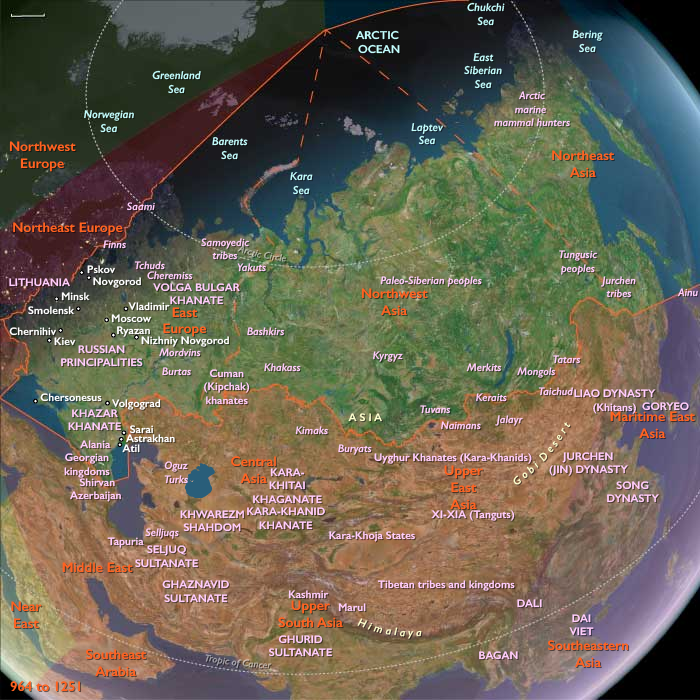
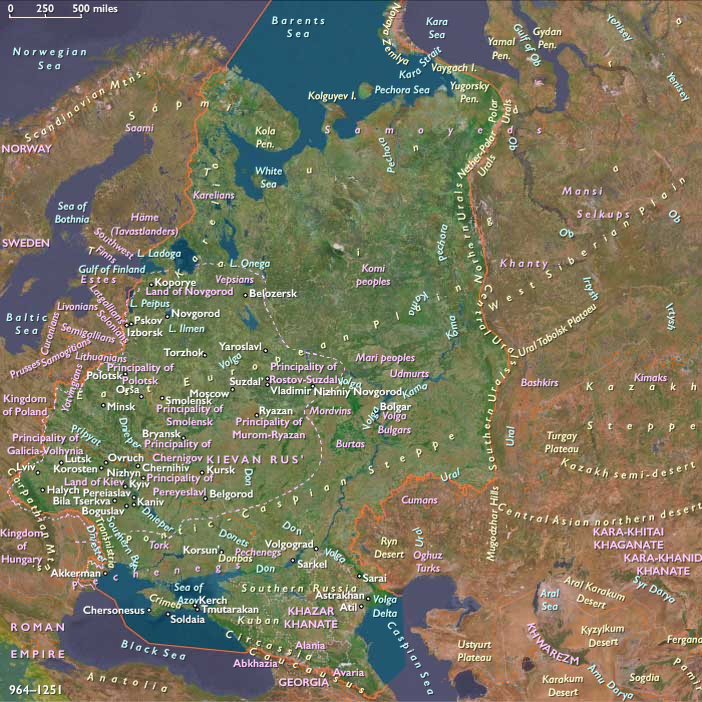
Yuri establishes the town of Gorodets in 1152 as a large fortress on the left bank of the Volga River, the first Russian fortress in today's Nizhny Novgorod Oblast.
Locations
People
Groups
- Kievan Rus', or Kiev, Great Principality of
- Chernigov (Chernihiv), Principality of
- Novgorod Republic
- Ryazan, Principality of
Subjects
Regions
Subregions
Related Events
Filter results
Showing 10 events out of 48687 total
Nidaros (Trondheim) becomes an archbishopric in 1152, having grown to be an important commercial center.
Manuel, following the death of Conrad in 1152, cannot reach an agreement with his successor, Frederick I Barbarossa, despite repeated attempts.
Edessa has been lost by 1152 and Antioch and Tripoli have no leaders; only Jerusalem has a true king, but even here a dispute is brewing.
Baldwin has been of age to rule by himself for seven years, and he begins to assert himself in political affairs.
Though he has not previously expressed an interest in the administration of the country, he now demands more authority.
He and his mother have become increasingly estranged since 1150, and Baldwin blames the constable Manasses for interfering with his legal succession.
Baldwin in early 1152 demands a second coronation from Patriarch Fulcher, separate from his mother.
The patriarch refuses and as a kind of self-coronation Baldwin parades through the city streets with laurel wreaths on his head.
Baldwin and Melisende agree to put the matter before the Haute Cour, or royal council.
The Haute Cour returns a decision that will divide the kingdom into two administrative districts.
Baldwin will retain Galilee in the north, including the cities of Acre and Tyre, while Melisende is to hold the richer Judea and Samaria, including Nablus and Jerusalem itself.
Supporting Melisende in the south are Manasses, and Baldwin's younger brother Amalric, who holds the County of Jaffa within Melisende's jurisdiction.
Neither Baldwin nor Melisende are pleased with the decision, as Baldwin wants to rule the entire kingdom and realizes it will divide the country's resources, but in order to prevent a civil war Melisende agrees to the compromise.
Within weeks of the division, Baldwin launches an invasion of the south.
Manasses is defeated at the castle of Mirabel and exiled, and Nablus falls quickly as well.
To prevent further violence, Jerusalem opens its gates to Baldwin.
Melisende and Amalric seek refuge in the Tower of David.
Throughout the siege the church negotiates with Baldwin.
The peace that is settled allows for Melisende to hold Nablus for life, with a solemn oath by Baldwin not to disturb her peace.
Baldwin names his supporter Humphrey II of Toron as the new constable.

Construction begins in 1152 on the baptistery of St. John adjacent to the Cathedral of Pisa.
Replacing an older baptistry, it is the second building, in chronological order, in the Piazza dei Miracoli, near the Cathedral and the famous Leaning Tower.
The baptistery is an example of the transition from the Romanesque style to the Gothic style: the lower registers are in the Romanesque style, with rounded arches, while the upper registers are in the Gothic style, with pointed arches.
Like the cathedral and its future campanile (later famous as the Leaning Tower) the baptistery displays continuity with the Tuscan Romanesque style of the latter buildings, finely decorated with white and polychrome inlaid marble.
The architect is Diotisalvi, whose signature can be read on two pillars inside the building, and who constructed only the first part, the ground floor.
The building will be continued after his death by Nicola Pisano, a century after its foundation, and then completed by Giovanni Pisano.
Emperor Conrad’s death in 1152 has also thwarted plans for a combined Greco-German imperial campaign against Sicily.
Frederick, however, threatens to invade.
The Hammadids, an offshoot of the Zirids who rule an area corresponding to present Algeria, have been weakened by the incursions of the Arabian Banu Hilal tribe sent in the eleventh century by the Fatimids to punish the Zirids for abandoning Shiism; they are superseded in 1152 by the Almohads.
Roger of Sicily has spent the past twenty-five years of his reign widening his kingdom by raiding imperial Greek states and conquering the Zirid emirates of the North African coastal areas from Tunis to Tripoli.
After the Almohads usurp the Almoravid caliphate, they set about the reconquest of the North African lands held by Sicily, in the process disposing of the Zirid remnants.
Henry, Third Earl of Huntingdon, a Prince of Scotland, of the House of Dunkeld, and an English peer, is the son of King David I of Scotland and Maud, daughter of Waltheof, Earl of Northumbria and Huntingdon, (beheaded 1075), by his spouse Judith of Normandy.
It is said that Henry had been named after his uncle, King Henry I of England.
Earl Henry, who had perhaps been seriously ill in the 1140s, dies unexpectedly at Newcastle or Roxburgh on June 12, 1152, in the Northumbrian domain which David and he had done much to attach to the Scots crown in the decades of English weakness after the death of Henry of England.
Unlike the death of William Adelin in the White Ship, which had left Henry I without male heirs, Earl Henry has three surviving sons.
Thus, although his death damages David's plans, and makes disorders after his death very likely indeed, it is not a disaster.
Eleven-year-old Malcolm, as the eldest of Earl Henry's sons, is sent by his grandfather on a circuit of the kingdom, accompanied by Donnchad, Mormaer of Fife, styled rector, perhaps indicating that he is to hold the regency for Malcolm on David's death.
Donnchad and Malcolm are accompanied by a large army.
William, Henry’s second son, inherits the earldom of Northumberland.
The Synod of Kells, which takes place in 1152, under the presidency of Cardinal Paparoni, continues the process begun at the Synod of Rathbreasail of reforming the Irish church.
The sessions are divided between the abbeys of Kells and Mellifont, and in later times the synod has been called the Synod of Kells-Mellifont and the Synod of Kells/Mellifont.
The diocesan system is further reorganized, with the number of metropolitan provinces being increased from two to four, by raising the dioceses of Dublin and Tuam to archdioceses.
The four provinces of Armagh, Cashel, Dublin and Tuam correspond to the contemporary boundaries of the provinces of Ulster, Munster, Leinster and Connacht respectively.
The diocesan structure established by the synod will largely survive until the sixteenth century, and today forms the basis of the territorial structure of both the Roman Catholic church and the Protestant Church of Ireland, with many of the sees now merged.
The Annulment of Louis VII and Eleanor of Aquitaine’s Marriage (1152 CE)
The marriage between King Louis VII of France and Eleanor of Aquitaine, once seen as a political triumph for the Capetian dynasty, had long been doomed due to their fundamental incompatibility. Their relationship was further strained by Eleanor’s strong-willed personality, Louis’ deep piety, and their failure to produce a male heir.
Despite Pope Eugenius III’s intervention and an attempt to force reconciliation, the union ultimately collapsed in 1152, ending in an annulment granted at Beaugency.
Papal Efforts to Reconcile the Royal Couple
- Eleanor had hoped for a divorce, but Pope Eugenius III refused, instead confirming the legality of their marriage and proclaiming that it could not be dissolved under any pretext.
- In an effort to repair their fractured relationship, the Pope arranged for Eleanor and Louis to share a bed specially prepared by him, an act that resulted in the conception of their second daughter, Alix of France.
- However, the birth of another daughter instead of a male heir only deepened the tensions between them.
The Road to Annulment
By 1152, their marriage was irreparably broken due to:
-
Lack of a Male Heir
- With only two daughters (Marie and Alix), Louis VII feared that he would die without a son, leaving the Capetian dynasty vulnerable.
- This concern was exacerbated by opposition from many of his barons, who disliked Eleanor’s influence at court.
-
Political and Personal Incompatibility
- Eleanor was free-spirited, politically ambitious, and accustomed to the lively culture of Aquitaine.
- Louis VII, originally trained for monastic life, was deeply pious, reserved, and uncomfortable with courtly excess.
-
Pressure from the Nobility
- Many of Louis’ barons resented Eleanor, especially after the failure of the Second Crusade (1147–1149), where rumors of her alleged affair with Raymond of Poitiers had circulated.
- A growing faction of the French nobility saw Eleanor as a disruptive influence, making the annulment a politically expedient solution.
The Annulment at Beaugency (March 11–21, 1152)
-
On March 11, 1152, Louis VII and Eleanor met at the royal castle of Beaugency to formally dissolve their marriage.
-
The Council of Beaugency was presided over by:
- Archbishop Hugh of Sens, Primate of France (who led the proceedings).
- Archbishops of Bordeaux and Rouen.
- Archbishop Samson of Reims, representing Eleanor.
-
On March 21, 1152, the four archbishops, with the approval of Pope Eugenius III, granted an annulmenton the grounds of consanguinity within the fourth degree.
-
Eleanor and Louis were third cousins, once removed, both descending from Robert II of France, a fact that had not previously prevented their union but was now used as a legal basis for dissolution.
Key Terms of the Annulment
- Their two daughters, Marie and Alix, were declared legitimate and placed under the custody of King Louis VII.
- Eleanor’s vast lands, including Aquitaine, were restored to her, ensuring that she remained an independent and powerful ruler.
- Louis VII swore not to interfere with Eleanor’s lands, as secured by Archbishop Samson of Reims.
The Immediate Consequences
- Eleanor regained full control over Aquitaine, immediately becoming one of the most sought-after heiresses in Europe.
- Louis VII was left without a male heir, which would lead to dynastic instability in France.
- Just two months later, on May 18, 1152, Eleanor married Henry Plantagenet, Duke of Normandy and Count of Anjou, the future King Henry II of England.
- This marriage united England and Aquitaine, creating the vast Angevin Empire, and placing France in a prolonged conflict with the Plantagenets.
Long-Term Impact
- The annulment reshaped the balance of power in Western Europe, shifting Aquitaine from Capetian to Angevin control.
- It set the stage for the Anglo-French rivalry, which would define European politics for the next three centuries.
- Louis VII eventually remarried, but his failure to secure Aquitaine weakened the Capetian monarchy, forcing his successors to confront the growing dominance of the Plantagenets.
What began as a personal dispute between an ill-matched royal couple ultimately led to one of the most significant political shifts in medieval Europe, influencing the course of English and French history for generations to come.
Years: 1152 - 1152
Locations
People
Groups
- Kievan Rus', or Kiev, Great Principality of
- Chernigov (Chernihiv), Principality of
- Novgorod Republic
- Ryazan, Principality of