
Yuan Lang was born in 513, as …
Years: 532 - 532
Yuan Lang was born in 513, as the third son of Yuan Rong, the Prince of Zhangwu, a key official in the Northern Wei imperial government who is a distant relative of the then-reigning Emperor Xuanwu.
His mother was Lady Cheng.
(It is unclear whether she was Yuan Rong's wife or concubine.)
In 526, while fighting the agrarian rebel leader Ge Rong, Yuan Rong had been killed in battle, and Yuan Lang's older brother Yuan Jingzhe had inherited the title of Prince of Zhangwu.
Yuan Lang was said to be intelligent in his youth.
In 529, at age sixteen, Yuan Lang had become an army officer, serving on the staff of Yuan Su, the Prince of Lu Prefecture, at that time the governor of Si Province (roughly modern Xinzhou, Shanxi).
In spring 531, he had become the governor of Bohai Prefecture (in modern Cangzhou, Hebei).
At the time that Yuan Lang became the governor of Bohai Prefecture, the imperial government was dominated by members of the paramount general Erzhu Rong, who, after Emperor Xiaozhuang had killed Erzhu Rong in 530, had overthrown and killed Emperor Xiaozhuang, installing Yuan Ye and Emperor Jiemin successively.
In summer 531, the general Gao Huan, believing the Erzhus to be corrupt and to have lost the support of the people, had risen in rebellion at Xindu (in modern Hengshui, Hebei), and, while initially he claimed to be merely wanting to overthrow the Erzhus and still recognizing Emperor Jiemin, he had soon come to believe, at the urging of his general Sun Teng, that he needed to have an emperor under his control who could issue edicts as he wished.
In winter 531, he had therefore declared Yuan Lang, whose Bohai Prefecture was under his control by that point, emperor, even though Yuan Lang's lineage was distant from that of recent emperors and was not even an imperial prince himself.
There is little evidence that the eighteen-year-old Yuan Lang exerted any real influence on Gao Huan's policy decisions as he battled the Erzhus.
He had initially remained at Xindu, but after Gao captured the important city Yecheng (in modern Handan, Hebei) in spring 532, Yuan Lang had been placed in Yecheng.
Gao soon prevails in a major battle against the joined forces of Erzhu Zhao, Erzhu Tianguang, Erzhu Dulü, and Erzhu Zhongyuan, and in light of Gao's victory, the general Husi Chun rebels at the capital Luoyang and executes the prime minister Erzhu Shilong and Erzhu Shilong's brother Erzhu Yanbo, delivering their heads, as well as Erzhu Tiangguang and Erzhu Dulü, whom Husi had captured, to Gao.
Erzhu Zhao flees back to his domain, while Erzhu Zhongyuan flees to the rival Liang Dynasty in the south.
The victorious Gao, along with Yuan Lang, approaches Luoyang.
Gao, now believing that Yuan Lang's lineage is too distant, making him an inappropriate choice for emperor, initially considers still permitting Emperor Jiemin to remain on the throne, but after his generals Wei Lan'gen and Cui Ling persuade him that Emperor Jiemin would be difficult to control, imprisons Emperor Jiemin, while instead deciding on making Yuan Xiu the Prince of Pingyang, a grandson of Emperor Xiaowen, emperor.
Gao then forces Yuan Lang to yield the throne to Yuan Xiu, who takes the throne as Emperor Xiaowu.
Emperor Xiaowu creates Yuan Lang the Prince of Anding.
However, in winter 532, about six and a half months after taking the throne, Emperor Xiaowu orders Yuan Lang to commit suicide.
Yuan Lang is buried without imperial honor, but it is not clear whether he was buried with any honor at all.
Locations
People
Groups
- Xianbei
- Tuoba
- Chinese (Han) people
- Northern Wei, Xianbei, or Tuoba Empire
- Liang Dynasty, Southern (Chinese dynasty)
Topics
Commodoties
Subjects
Regions
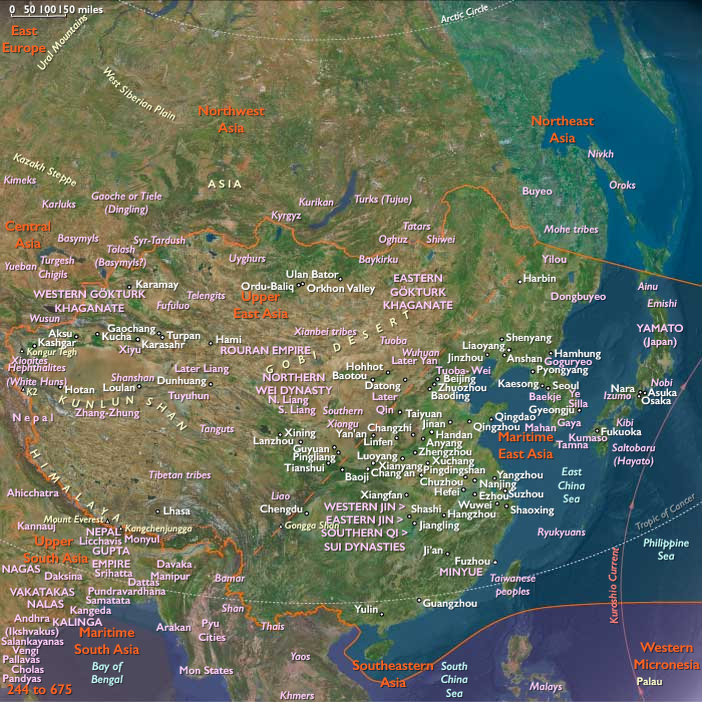
Subregions
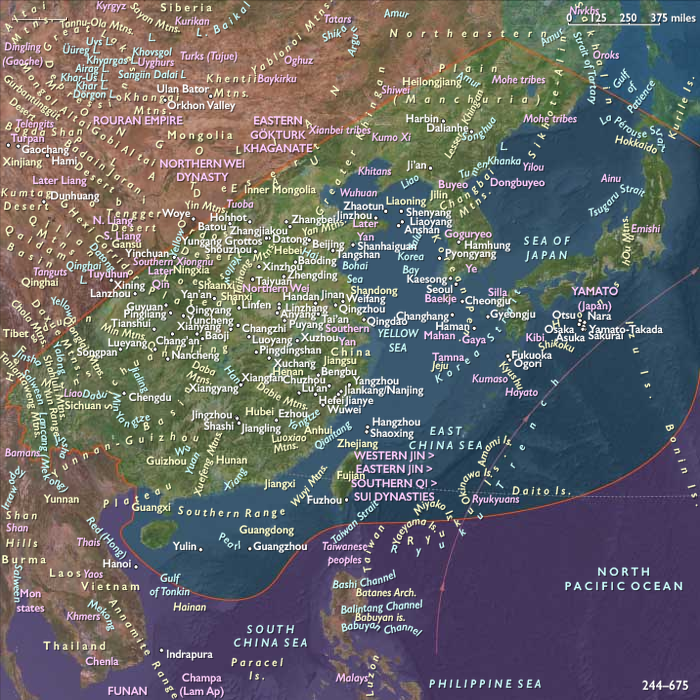
Related Events
Showing 10 events out of 58080 total
Years: 532 - 532
Locations
People
Groups
- Xianbei
- Tuoba
- Chinese (Han) people
- Northern Wei, Xianbei, or Tuoba Empire
- Liang Dynasty, Southern (Chinese dynasty)
Topics
Commodoties
Subjects
Regions
Subregions