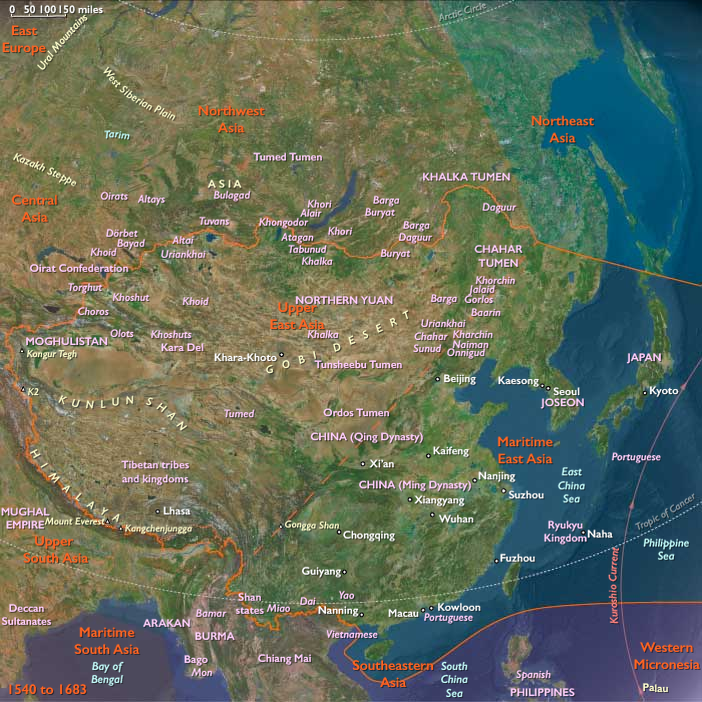
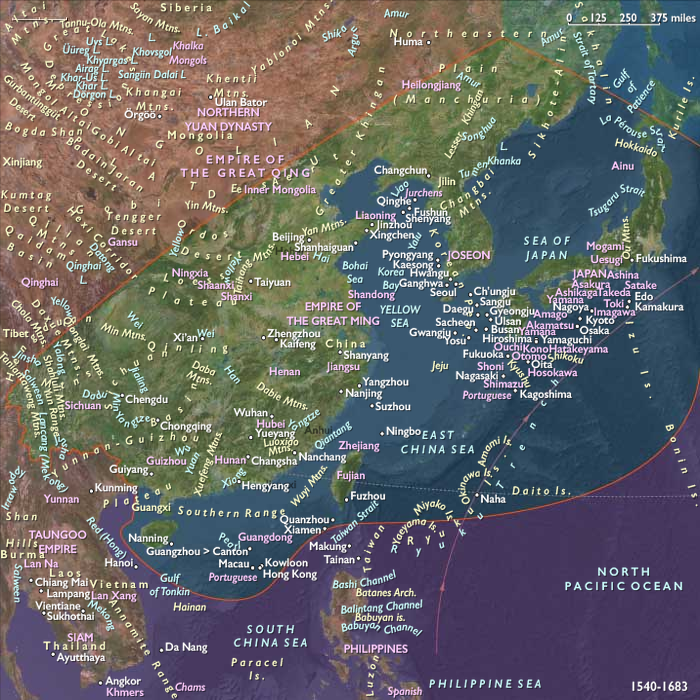
Yuan Chonghuan, reinstated in 1628 under a …
Years: 1628 - 1628
Yuan Chonghuan, reinstated in 1628 under a new government as field marshal of all the forces of the northeast, embarks on an ambitious five-year plan for the complete recovery of Liaodong.
Locations
People
Groups
Topics
Commodoties
Subjects
Regions
Subregions
Related Events
Filter results
Showing 10 events out of 32726 total
One of Yamada’s ships transporting rice in 1628 from Ayutthaya to Malacca is arrested by a Dutch warship blockading the city.
The ship is released once the identity of the owner becomes clear, since the Dutch know that Yamada is held in great respect by the King of Siam, and they do not wish to enter into a diplomatic conflict.
Yamada is also valued by the Dutch as a supplier of deer hide, and they invite him to trade more with Batavia (Accounts of the castle of Batavia, March 1, 1628).
Philip has clear intentions to try and control the Spanish currency, which had become increasingly unstable during the reign of his father and grandfather, but in practice, inflation has soared.
Partly this is because in 1627 Olivares had attempted to deal with the problem of Philip's Genoese bankers —who had proved uncooperative in recent years—by declaring a state bankruptcy.
With the Genoese debt now removed, Olivares hopes to turn to indigenous bankers for renewed funds.
In practice, the plan is a disaster.
The Spanish treasure fleet of 1628 is captured by the Dutch, and Spain's ability to borrow and transfer money across Europe declines sharply.
The direct line of Mantua's Gonzaga family had come to an end in 1627 with the vicious and weak Vincenzo II, who on December 26 had died at the age of thirty-three on the same day that his niece Maria Gonzaga's marriage with Charles de Nevers was celebrated.
Nevers, the eldest son and heir of Charles, Duke of Nevers, Rethel and Mayenne, is the head of the cadet branch of the House of Gonzaga, and after Vincenzo II, heir of the Duchy of Mantua.
The Duke of Nevers is a son of Luigi, younger brother of Vincenzo II's grandfather.
Luigi had been naturalized French as Louis about 1550, and in 1566 had married the heiress of the duchies of Nevers and Rethel.
The French Crown would naturally prefer Nevers, a French peer, as ruler in Mantua.
Nevers arrives here in January of 1628 and proclaims himself its sovereign.
There are two rival claimants.
One is Charles Emmanuel I, Duke of Savoy, whose daughter Margerita is the widow of Francis IV.
Although their son had died an infant in 1612, it is their elder daughter Maria (1612-1660) who had married Charles de Nevers in 1627.
Charles Emmanuel bases his right to Mantua on his daughter's claim to a substantial portion of the Gonzaga realm, the Marquessate of Montferrat, which is demonstrably heritable by females since the Gonzagas had acquired it through marriage to Margherita Paleologa in 1540.
The other claimant is Ferrante II, Duke of Guastalla, a distant Gonzaga cousin who had voiced his claim but had not immediately placed troops in the field.
He is, however, supported by Emperor Ferdinand II, whose wife at the time, Eleanor of Mantua the elder (1598-1655), had been the sister of the last three Dukes of Mantua.
He seeks to reattach the Duchy of Mantua to the Holy Roman Empire; Ferrante, being in the Spanish-Imperial camp, is a useful tool to that purpose.
As the Thirty Years War wears on, it affects dynastic alliances.
Charles Emmanuel obtains support from the Habsburgs, who control Milan.
The resulting French-Habsburg war over the succession is just one of the many theaters of the Thirty Years War, fought all over Europe.
The initial attempt of Don Gonzalo Fernandez de Córdoba, Spanish governor of Milan, and Charles-Emmanuel is to partition the Mantuan-Montferrat patrimony, which lies to east and to west of Milan.

The Spanish minister supports the Guastalla claimant in Mantua, as the weaker of two neighbors, and the Savoy claimant in Montferrat, the lesser of the territories.
Friction between the confederates ensues, when Charles-Emmanuel moves his troops into more territory than had been agreed upon, laying siege to the town of Casale, capital of Montferrat.
William Harvey is the first to describe correctly and in detail the systemic circulation and properties of blood being pumped to the body and lungs by the heart.
He publishes in 1628 in Frankfurt am Main (host to an annual book fair that Harvey knew would allow immediate dispersion of his work) his completed treatise on the circulation of the blood, Exercitatio Anatomica de Motu Cordis et Sanguinis in Animalibus, containing his findings about blood circulation.
Appointed 'Physician Extraordinary' to King James I in 1618, he seems to have similarly served various aristocrats, including Lord Chancellor Bacon. He
Harvey "fell mightily in his practice" as a result of negative comments by other physicians, but continues to advance his career.
The Plymouth Colony, the second English settlement in America, has increased to two hundred inhabitants by 1628, enough reinforcements having arrived during the difficult early years.
Another fifty settle in ...
...Naumkeag and ...
...twenty-five more live in Dover, further north.
A couple of dozen free-thinkers, either lone pioneers or fur traders in official posts, link the three settlements.
The Iroquois Confederacy (Haudenosaunee, also known as the League of Peace and Power, or Five Nations), and in particular the Mohawk, have come to rely on the trade for the purchase of firearms and other European goods with the establishment in the 1620s of Dutch trading posts in the Hudson Valley.
The League has from 1609 engaged in the Beaver Wars with the French and their Iroquoian-speaking Huron allies.
They also put great pressure on the Algonquian peoples of the Atlantic coast and what is now the boreal Canadian Shield region of Canada.
The Mohawks defeat the Mahicans in 1628 to gain a monopoly in the fur trade with the Dutch at Fort Orange, New Netherland.
The Mohawks will not allow Canadian natives to trade with the Dutch.
James I of England had asserted sovereignty over Nevis on August 30, 1620, by awarding a Royal Patent for colonization to James Hay, 1st Viscount Doncaster, soon to be created Earl of Carlisle.
Actual European settlement does not happen until 1628, however, when Anthony Hilton moves from nearby Saint Kitts following a murder plot against him.
Accompanied by eighty other settlers, soon to be boosted by a further one hundred settlers from London who had originally hoped to settle Barbuda, Hilton becomes the first Governor of Nevis.