
Moreover, areas of white and black settlement …
Years: 1864 - 1875
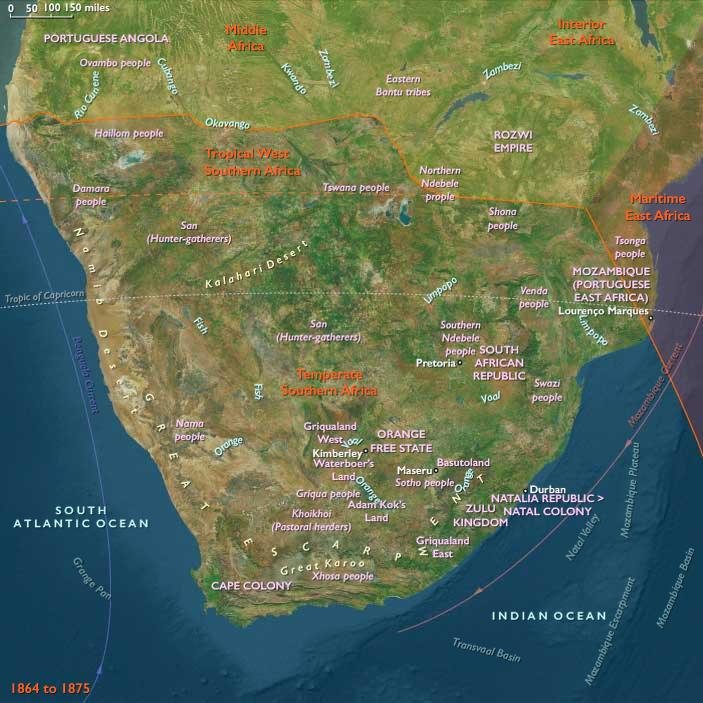
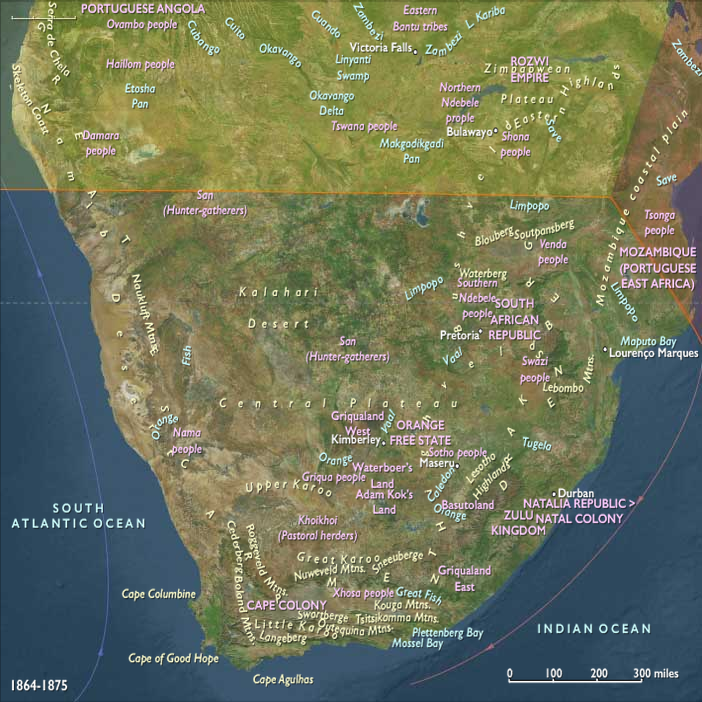
Moreover, areas of white and black settlement and political control are largely separate.
In 1865 the Cape contains two hundred thousand Khoikhoi and people of mixed ancestry (the basis of today's Cape Coloured population), as well as one hundred thousand Bantu speakers.
Several hundred thousand blacks live in Natal and in the Voortrekker republics.
The vast majority of South Africa's black inhabitants, however, continue to live in independent African states ruled by their own kings and chiefs.
In the 1860s, Mpande's Zululand is a still powerful state in which most Zulus live.
Moshoeshoe's Lesotho, although it had been attacked by the Orange Free State and its borders contracted, contains most of the Sotho people.
To the northeast of the South African Republic, the Pedi (Northern Sotho) under their king Sekhukhune have a well-armed state, and the Swazi kingdom continues to be a powerful entity.
Any observer traveling in South Africa in the late 1860s would have had little reason to assume that this balance of power between blacks and whites will change dramatically during the remainder of the nineteenth century.
People
Groups
- Khoikhoi
- Sotho (Basotho or Basuto) people
- Xhosa people
- Swazi
- Zulu people
- Afrikaners
- Boers
- Britain (United Kingdom of Great Britain and Ireland)
- Cape Colony, British
- Zululand
- Zulu, Kingdom of the
- Sotho kingdom
- South African Republic (the Transvaal)
- Swaziland, Kingdom of
- Swaziland, Kingdom of
- Natal Colony, British
- Orange Free State, Republic of the (Boer Republic)
Topics
Subjects
Regions
Subregions
Years: 1864 - 1875
People
Groups
- Khoikhoi
- Sotho (Basotho or Basuto) people
- Xhosa people
- Swazi
- Zulu people
- Afrikaners
- Boers
- Britain (United Kingdom of Great Britain and Ireland)
- Cape Colony, British
- Zululand
- Zulu, Kingdom of the
- Sotho kingdom
- South African Republic (the Transvaal)
- Swaziland, Kingdom of
- Swaziland, Kingdom of
- Natal Colony, British
- Orange Free State, Republic of the (Boer Republic)
Topics
Subjects
Regions
Subregions