Yasovaram, a son of King Indravarman I …
Years: 889 - 889
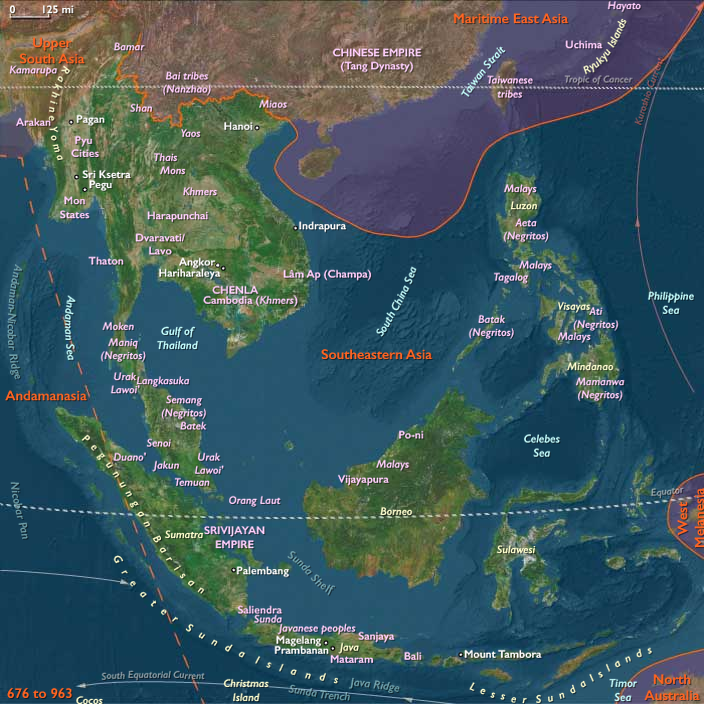
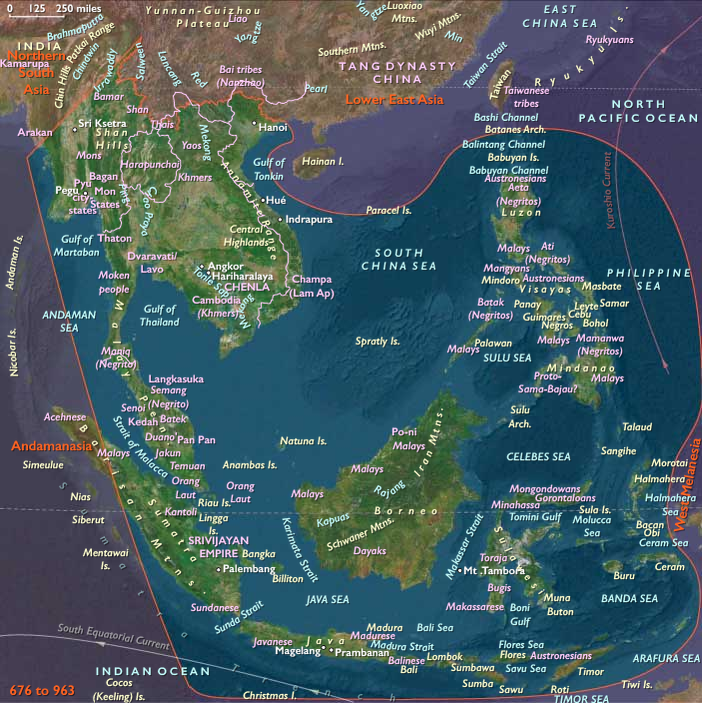
Yasovaram, a son of King Indravarman I and his wife Indradevi becomes emperor of the Khmer in 889.
After the death of Indravarman, a succession war had been fought between his two sons, Yasovarman and his brother.
It is believed that the war was fought on land and on sea by the Tonlé Sap.
In the end, Yasovarman prevailed.
During the first year of his reign, he builds about one hundred monasteries (ashrams) throughout his kingdom.
Each ashram is used as a resting place for the ascetic and the king during his trips.
Locations
People
Groups
Topics
Subjects
Regions
Subregions
Related Events
Filter results
Showing 10 events out of 53721 total
Li Jie was born in 867, during the reign of his father Emperor Yizong, in the eastern palace at the imperial capital Chang'an.
His mother was Emperor Yizong's concubine Consort Wang, who was said to have come from a humble background and whose rank within the palace was not recorded.
She appears to have died shortly after giving birth to Li Jie.
(As Li Jie was also said to have been from the same mother as his older brother Li Yan, whose mother was a different Consort Wang, it might have been that he was raised by Li Yan's mother.)
Emperor Yizong had created Li Jie the Prince of Shou in 872.
In 877, by which time Li Yan (named Li Xuan by this point) was emperor (as Emperor Xizong), Li Jie was given the honorary titles of Kaifu Yitong Sansi, commandant at You Prefecture (in modern Beijing), and military governor (Jiedushi) of Lulong Circuit (headquartered at Beijing) (At this time, Lulong Circuit was actually governed by the warlord Li Keju.)
It was said that Li Jie was particularly close to Emperor Xizong since they shared the same mother, and he had followed Emperor Xizong in flight from Chang'an from the attack of the agrarian rebels led by Huang Chao in 880.
While on this flight, Li Jie, who was then thirteen, had run out of energy and requested a horse from the eunuch Tian Lingzi, who dominated Emperor Xizong's court; Tian had refused and whipped Li Jie's attendant for the request.
Li Jie thereafter bears a deep resentment for Tian.
Emperor Xizong had grown gravely ill 888, by which time Huang's rebellion had been crushed and the imperial court had returned to Chang'an.
It was said that Emperor Xizong's younger brother and Li Jie's older brother Li Bao the Prince of Ji was the oldest among Emperor Xizong's surviving brothers and was considered wise, so the imperial officials wanted him to succeed Emperor Xizong, but the powerful eunuch Yang Fugong (who had succeeded Tian as the surveyor of the eunuch-controlled Shence Armies) wanted Li Jie to succeed Emperor Xizong, so Emperor Xizong issued an edict creating Li Jie crown prince.
Shortly after, Emperor Xizong dies, and Li Jie, changing his name to Li Min, takes the throne as Emperor Zhaozong.
During the mourning period, the chancellor Wei Zhaodu serves as regent.
Emperor Zhaozong's ascension creates great anticipation in the people's minds, as he is considered intelligent, handsome, decisive, and talented, with ambitions to restore imperial power that had been lost during Emperor Xizong's reign.
Not long after taking the throne, he changes his name further to Li Ye.
As soon as Emperor Zhaozong takes the throne, he receives petitions from Wang Jian and Gu Yanlang, advocating that Tian Lingzi's brother Chen Jingxuan the military governor of Xichuan Circuit (headquartered in modern Chengdu, Sichuan), be removed from his post.
(Wang, who is allied with Gu (the military governor of neighboring Dongchuan Circuit (headquartered in modern Mianyang, Sichuan), has been fighting Chen for the control of Xichuan but is unable to prevail against Chen by himself.)
Still resenting Tian, who is now sheltered by Chen from edicts that Emperor Xizong had previously entered ordering Tian into exile, Emperor Zhaozong orders Chen back to Chang'an and commissions Wei Zhaodu as his replacement.
When Chen refuses to be replaced, Emperor Zhaozong orders a general campaign against him, with Wei in command, assisted by Wang, Gu, and Yang Fugong's adoptive nephew Yang Shouliang the military governor of Shannan West Circuit (headquartered in modern Hanzhong, Shaanxi).
While the campaign against Chen was starting, another campaign that had been ongoing during the latter years of Emperor Zhaozong's reign is ending.
Qin Zongquan, formerly the Tang military governor of Fengguo Circuit (headquartered in modern Zhumadian, Henan), had declared himself emperor at Fengguo's capital Cai Prefecture in 885 and had sent out armies to conquer the nearby Tang circuits.
By 888, his power had waned under attacks by Tang's military governor of Xuanwu Circuit (headquartered in modern Kaifeng, Henan), Zhu Quanzhong, and in late 888 he is overthrown in a coup by his officer Shen Cong; he is subsequently delivered to Zhu, who then delivers him to Chang'an to be executed.

The Unified Silla kingdom seeks to collect taxes by force directly from peasants, setting off massive peasant rebellions.
The Magyars' early homes had been on the upper waters of the Volga and Kama rivers; unrecorded causes had driven them, at an uncertain date, southward into the steppes, where they have adopted the life of peripatetic herders.
Their base in the late ninth century is the lower Don, ranging over the steppes to the west of that river.
They now comprise a federation of hordes, or tribes, each under a hereditary chieftain and each composed of a varying number of clans, the members of which share a real or imagined blood kinship.
All clan members are free, but the community includes slaves taken in battle or in raids.
There are seven Magyar hordes, but other elements are part of the federation, including three hordes of Turkic Khazars (the Kavars).
Either because of this fact or perhaps because of a memory of earlier conditions, this federation is known to its neighbors as the On-Ogur (literally, “Ten Arrows”), from the Slavic pronunciation of which the name “Hungarian” is derived.
In the late ninth century, the Magyars breach Khazar control of the steppe, but in 889, attacks by a newly arrived Turkic people, the Pechenegs, whose migration the declining Khazar state can no longer impede, drive the Magyars and their confederates from their home in the northern Caucasus to the western extremities of the steppes, the strong presence of the Varangian Rus’ in Kiev blocking the Magyars’ northward advance.
A Persian work, Denkart, represents Judaism as the principal religion of the Khazars.
In the capital city, the Khazars establish a supreme court composed of seven members, and every major religion (Christianity, Islam, Judaism, and Slavic paganism) is represented on this judicial panel.
The Khazars thus sponsor religious tolerance in a time when surrounding countries persecute those who refuse to follow the faith of the rulers.
Income that is derived from duties on goods passing through Khazar territory, in addition to tribute paid by subordinate tribes, maintains the wealth and the strength of the Jewish Khazar empire throughout the ninth century.
In about 889, the Khazars and the Oguz, a confederation of Turkic peoples of the central Asian steppes, attack the nomadic Turkic Pechenegs, who had originally inhabited the area between the Volga and Yaik (Ural) rivers.
The Przemysl family is (according to legend) descended from a Czech plowman of the same name who was chosen by Libuse, a royal princess, as her husband.
As the head of the Přemyslids who dominate the environs of present-day Prague, Bořivoj had declared himself kníže—in Latin dux, which means sovereign prince—around the year 870.
His title will be later translated by German scholars as "duke" of the Bohemians (Czechs).
Bořivoj had been recognized as such around 872 by his overlord Svatopluk I of Great Moravia, who had dispatched Bishop Methodius to begin the conversion of the Bohemian Slavs to Christianity.
Borivoj and his wife Ludmila had been baptized by Methodius, probably in 883, and the latter had become an enthusiastic evangelist, although the religion fails to take root among Bořivoj's subjects.
Borivoj had been deposed in the years 883/884 by a revolt in support of his kinsman Strojmír.
He was restored in 885 only with the support of his suzerain Svatopluk of Moravia.
When Borivoj dies about four years later, his sons still minors, Svatopluk takes over the rule of Bohemia himself.
As with most of the early Bohemian rulers, Borivoj is a shadowy figure; exact dates for his reign and vital statistics cannot be established.
Nonetheless, several major fortifications and religious foundations are said to have dated from this time.
In old Czech legends he is said to have been son of a Bohemian prince named Hostivít.
Odo of France, recognizing the superiority of Arnulf’s position, had formally admitted the suzerainty of Arnulf in 888.
Arnulf had taken advantage of the problems in West Francia upon the death of Charles The Fat to secure the territory of Lorraine, which he had converted into a kingdom for his son, Zwentibold.
In addition, in 889, Arnulf supports the claim of Louis the Blind to the kingdom of Provence, after receiving a personal appeal from Louis’ mother, Ermengard, who comes to see Arnulf at Forchheim in May 889.
The Slavic language replaces Greek, as a result of the intensive work of the Slav scholars, in Bulgarian church services and in literary life and becomes Bulgaria's official language.
Bulgaria's conversion has a political dimension, for it contributes both to the growth of central authority and to the melding of Bulgars and Slavs into a unified Bulgarian people.
Boris has adopted Greek Orthodox political conceptions, referring to himself as ruler “by the grace of God,” and the new religion provides justification for suppressing those boyars of Bulgar origin who cling to paganism and the political and social order with which it is linked.
After a reign of thirty-six years, Boris, whose faith apparently is deep and genuine, abdicates in 889 and becomes a monk, but he retains the right to take an active part in the government of the state.
His successor,Vladimir-Rasate, is the oldest of Boris-Mihail's sons and possibly the only one of them who had been born before Boris' adoption of Christianity.
According to Emperor Constantine VII Porphyrogenitos, Vladimir had taken part in a Bulgarian invasion of the Serbian lands, predating the Christianization of Bulgaria.
Another Bulgarian-Byzantine war begins in 889, this time over trade rights.
…Rayy in 889/890, where he establishes his headquarters.
During his stay in Tabaristan, Rafi had been joined by Ali ibn al-Layth, Amr's brother, who had initially been the favored candidate to succeed Ya'qub.
Ali's sons, al-Mu'addal and al-Layth, will later accompany Rafi in his attempt to regain control of Khurasan in 896.
Rafi invades and conquers the Zaydid domains of Gurgan and Tabaristan in 888/889, defeating the Zaydid ruler Muhammad ibn Zayd in battle at the Chalus River.
From Tabaristan, …
…Rafi marches to Qazvin, then …