Yáo Cháng founds Later Qin, a state …
Years: 384 - 384
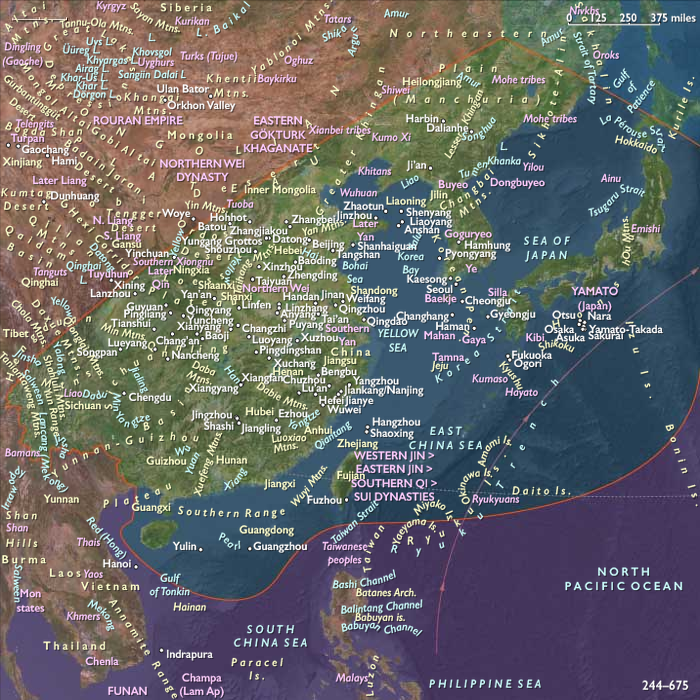
Yáo Cháng founds Later Qin, a state of Qiang ethnicity of the Sixteen Kingdoms Era, entirely distinct from the ancient Qin Dynasty, the Former Qin, and the Western Qin, in 384.
All rulers of the Later Qin will declare themselves "emperors."
Locations
People
Groups
Topics
- Six Dynasties Period in China
- Sixteen Kingdoms Period in China
- Civil Wars in China triggered by the Wu Hu Invasion
Commodoties
Subjects
Regions
Subregions
Related Events
Filter results
Showing 10 events out of 59552 total
Murong Chui, not yet in open rebellion against Former Qin, arrives at Luoyang in spring 384, but Fu Hui, hearing of Fu Feilong's death, refuses to welcome him.
Murong Chui then enters into an alliance with Zhai Bin, who urges him to take the imperial title.
Murong Chui refuses at this point (reasoning that he should welcome Murong Wei back as emperor) but accepts the title of Prince of Yan, formally breaking away from Former Qin and establishing Later Yan.
(All rulers of the Later Yan will declare themselves "emperors".)
Immediately, the struggle is on for Murong Chui to capture the territory that was formerly Former Yan's.
Both Murong Chui and Murong Nong quickly capture many cities, isolating Luoyang and …
…Yecheng.
Fu Pi tries to persuade him to stop his rebellion, but he refuses, and instead tries to persuade Fu Pi to leave Yecheng with his forces intact; Fu Pi refuses, and Murong Chui puts Yecheng under siege.
With Former Qin now facing further rebellion by Murong Chui's nephews Murong Hong and Murong Chong, and Yao Chang, in the west, Yecheng is not able to receive any reinforcements, but Murong Chui is still unable to capture it quickly.
When Zhai Bin, in disappointment over not being given a prime ministerial title, considers switching sides again to Former Qin, Murong Chui kills him.
Zhai Bin's nephew Zhai Zhen rebels against Later Yan, and for the next several years, while battling Former Qin remnants, Murong Chui will also have to battle Dingling forces under Zhai Zhen and later his cousins Zhai Cheng and Zhai Liao.
Buddhism becomes the official state religion of Baekje in 384.
Zhai Liao is defeated in late 384 by Murong Chui's sons Murong Lin and Murong Nong and forced to flee to his cousin Zhai Zhen.
King Sosurim has spent most of his reign and life trying to keep Goguryeo under control and strengthening royal authority.
Although he is not able to avenge the death of his father and previous Goguryeo ruler, King Gogugwon, he has played a major role in setting up the foundations that make possible the great conquests of his nephew and later ruler of Goguryeo, King Gwanggaeto the Great.
He dies in 384 and is buried in Sosurim, which is a forest in Goguryeo.
Gregory of Nazianzus, resigning his office in 384 for the sake of peace in the Church, returns to his native region, turning his attention to the incursion of Apollinarian heretics into the flock of Nazianzus, then again retires to monastic life.
Valentinian, now sole emperor in the West, rules in favor of Ambrose and against Symmachus in 384 in the controversial issue of restoring the Altar of Victory to the Roman Senate House.
Jerome, invited to Rome originally to the synod of 382 held for the purpose of ending the schism of Antioch, has made himself indispensable to Pope Damasus, and taken a prominent place in his councils.
Among other duties he has undertaken the revision of the text of the Latin Bible on the basis of the Greek New Testament and the Hebrew Old Testament, in order to put an end to the marked divergences in the current western texts.
Prior to Jerome's translation, all Old Testament translations had been based on the Septuagint.
Jerome has chosen, against the pleadings of other Christians including Augustine himself, to use the Hebrew Old Testament instead of the Septuagint.
The commission to translate the Bible into Latin will determine the course of Jerome’s scholarly activity for many years, and will be his most important achievement.
His translation of the Bible from Greek to Latin is called the Vulgate (vulgar) because it is in the common, or vulgar, tongue of the people.
He has undoubtedly exercised an important influence during these three years in Rome, to which, outside of his unusual learning, his zeal for ascetic strictness and the realization of the monastic ideal have contributed not a little.
A circle of well-born and well-educated women, including some from the noblest patrician families, such as the widows Marcella and Paula, with their daughters Blaesilla and Eustochium, surround Jerome.
The resulting inclination of these women for the monastic life, and his unsparing criticism of the life of the secular clergy, brought a growing hostility against him among the clergy and their supporters.
Soon after the death of his patron Damasus on December 10, 384, and having lost his necessary protection, Jerome is forced to leave his position at Rome following an inquisition of the Roman clergy into allegations that he had improper relations with the widow Paula.
Augustine, born in the city of Thagaste (the present day Souk Ahras, Algeria) to a pagan father named Patricius and a devout Christian Berber mother named Monica, had at the age of eleven been sent to school at Madaurus, a small Numidian city about nineteen miles south of Thagaste noted for its pagan climate.
Here he had become familiar with Latin literature, as well as pagan beliefs and practices.
In 369 and 370, he had remained at home, where he read Cicero's dialogue Hortensius (now lost), which he will later describe as leaving a lasting impression on him and sparking his interest in philosophy.
At age seventeen, through the generosity of a fellow citizen Romanianus, he had moved to Carthage to continue his education in rhetoric.
Although raised as a Christian, Augustine had left the Church to follow the Manichaean religion, much to the despair of his mother.
As a youth, Augustine lived a hedonistic lifestyle for a time, associating with hooligans (Latin: euersores, literally meaning wreckers) who boasted of their experience with the opposite sex and urged the inexperienced boys, like Augustine, to seek out experiences with women or to make up stories about experiences in order to gain acceptance and avoid ridicule.
At a young age, he had developed a stable relationship with a young woman in Carthage, who would be his concubine for over thirteen years and who had given birth to his son, Adeodatus.
During the years 373 and 374, Augustine had taught grammar at Thagaste.
The following year, he had moved to Carthage to conduct a school of rhetoric, where he was to remain for the next nine years.
Disturbed by the unruly behavior of the students in Carthage, in 383 he had moved to establish a school in Rome, where he believed the best and brightest rhetoricians practiced.
However, Augustine was disappointed with the Roman schools, where he was met with apathy.
Once the time came for his students to pay their fees they simply fled.
Manichean friends introduce him to the prefect of the City of Rome, Symmachus, who has been asked to provide a professor of rhetoric for the imperial court at Milan.
Winning the job, the young provincial heads north to take up his position in late 384.
At age thirty, Augustine has won the most visible academic chair in the Latin world, at a time when such posts give ready access to political careers.
Although Augustine shows some fervor for Manichaeism, he has never become an initiate or "elect" but remains an "auditor", the lowest level in that sect's hierarchy.

Maximus, making his capital at Augusta Treverorum in Gaul, rules Britain, Gaul, Spain and Africa.
He issues coinage and a number of edicts reorganizing Gaul's system of provinces.
Some scholars believe Maximus may have founded the office of the Comes Britanniarum as well.
He becomes a popular emperor: Quintus Aurelius Symmachus delivers a panegyric on Maximus' virtues.
He uses foederati forces such as the Alamanni to great effect.
Ithacius goes to the imperial court, where he persuades the emperor to have Priscillian tried.
Years: 384 - 384
Locations
People
Groups
Topics
- Six Dynasties Period in China
- Sixteen Kingdoms Period in China
- Civil Wars in China triggered by the Wu Hu Invasion