Yamada Nagamasa visits Japan in 1629 with …
Years: 1629 - 1629
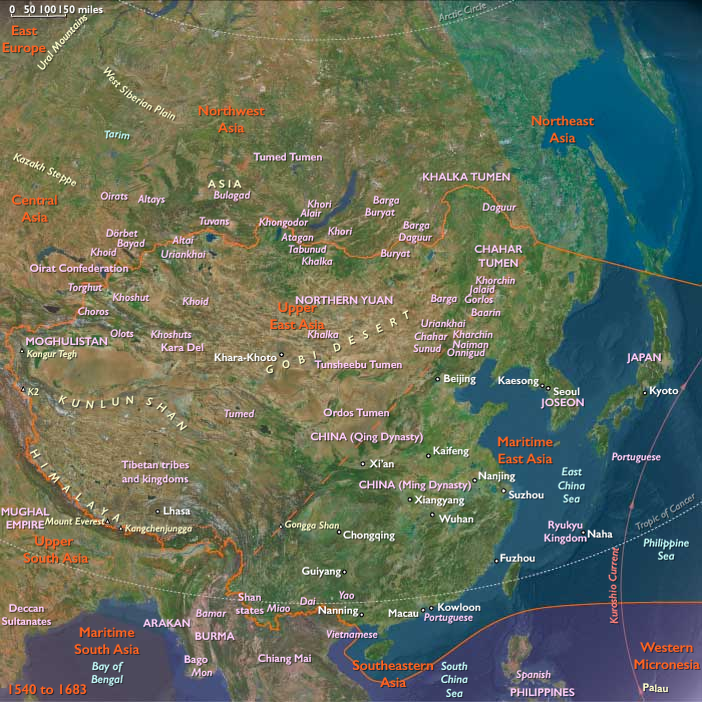
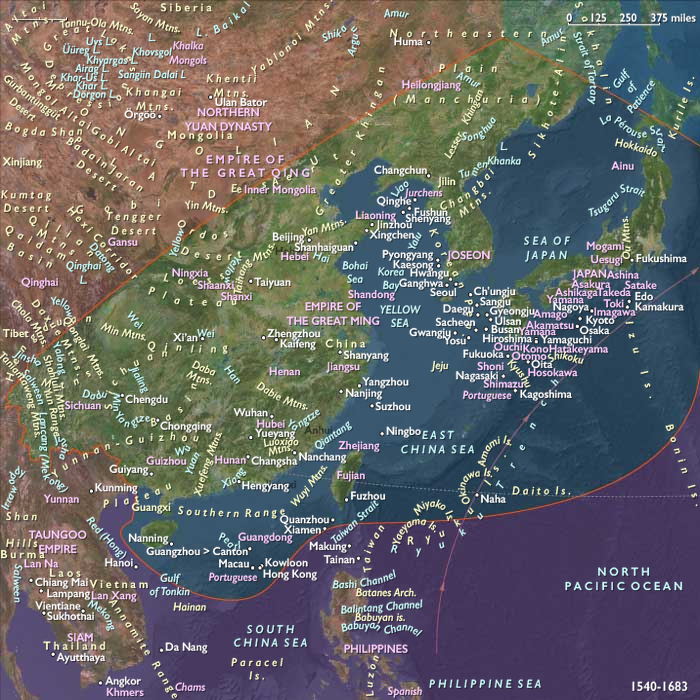
Yamada Nagamasa visits Japan in 1629 with an embassy from the Thai king Songtham.
Locations
People
Groups
- Ayutthaya (Siam), Thai state of
- Netherlands, United Provinces of the (Dutch Republic)
- Dutch East India Company in Indonesia
- Japan, Tokugawa, or Edo, Period
- Dutch East India Company (Vereenigde Oostindische Compagnie or VOC in Dutch, literally "United East Indies Company")
Commodoties
Subjects
Regions
Subregions
Related Events
Filter results
Showing 10 events out of 32689 total
Almost the entire native population of the Banda Islands has been driven away by 1629, starved to death or killed in an attempt to replace them with Dutch plantations.
Readings of historical sources suggest around one thousand Bandanese likely survive in the islands, and have been spread throughout the nutmeg groves as forced laborers.
Post conquest, the Dutch have subsequently resettled the islands with imported slaves, convicts and indentured laborers (to work the nutmeg plantations), as well as immigrants from elsewhere in Indonesia.
These plantations are used to grow cloves and nutmeg for export.
Coen had hoped to settle large numbers of Dutch colonists in the East Indies, but this part of his policies will never materialize, because the Heeren XVII (the seventeen Lords of the VOC) are wary of large, open-ended financial commitments.
Prince Si Sin had entered monkhood as the means to protect himself from political punishments, as it is against the Theravada law to hurt a monk.
Yamada had then persuaded the prince to go the palace by pretending to support him against Sri Suriyavong.
Having renouncing his monkhood before entering the palace, the former prince is seized by the royal guards and exiled to Phetchaburi, where he is locked up in a well for starvation.
Local monks rescue him, however, and stage a rebellion at Phetburi.
Si Suriyavong sends Yamada to counter Prince Si Sin, who is defeated and captured.
Before being executed, Prince Si Sin reportedly warns his nephew about the ambitions of Suriyavong, who subsequently assumes absolute power and alienates the king by cremating the ashes of his father for the second time (a practice reserved only for royalty).
The Thai aristocracy chooses to attend the funeral instead of the royal audience, which further infuriates the monarch, but Si Suriyavong sends Okya Kamhaeng to calm him down and convince the king of Sri Suriyavong’s loyalty.
Chettha is thus taken by surprise when Sri Suriyavong marches Japanese troops into the palace.
The king flees to Wat Maheyong north of Ayutthaya and is quickly captured and executed, together with his mother, at Wat Kokphraya in 1629.
Sri Suriyavong gives the throne to Chettha’s younger brother, the child prince Athittayawong, for whom he serves as regent.
However, Sri Suriyawong persuades his supporters and the nobility to give him full power and crown him as the second king.
It is then decided that there will not be two kings in the same kingdom and Athitayawong is executed, after reigning for only thirty-eight days, at Wat Kok Phraya, ending the Sukhothai dynasty.
Sri Suriyawong ascends the throne as King Prasat Thong.
Chongzhen, the new emperor of the Ming Dynasty, reiterates the state prohibition against female infanticide in 1629, while the empire and the Chinese economy begin to crumble.
In the same year, a third of the courier stations are closed down due to lack of government funds to sustain them.
Born Zhu Youjian, Chongzhen is the fifth son of the Taichang Emperor.
As such, he has grown up in a relatively quiet environment, since most of the younger sons are left out of the power struggle that their elder brother the Tianqi Emperor had had to endure.
Chongzhen succeeds his brother to the throne at age seventeen and immediately eliminates the eunuch Wei Zhongxian and Madam Ke, who had become de facto rulers of the empire.
Chongzhen tries to rule by himself and did his best to salvage the dynasty.
However, years of internal corruption and an empty treasury make it almost impossible to find capable ministers to fill important government posts.
The Chongzhen Emperor had taken the reign in 1627 at the age of sixteen, and in 1629 (at the age of 18) he grants Yuan Chonghuan the title of "Senior Guardian of the Heir Apparent".
The Chongzhen Emperor gives him his Imperial Sword and states that he will fully support Yuan's decisions.
Yuan now has to face again a larger Manchurian force (slightly above two hundred thousand) under Huang Taiji.
This time the Manchurians have incorporated many more men including the newly surrendered Mongols, rebel Ming army, and the conquered Korean forces and various small states of the North.
However, the Manchus are not confident enough to attack Jinzhou or Ningyuan again and change their strategy.
Bypasssing Jinzhou, Ningyuan and Shanhai Pass, the Manchus break through the Great Hall west of Shanhai Pass and suddenly appear north of Beijing in the winter of 1629.
Yuan rushes back with an elite army from Ningyuan to defend the capital, reaching Beijing just days before the Manchus.
Outside the city wall of Beijing, he defeats the Manchurian "Eight Banners", which number one hundred thousand, but is not strong enough to destroy the attacking army.
Yuan, instead of being fêted, is heavily criticized when he arrives in Beijing, and some eunuchs even accuse Yuan of collaborating with the enemy.
They have in fact been tricked by Huang Taiji into thinking that Yuan had betrayed them.

Denmark withdraws from the war in 1629.
The Catholic reconquest of Germany had resumed in the 1620s with the destruction of Protestantism in Bohemia and the Palatinate.
With Holy Roman Emperor Ferdinand II’s Edict of Restitution in 1629, its basis seems complete.
These same years have seen, in central Europe at least, the worst of all witch-persecutions, the climax of the European craze.
Many of the witch-trials of the 1620s have multiplied with the Catholic reconquest.
In some areas, the lord or bishop is the instigator, in others the Jesuits.
Sometimes local witch-committees are set up to further the work.
The first persecutions for witchcraft in Würzburg had started in 1616-1617 in the territory around the city with the consent of Julius Echter von Mespelbrunn, Prince bishop of Würzburg, and, following an isolated witch trial in 1625, gives way to the great hysteria beginning in 1626.
As so often with the mass trials of sorcery, the victims soon count people from all society; also nobles, councilmen and mayors.
This is during a witch hysteria that causes a series of witch trials in South Germany, such as in Mainz, Bamberg, ...
...Ellwangen, and ...
...Eichstätt, a Bavarian prince-bishopric where a judge claims the death of two hundred and seventy-four witches in 1629.
Abbas, whose health has been troubled from 1621 onward, dies at his palace in Mazandaran in 1629 and is buried in Kashan.
Sam Mirza succeeds Abbas at the age of seventeen, taking the name Shah Safi.
Imam Muhammad proposes a truce with the Ottomans in 1629, as he sees the need to rest his own forces.
The governor Haydar Pasha agrees, and on March 9, he hands over the keys to San'a to the imam's son Ali.
The Turks withdraw to the coast under the imam's protection, and another son, Yahya, is made governor (amil) of San'a.
Ta'izz, another major city, falls to the imam’s forces in the same year.
Years: 1629 - 1629
Locations
People
Groups
- Ayutthaya (Siam), Thai state of
- Netherlands, United Provinces of the (Dutch Republic)
- Dutch East India Company in Indonesia
- Japan, Tokugawa, or Edo, Period
- Dutch East India Company (Vereenigde Oostindische Compagnie or VOC in Dutch, literally "United East Indies Company")