Yamada Nagamasa had visited Japan in 1629 …
Years: 1630 - 1630
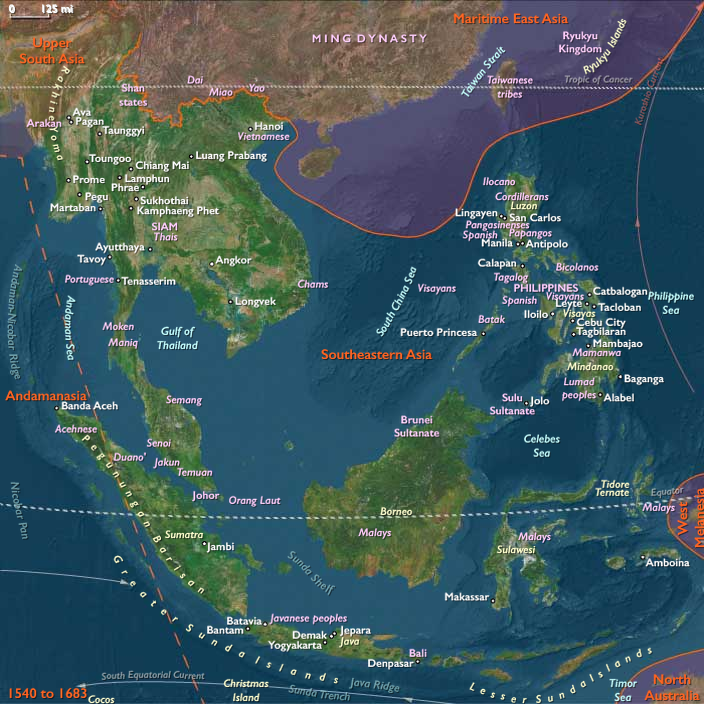
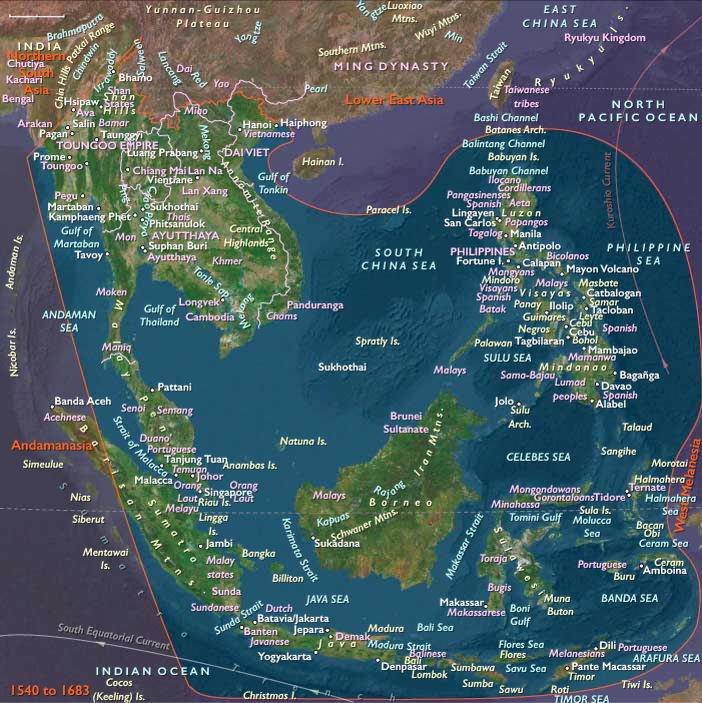
Yamada Nagamasa had visited Japan in 1629 with an embassy from King Songtham, who had died shortly after his departure.
Having fought successfully for Ayuttahya, he is finally nominated Lord of Ligor (modern Nakhon Si Thammarat), in the southern peninsula in 1630, accompanied by three hundred samurai.
Becoming involved in the succession war following the death of Songtham, Yamada is wounded in combat in 1630, then apparently poisoned through his wound, which leads to his death.
Following Yamada's death in 1630, the usurper Prasat Thong sends an army of four thousand soldiers to destroy the Japanese settlement in Ayutthaya, but many Japanese manage to flee to Cambodia.
Locations
People
Groups
Commodoties
Subjects
Regions
Subregions
Related Events
Filter results
Showing 10 events out of 32637 total
Huang Taiji had publicly stated that he would never be able to beat Yuan in a fair game, thus, making the Chongzhen Emperor kill him had been the only method to get rid of him.
When the message of Yuan's death reaches Huang Taiji, he changes the name of the manchu state from Jin to Qing and proclaims himself Emperor Qing Taizong.
Some historical information states that Huang Taiji feared Yuan's last word stating his soul will always guard Liaodong Peninsula: As the name Chonghuan means Undying Flames, containing the element "Fire", Huang Taiji had chosen the word Qing, meaning cleanse, which contains the element "Water", to overcome it; however, even if this is the case, the main reason is probably because the "Ming" of the Ming Dynasty contains the element "Fire" itself.
The Chongzhen Emperor orders Yuan’s arrest during an interview on January 13, 1630.
He is accused, without much evidence, of collusion with the enemy and condemned to the "death by a thousand cuts" at Ganshiqiao in Beijing.
When Yuan is asked for last words before his execution, he produces the poem: "A life's work always ends up in vain; half of my career seems to be in dreams. I do not worry about lacking brave warriors after my death, for my loyal spirit will continue to guard Liaodong."
His family is resettled.
He is left there after the torture, shouting for half a day and then stops.
It is said that because of his "betrayal", many Beijing citizens hated him so much that they rushed to buy his body parts so they could eat them.
His head, the only recognizable part after the torture, is taken outside the Inner City Wall by a city guard, whose surname is She, and buried near Guanqu Men.
The guard's family have guarded it from one generation to the next ever since.
Yuan is mourned throughout most of the country outside Beijing and even in Korea; with his death many now regard the Ming Dynasty and its allies as highly vulnerable.
Protestant Sweden, with the encouragement of Catholic France, concludes a truce with Catholic Poland, its rival in the Baltic.
King Sigismund’s thirty-year war with the Swedes has cost him most of Polish Livonia.
King Gustavus Adolphus, like Christian IV before him, comes to aid the German Lutherans, to forestall Catholic aggression against their homeland, and to obtain economic influence in the German states around the Baltic Sea.
In addition, Gustavus is concerned about the growing power of the Holy Roman Empire.
No one knows the exact reason for Gustavus to enter the war and this will long be widely argued.
Like Christian IV, Gustavus is subsidized by Cardinal Richelieu, the Chief Minister of Louis XIII of France, and by the Dutch Republic.
Bartsch, who had married Johannes Kepler's daughter Susanna on March 12, 1630, has helped Kepler with his calculations.
After Kepler's death in 1630, Bartsch edits Kepler's posthumously published work Somnium.
He also helps gather money from Kepler's estate for his widow.
Fifty people accused of witchcraft are executed between November 1628 and August 1630 at Reichertsofen an der Paar, in the district of Neuburg, after which the witch-hunting madness evaporates.
Control of the Ottoman state treasury has by the end of the first quarter of the sixteenth century largely passed, through land grants, into the hands of local a'yan, who will gradually become the real rulers, serving local rather than imperial interests.
Discontinuance of the devsirme and the rise of hereditary succession to imperial offices have meanwhile shut off new sources of vitality.
Monarchs, confined to the palace during their youth, become weaker and participate less in military affairs and government councils.
Sultan Murad IV is as early as 1630 presented by one of his advisers with a memorandum explaining the causes of the perceived decline and urging a restoration of the system as it had existed under Süleyman.
A second Ottoman campaign to recover Persian-held areas, mounted in 1629, fails in 1630 due to weather conditions.
Later in this year, however, the Turks are victorious success in the Battle of Mihriban and sack of Hamadan, ...
...but are turned back by the Persian defenders of Baghdad.
Jusepe de Ribera, born near Valencia, Spain at Xátiva, had been intended by his parents for a literary or learned career, but he had neglected these studies and is said to have apprenticed with the Spanish painter Francisco Ribalta in Valencia, although no proof of this connection exists.
Longing to study art in Italy, he had made his way to Rome via Parma, where he is recorded in 1611.
According to one source, a cardinal noticed him drawing from the frescoes on a Roman palace facade, and housed him.
Roman artists gave him the nickname "Lo Spagnoletto."
He became a follower of Caravaggio's style, one of the so-called Tenebrosi, or shadow-painters, owing to the sharp contrasts of light and shade marking their style.
He traveled to Parma, where he completed a painting on the subject of Jacob's Ladder, now in the Prado Museum, Madrid.
Ribera lived in Rome from 1613-16, on the Via Margutta, and associated with other Caravaggisti, including Gerrit van Honthorst and Hendrik ter Brugghen.
He then moved to Naples, to avoid his creditors, according to Giulio Mancini, who described him as extravagant.
He may also have already arranged his marriage, to the daughter of a Neapolitan painter, Giovanni Bernardino Azzolino, in November, 1616.
The Kingdom of Naples, at this time part of the Spanish Empire, has been ruled by a succession of Spanish Viceroys.
Ribera's Spanish nationality aligns him with the small Spanish governing class in the city, and also with the Flemish merchant community, from another Spanish territory, who include important collectors of and dealers in art.
Ribera has begun to sign his work as "Jusepe de Ribera, Español" or "Jusepe de Ribera, Spaniard".
He had been able to quickly attract the attention of the Viceroy, the Duke of Osuna, also recently arrived, who had given him a number of major commissions, which showed the influence of Guido Reni.
The period after Osuna was recalled in 1620 seems to have been difficult.
Few paintings survive from 1620 to 1626; but this was the period in which most of his best prints were produced.
These were at least partly an attempt to attract attention from a wider audience than Naples.
His career had picked up by the late 1620s, and he is accepted as the leading painter in Naples from this point forward.
Although Ribera will never return to Spain, many of his paintings will be taken back by returning members of the Spanish governing class, for example the Duke of Osuna, and his etchings are brought to Spain by dealers.
His influence can be seen in Velázquez, Murillo, and most other Spanish painters of the period.
In his earlier style, founded sometimes on Caravaggio and sometimes on the wholly diverse method of Correggio, the study of Spanish and Venetian masters can be traced.
Along with his massive and predominating shadows, he retains from first to last a great strength in local coloring.
His forms, though ordinary and sometimes coarse, are correct; the impression of his works gloomy and startling.
He delights in subjects of horror.
He is an important etcher, the most significant Spanish printmaker before Goya, producing about forty prints, nearly all in the 1620s.

The site on the Piazza Barberini in Rome's Rione Trevi had formerly been occupied by a garden-vineyard of the Sforza family, in which a palazzetto had been built in 1549.
The sloping site had passed from one cardinal to another during the sixteenth century, with no project fully getting off the ground.
When Cardinal Alessandro Sforza met financial hardships, the still semi-urban site had been purchased in 1625 by Maffeo Barberini, of the Barberini family, who had then taken the papal throne as Pope Urban VIII.
Three great architects work to create the Palazzo Barberini, each contributing his own style and character to the building.
Carlo Maderno, then at work extending the nave of St. Peter's, had been commissioned to enclose the Villa Sforza within a vast Renaissance block along the lines of Palazzo Farnese; however, the design has quickly evolved into a precedent-setting combination of an urban seat of princely power combined with a garden front that has the nature of a suburban villa with a semi-enclosed garden.
Maderno had begun in 1627, assisted by his nephew Francesco Borromini.
When Maderno died in 1629, Borromini had been passed over and the commission awarded to Bernini, a young prodigy at this time better known as a sculptor.
Borromini had stayed on regardless and the two architects had worked together, albeit briefly, on this project and at the Palazzo Spada.