
Xuanzang travels up the river to Srughna …
Years: 635 - 635
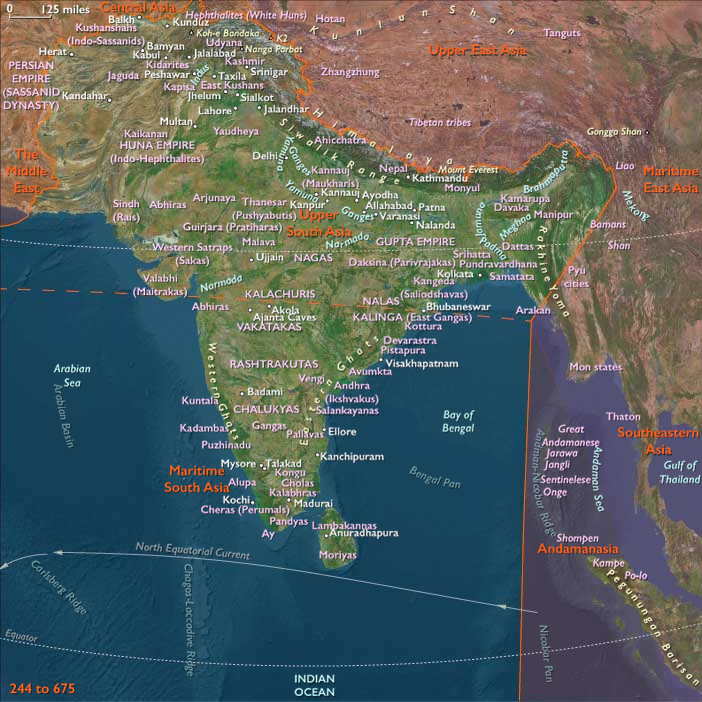
Xuanzang travels up the river to Srughna before crossing eastward to Matipura, where he arrives in 635, having crossed the river Ganges.
At Matipura Monastery, Xuanzang studies under Mitrasena.
From here, …
Locations
People
Groups
- Hinduism
- Jainism
- Kashmir, Kingdom of
- Buddhism
- Buddhists, Theravada
- Buddhism, Mahayana
- Western Turkic Khaganate
- Harsha (Harsavardhana), Empire of (Thaneswar)
- Chinese Empire, Tang Dynasty
Topics
Subjects
Regions
Subregions

Related Events
Filter results
Showing 10 events out of 56659 total
The first Christian missionaries arrive in China: Alopen, bishop of the Assyrian Church of the East, whose name is known only from the Chinese of the Nestorian Stele, introduces Nestorian Christianity to the Tang Dynasty.
According to the Stele, Alopen and his fellow missionaries came to China from Daqin (or Ta Tsin—the Roman Empire) in the ninth year of Emperor Taizong (635), bringing sacred books and images.
He would have come to China via the Silk Road.
The Nestorian mission benefits from Taizong's policy of religious tolerance, which reverses measures his father Gaozu had taken against Buddhism and other foreign religions and influences.
According to the Stele, Taizong welcomed Alopen and arranged for the translation of the holy writings he had brought with him at the Imperial Library.
Upon studying them, Taizong, a great scholar and patron, found them most acceptable and arranged for their dissemination.
Indeed, four documents from the early period of Christianity in China (the Jesus Sutras) date to around Alopen's time.
Heraclius, now around sixty and unpopular with the Chalcedonian Church, is broken in body and spirit by disease, by long years of the cares of state, and by the wounds and emotions of a hundred battles.
Although the sight of the emperor in battle armor would have inspired the troops and silenced the bickering generals, he does not take personal command of the army to resist the Muslim Arab conquest of Syria and Palestine.
He sends his brother Theodore to assemble forces to retake the newly won Muslim territories.
Monophysites and Jews throughout Syria welcome the Arab invaders, as they are discontent with Constantinople’s rule.
…Xuanzang heads south to Sankassa (Kapitha), said to be where Buddha descended from heaven, then onward to …
…the northern Indian emperor Harsha's grand capital of Kanyakubja (Kannauj).
Dagobert I Founds the Abbey of Saint-Denis (635 CE)
In 635 CE, King Dagobert I establishes the Abbey of Saint-Denis in the suburbs of Paris, dedicating it to Saint Denis, the third-century martyr and first Bishop of Paris, venerated as the Apostle of France. This act strengthens the connection between the Merovingian monarchy and the Church, reinforcing Paris as a religious and political center.
1. The Importance of Saint Denis
- Saint Denis, a third-century missionary and bishop, was believed to have been beheaded by Roman authorities on Montmartre.
- According to legend, he carried his severed head several miles before collapsing at the site where the abbey was built.
- He became one of the most revered saints in Frankish Christianity, symbolizing royal protection and divine favor.
2. The Abbey as a Royal Burial Site
- Dagobert chooses Saint-Denis as the future royal necropolis, ensuring that it becomes the burial site for Frankish kings.
- He himself is later buried at Saint-Denis in 639 CE, beginning a tradition that will continue through the Carolingians and Capetians, making the abbey the final resting place of French royalty for centuries.
3. The Political and Religious Significance
- The foundation of Saint-Denis Abbey reinforces the Merovingian monarchy’s alliance with the Church, securing ecclesiastical support for royal authority.
- It helps elevate Paris as a central religious city, further strengthening Frankish identity around Catholicism.
- The abbey later becomes one of the most important monastic institutions in medieval France, serving as a center for learning, pilgrimage, and royal ceremonies.
Conclusion: A Lasting Symbol of French Kingship
Dagobert I’s foundation of the Abbey of Saint-Denis in 635 CE marks a pivotal moment in Frankish religious and political history. By dedicating it to France’s patron saint, he establishes a spiritual and dynastic center that will endure as the primary royal burial site and a symbol of the sacred nature of kingship in medieval France.
Judicael of Domnonée Submits to Dagobert I but Insults Him (635–636 CE)
Around 635–636 CE, Judicael, High King of Domnonée in northern Brittany, travels to King Dagobert I's palace in Clichy to pledge allegiance to the Frankish crown. Under threat of invasion, he submits to Frankish lordship and arrives bearing gifts, yet insults Dagobert by refusing to dine at the royal table, highlighting the tense relationship between the Franks and the Bretons.
1. Domnonée: A Breton Kingdom with British Roots
- Domnonée was founded in the fourth century by Romano-British migrants from Dumnonia (modern Devon and Cornwall), who fled Anglo-Saxon incursions.
- By the early seventh century, Domnonée had become a strong Breton kingdom, resisting Frankish expansion into Brittany.
- Judicael, as its high king, sought to preserve Breton autonomy despite increasing Frankish pressure.
2. The Meeting at Clichy: A Forced Submission
- Facing the threat of a Frankish invasion, Judicael reluctantly agrees to meet Dagobert I at his palace in Clichy, northwest of Paris.
- He arrives with diplomatic gifts, signifying his formal submission to Frankish overlordship.
- This meeting demonstrates Frankish dominance over Brittany, at least nominally, reinforcing the kingdom’s tributary status.
3. The Insult: Judicael Refuses to Dine with Dagobert
- Despite his submission, Judicael offends Dagobert by refusing to eat at the royal table, an act seen as a direct insult to the Frankish king.
- This gesture of defiance may have been an attempt to assert Breton independence, signaling that while he acknowledged Frankish supremacy, he would not fully integrate into the Frankish court culture.
- Dagobert, though angered, does not immediately retaliate, likely calculating that military intervention in Brittany would be costly and ineffective.
4. The Aftermath and Breton Autonomy
- Though Judicael pledges fealty to Dagobert, his actions suggest that Brittany remains largely autonomous, despite Frankish claims of overlordship.
- The Bretons continue to resist full Frankish integration, maintaining their distinct cultural and political identity well into the medieval period.
- Later, Brittany will again challenge Frankish rule, with the struggle for control over the peninsula persisting into the Carolingian era.
Conclusion: A Diplomatic Victory with Lingering Tensions
Judicael’s visit to Clichy (635–636 CE) represents a temporary submission of Domnonée to Frankish rule, but his refusal to dine with Dagobert I signals continued Breton resistance to foreign domination. This episode exemplifies the complex relationship between the Franks and the Bretons, where military threats secured political pledges, but cultural and regional autonomy remained intact.
The Political Structure of Brittany and Its Relationship with the Franks (6th–7th Century CE)
Throughout the sixth and seventh centuries, the Bretons were divided into several minor kingdoms (regna), of which the best known—according to Gregory of Tours—were:
- Domnonée (Domnonia) – Likely the chief kingdom, originating from Dumnonian migrants from Britain.
- Cornouaille – Centered in western Brittany, corresponding to modern Cornouaille.
- Gwened (Vannes/Venetis) – A key coastal power, often in conflict with the Franks.
While initially acknowledging Frankish overlordship under Clovis I and Childebert I, the Bretons made multiple attempts to resist Frankish rule, particularly during the reign of Chilperic I, who subdued Waroch II and reasserted Frankish dominance over eastern Brittany.
By the seventh century, under Guntram and Dagobert I, Brittany remained a Frankish tributary-vassal state, though it retained de facto autonomy under its local kings.
1. Domnonée’s Rise as the Chief Breton Kingdom
- By the early seventh century, Domnonée appears to have consolidated power over neighboring Breton territories, including Broweroch.
- The rulers of Domnonée likely continued as High Kings of the Bretons, giving them a dominant political status in the region.
- Domnonian kings are now listed as “Kings of the Bretons”, reinforcing their supremacy over the other minor kingdoms.
2. King Judicael: The High King of the Bretons (c. 610–640 CE)
- According to the Chronicle of Fredegar, the reigning King of the Bretons at this time was Judicael, son of Hoel III (580–612 CE).
- It is highly probable that he was the same Judicael known from Breton tradition, who ruled Domnonée and expanded his authority over Brittany.
- This would mean that Domnonée had effectively absorbed Broweroch, and Judicael had become the High King of Brittany.
3. Judicael’s Dealings with Dagobert I and Eligius
- Judicael’s increased power likely explains why he was involved in diplomatic interactions with King Dagobert I and Saint Eligius, a Frankish court official.
- His meeting with Dagobert at Clichy (635–636 CE) suggests that he was recognized as the principal ruler of the Bretons, pledging nominal submission to the Frankish crown while retaining internal autonomy.
4. The Lasting Impact of Domnonian Supremacy
- Domnonée’s dominance over Brittany during this period set a precedent for later Breton rule, where the title “King of the Bretons” would continue to be used.
- Though Brittany remained a tributary to the Franks, it resisted full integration, maintaining a distinct identity and political independence.
- The struggle between Breton autonomy and Frankish overlordship would continue for centuries, shaping the future of medieval Brittany.
Conclusion: The Unification of Brittany Under Domnonée
The evidence suggests that by the seventh century, Domnonée had effectively become the chief Breton state, with Judicael serving as High King of the Bretons. His dealings with Dagobert I and Saint Eligius reflect Brittany’s continued vassalage to the Franks, but also its strong regional identity and resistance to direct Frankish control. This period marks an important phase of consolidation for the Breton kingdoms, setting the stage for their ongoing struggle for independence in the medieval era.
King Meurig of Glywysing and Gwent reunites his kingdom with Ergyng (Archenfield), lying mostly in what is now western Herefordshire, by marrying Onbrawst, the daughter of Gwrgan Fawr (the Great), the ruler of this kingdom.
He will later be claimed to have been a great patron of the ecclesiastical center at Llandaff, where he is said to be buried.
Meurig is the father of Athrwys ap Meurig, one of a number of figures that researchers have claimed as the "real King Arthur".
Athrwys is believed to have predeceased Meurig, who will be succeeded by his grandsons, Ithel and Morgan Mwynfawr.
The first battle in Palestine between the Muslims and the Christians takes place in 635 at Wadi al-'Arabah, south of the Dead Sea.
The Roman defenders are defeated and retreat toward Gaza but are overtaken and almost annihilated.
The Muslim Arabs under 'Amr ibn al-'As take Gaza, the principal Jewish community in Palestine, and make it a Muslim city. (Gaza has long been an important center of Islamic tradition and is the reputed site of the burial place of Hashim ibn 'Abd Manaf, great-grandfather of the Prophet Muhammad. It will become the first city in Palestine to develop into a center of Islamic law.)
In other places, the defenders' natural advantages are more effective and the invaders are hard pressed.
Theodore Trithyrius, based in Antioch, is a Greek Christian treasurer working for the authority of Emperor Heraclius and extremely loyal to the emperor himself.
He enjoys supremacy under his title of sacellarius, usually appointed to the state treasurer.
The emperor had in 634 sent his brother Theodore to fight the invading armies of Muslims in Ajnadayn, where he had been decisively defeated.
On his retreat, Theodore had blamed his brother's incestuous marriage to their niece Martina for the defeat of the Empire’s forces and delved into an argument with him.
Heraclius had stripped him of his command and sent him to Constantinople.
With Theodore gone, Heraclius had appointed Trithyrius to take lead as the commander of his brother's army.
Circumstances are beginning to take a serious toll in 635, however, as the imperial armies has failed considerably in other battles.
This is partly due to financial setbacks and the empire failing to provide salaries for the troops.
For most times, Trithyrius's role with the army serves constant reassurance.
A certain lassitude has filled the air and Heraclius has to disband many regiments for economy's sake.
There is no enthusiasm towards joining the army, however, as the presence of the imperial paymaster encourages mercenary recruitment.
In the Battle of Fahl in January 635, the Rashidun army of thirty thousand men under Khalid defeats the imperial forces led by Theodore Trithyrius at Pella in the Jordan Valley.
Years: 635 - 635
Locations
People
Groups
- Hinduism
- Jainism
- Kashmir, Kingdom of
- Buddhism
- Buddhists, Theravada
- Buddhism, Mahayana
- Western Turkic Khaganate
- Harsha (Harsavardhana), Empire of (Thaneswar)
- Chinese Empire, Tang Dynasty
