
Bernini completes work on the Palazzo Barberini …
Years: 1633 - 1633
Bernini completes work on the Palazzo Barberini by 1633.
The palazzo is disposed around a forecourt centered on Bernini's grand two-story hall backed by an oval salone, with an extended wing dominating the piazza, which lies on a lower level.
At the rear, a long wing protects the giardino segreto ("secret garden"), from the piazza below, above which it rises from a rusticated basement that is slightly battered like a military bastion.
The main block presents three tiers of great arch-headed windows, like glazed arcades, a formula that is more Venetian than Roman.
On the uppermost floor, Borromini's windows are set in a false perspective that suggests extra depth, a feature that will be copied into the twentieth century.
Flanking the hall, two sets of stairs lead to the piano nobile, a large squared staircase by Bernini to the left and a smaller oval, or helicoidal, staircase by Borromini to the right.
Aside from Borromini's false-perspective window reveals, among the other influential aspects of Palazzo Barberini, ones that will be repeated throughout Europe, are the unit of a central two-story hall backed by an oval salone and the symmetrical wings that extended forward from the main block to create a cour d'honneur.
The Salon ceiling is graced by Pietro da Cortona's masterpiece, the Baroque fresco of the Allegory of Divine Providence and Barberini Power.
This vast panegyric allegory is to become highly influential in guiding decoration for palatial and church ceilings; its influence can be seen in other panoramic scenes such as the frescoed ceilings at Sant'Ignazio (by Pozzo); or those at Villa Pisani at Stra, the throne room of the Royal Palace of Madrid, and the Ca' Rezzonico in Venice (by Tiepolo).
Also in the palace is a masterpiece of Andrea Sacchi, a contemporary critic of the Cortona style, Divine Wisdom.
Today Palazzo Barberini houses the Galleria Nazionale d'Arte Antica, one of the most important painting collections in Italy, and is home also to the Italian Institute of Numismatics.
Recently found hidden in the cellars of the rear part of the building is a Mithraeum, dating probably from the second century CE.
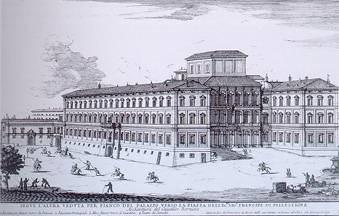
Palazzo Barberini in an 18th-century engraving: its entrance court is a public space.
Locations
People
Groups
Topics
Subjects
Regions
Subregions
Years: 1633 - 1633
Palazzo Barberini in an 18th-century engraving: its entrance court is a public space.
Locations
People
Groups
Topics
Subjects
Regions
Subregions