Catalonia’s vigorous school of painting culminates in Bartolome Bermejo’s dark, brooding “Pietá,” painted in 1490.
Bermejo, whose real name is Bartolomé de Cárdenas, was born in Córdoba.
He is first documented in a first payment issued in Valencia in 1468 when a patron, Antonio Juan, commissioned him to paint the altarpiece of the church of San Miguel in Tous, in Valencia (the central panel of which is currently housed in the National Gallery, London).
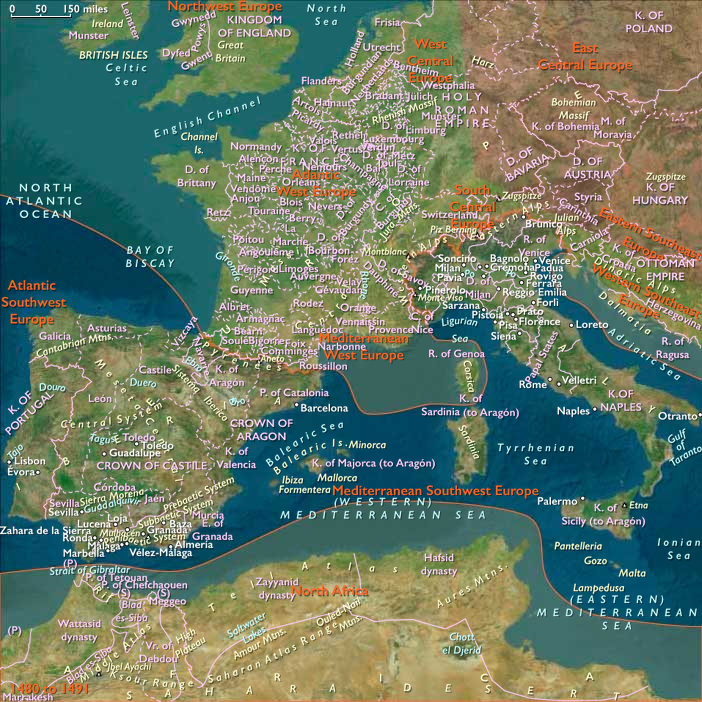
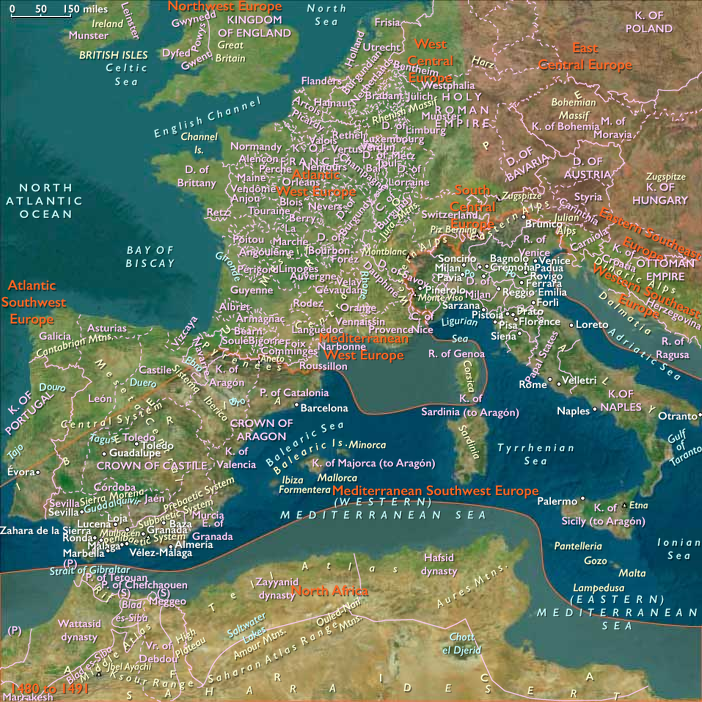
He is active in four cities of the Crown of Aragon: Valencia, Daroca (1474), Zaragoza (1477–84) and Barcelona (1486–1501).
Although it is unclear where Bermejo received his training, his complete mastery of the oil glaze technique suggests direct contact with fifteenth century Flemish painting, which he is able to adapt perfectly to the demands of Spanish altarpieces of the period.
He never settles in any one place for more than a decade, and his one work for which there exists a contract (1474), the Retable of Santo Domingo de Silos, painted for the church by that name in Daroca, had been left incomplete when he had moved on to Zaragoza, where a second contract had to be made (1477), in collaboration with the local painter Martín Bernat.
Previously, in Daroca Bermejo had married a local widow, Gracia de Palanciano, and produced at least two other works, the Dead Christ with Angels for a local merchant, Johan de Loperuelo (now Museu del Castell de Perelada) and the Retable of Saint Engracia (various museums in Spain and the U.S.).
Bermejo's seven-year residence in Zaragoza produced at least one additional altarpiece in collaboration with Martín Bernat and he also was part of a team that polychromed the alabaster High Altar Retable of Zaragoza Cathedral.
An undocumented return to Valencia around 1485 had resulted in the production of a Flemish-style Triptych of the Virgin of Montserrat, for Francesco della Chiesa, an Italian merchant, for the family chapel in Acqui Cathedral.
This was again a collaboration: Bermejo painted the central panel, while the wings were completed by the Valencian master Rodrigo de Osona.
Bermejo's later years are spent in Barcelona, where he works on the High Altar Retable (destroyed in 1936) for the convent church of Santa Anna, and completes his masterwork for Canon Lluís Desplà i Oms' private chapel, the Pietà (1490), which contains the donor's portrait.
Other documents in Barcelona concern designs for stained-glass windows.
Beyond his skill in oil glaze painting, Bermejo's distinctive style can be seen in his physical types, a lively sense of drama in his narrative scenes, and above all in his attention to landscape, particularly in the extensive sunrise and sunset settings in the Triptych of the Virgin of Montserrat and the Pietà.
Bermejo's distinctive style has a considerable influence, particularly in Aragon, where it is widely disseminated in the prolific studio of Martín Bernat.
No one at this time, however, can duplicate his landscapes.
There are three surviving works that incorporate the artist's name within the compositions, still unusual in Spanish painting of this period: Saint Michael with Kneeling Donor, Antonio Juan); the Triptych of the Virgin of Montserrat with Donor, Francesco della Chiesa; and the Pietà with Canon Desplà.
The first two bear the artist's name on simulated parchment, and the last is found in an inscription on the frame.
Indirect evidence also speaks of royal patronage, for an Epiphany now in the Royal Chapel of Granada was part of the personal collection of Isabella I of Castile.