
Winfrid-Boniface has labored in Hesse, Thuringia and …
Years: 723 - 723
Winfrid-Boniface has labored in Hesse, Thuringia and Frisia for five years, and in late 722 had been recalled by Gregory to Rome to be consecrated as a bishop; the pope, who has greatly encouraged the Christianizing of Germany, also had given him the name Boniface, by which he is henceforth to be known.
The pope also provides him with a collection of canons (ecclesiastical regulations) and letters of recommendation to such important personages as Charles, master of the Frankish kingdom, whose protection is essential to Boniface's success.
He returns to his missionary work in Germany the following year.
Veneration of sacred groves and sacred trees is found throughout the history of the Germanic peoples and were targeted for destruction by Christian missionaries during the Christianization of the Germanic peoples.
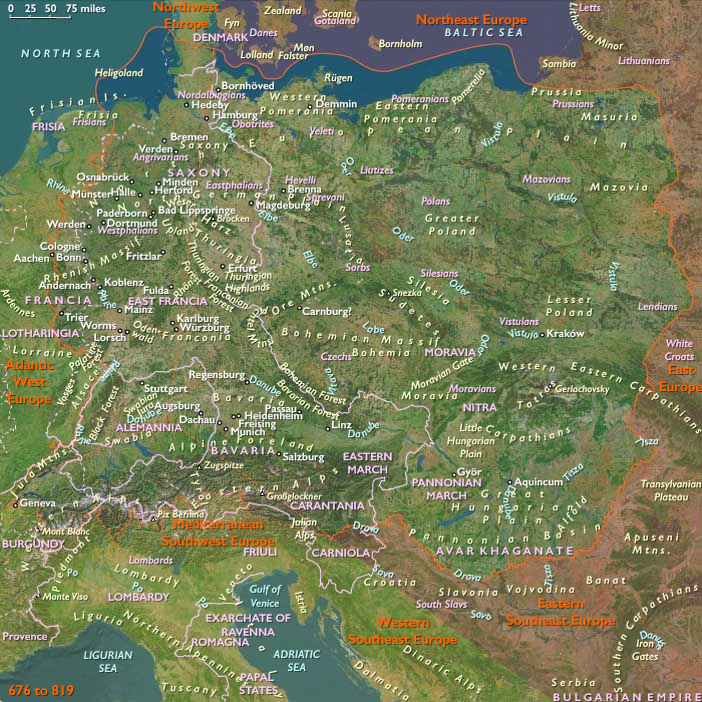
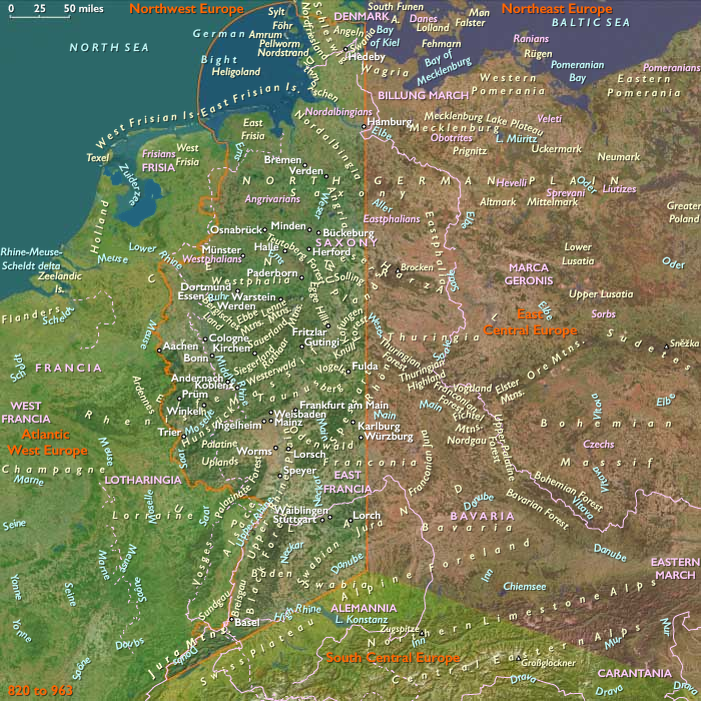
On his arrival in northern Hesse, Boniface, cloaked by the pagan awe of Charles's name, fells the sacred oak tree dedicated to the Germanic god Thor at Geismar near the present-day town of Fritzlar.
He builds a chapel from its wood at the site where today stands the cathedral of Fritzlar.
The felling of Thor's Oak, an ancient tree sacred to the Germanic tribe of the Chatti, is commonly regarded as the beginning of German Christianization.
Locations
People
Groups
- Polytheism (“paganism”)
- Franks
- Chatti (Germanic tribe)
- Christianity, Chalcedonian
- Benedictines, or Order of St. Benedict
- Francia (mayors of the palaces of Austrasia and Neustria)
Topics
Commodoties
Subjects
Regions
Subregions
Years: 723 - 723
Locations
People
Groups
- Polytheism (“paganism”)
- Franks
- Chatti (Germanic tribe)
- Christianity, Chalcedonian
- Benedictines, or Order of St. Benedict
- Francia (mayors of the palaces of Austrasia and Neustria)
Topics
Commodoties
Subjects
Regions
Subregions