
The Birth and Early Years of William …
Years: 1035 - 1035
The Birth and Early Years of William of Normandy (1027/1028–1035)
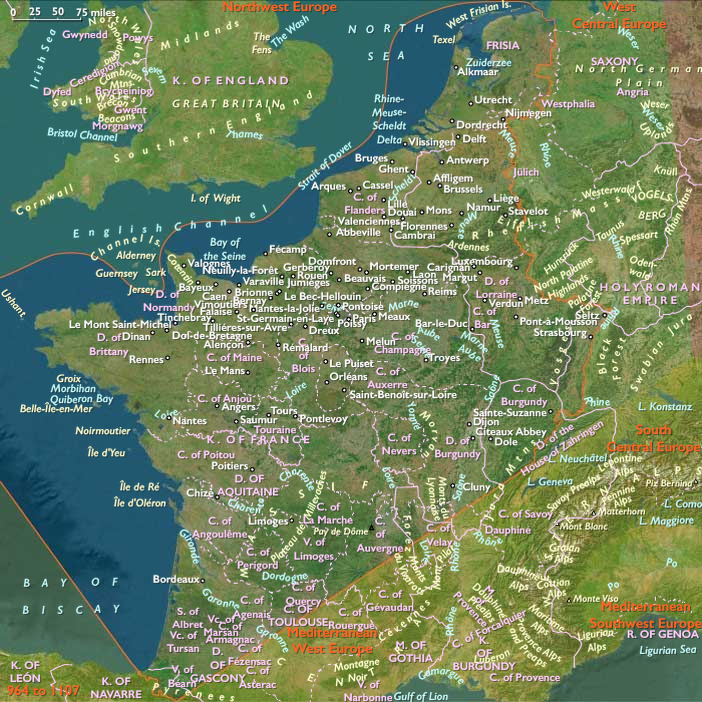
William of Normandy, later known as William the Conqueror, was born in late 1028 at Falaise, Normandy. He was the only son of Duke Robert I of Normandy and Herleva, the daughter of Fulbert of Falaise, who may have been a tanner or embalmer. William’s illegitimacy would later shape his early challenges and struggles for power.
William’s Parentage and Family Connections
- His mother, Herleva, was possibly a member of the ducal household but never married Robert.
- After William’s birth, Herleva married Herluin de Conteville, with whom she had two more sons:
- Odo of Bayeux (later Bishop of Bayeux and one of William’s key allies).
- Robert, Count of Mortain (another future supporter of William).
- One of Herleva’s brothers, Walter, would become an important protector of William during his minority.
- Robert also had a daughter, Adelaide of Normandy, by another mistress.
Robert I’s Controversial Accession (1027)
- Robert I became Duke of Normandy on August 6, 1027, succeeding his elder brother Richard III, who had ruled for only a year.
- Robert and Richard had been at odds over the succession, and Richard’s sudden death in 1027 led some to accuse Robert of murdering his brother, a plausible but unproven charge.
- Normandy, already unstable, was further weakened by internal feuds and external threats, including:
- Noble families seizing Church lands.
- Alan III of Brittany waging war against the duchy, possibly attempting to take control of Normandy.
Norman Political Landscape and Supporters
By 1031, Robert had secured the loyalty of several key noblemen, who would later play major roles in William’s rise:
- Robert, Archbishop of Rouen, Robert’s uncle, who had initially opposed him.
- Osbern, a nephew of Gunnor, wife of Duke Richard I, who became William’s steward and guardian.
- Count Gilbert of Brionne, a grandson of Richard I, another future protector of William.
Robert continued to support the exiled English princes, Edward and Alfred, in their bid to reclaim the English throne. There are indications that he may have been briefly betrothed to a daughter of King Cnut, but no marriage took place.
William’s Status as Heir and Robert’s Pilgrimage (1035)
- Earlier Norman dukes had been illegitimate, so William’s status as Robert’s only son made him the likely heir.
- William’s association in ducal charters suggests that he was already recognized as Robert’s successor.
- In 1034, Robert, possibly seeking penance for past actions, began to donate generously to the poor and undertook to rebuild Rouen Cathedral.
- That same year, Robert decided to go on pilgrimage to Jerusalem, despite his nobles urging him not to go.
- In January 1035, Robert convened a council of Norman magnates and had them swear fealty to William as his heir before departing for the Holy Land.
- Before leaving, Robert appointed his cousin, Alan III of Brittany, as guardian of young William.
Robert I’s Death and William’s Precarious Succession (1035)
- Robert died in early July 1035 at Nicaea, on his way back from Jerusalem.
- His death left William, a boy of about seven or eight, as Duke of Normandy, setting the stage for one of the most dangerous and chaotic minorities in medieval history.
William’s early years as Duke would be marked by anarchy, as rival Norman nobles contested his rule, leading to decades of instability before his eventual consolidation of power.
Locations
People
- Alan III of Brittany
- Alfred Ætheling
- Cnut the Great
- Edward the Confessor
- Malcolm II of Scotland
- Robert I, Duke of Normandy
- William the Conqueror
Groups
- Anglo-Saxons
- Christianity, Chalcedonian
- Denmark, Kingdom of
- Danes (Scandinavians)
- Normandy, Duchy of
- Brittanny, Duchy of
- Normans
- England, (Danish) Kingdom of
- North Sea Empire
Commodoties
Subjects
Regions

Subregions
Related Events
Showing 10 events out of 51491 total
Years: 1035 - 1035
Locations
People
- Alan III of Brittany
- Alfred Ætheling
- Cnut the Great
- Edward the Confessor
- Malcolm II of Scotland
- Robert I, Duke of Normandy
- William the Conqueror
Groups
- Anglo-Saxons
- Christianity, Chalcedonian
- Denmark, Kingdom of
- Danes (Scandinavians)
- Normandy, Duchy of
- Brittanny, Duchy of
- Normans
- England, (Danish) Kingdom of
- North Sea Empire
Commodoties
Subjects
Regions
Subregions