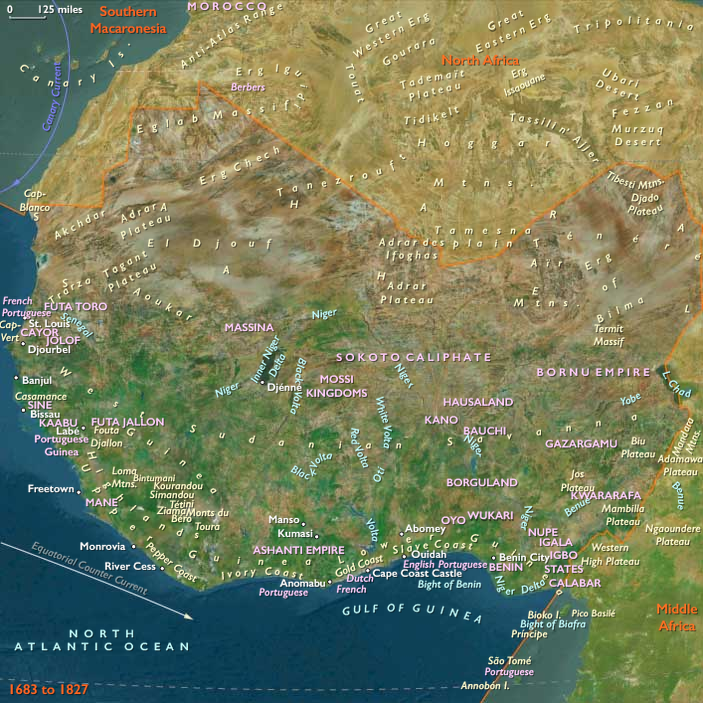
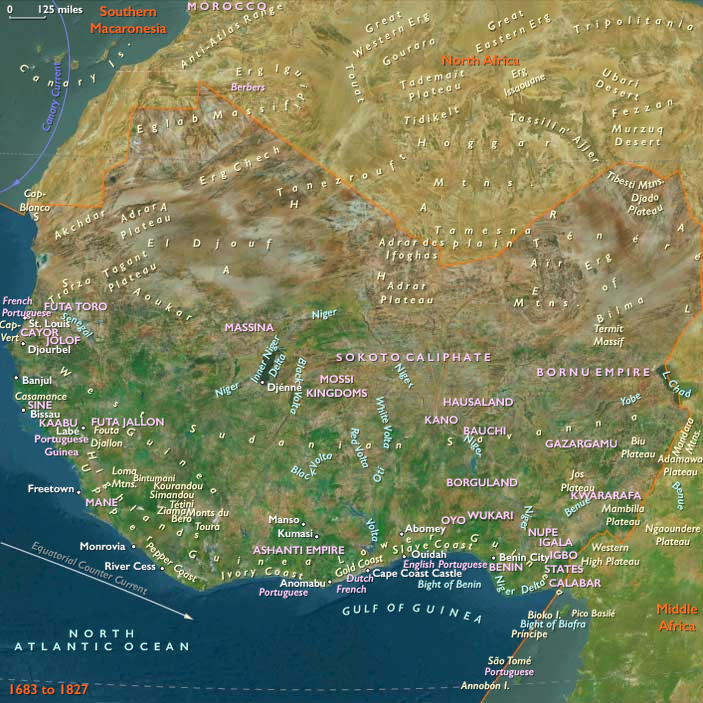
This success convinces Pitt to launch two …
Years: 1758 - 1758
The loss of these valuable colonies further weaken the French economy.
Locations
People
Groups
- France, (Bourbon) Kingdom of
- Britain, Kingdom of Great
- East India Company, British (United Company of Merchants of England Trading to the East Indies)
Topics
Subjects
Regions
Subregions
Related Events
Filter results
Showing 10 events out of 26586 total
He orders the generals to kill all the men in Barkol or Suzhou, and divides their wives and children among the Qing soldiers.
In his account of the war, Qing scholar Wei Yuan, writes that about forty percent of the Dzungar households were killed by smallpox, twenty percent fled to Russia or the Kazakh Khanate, and thirty percent were killed by the army, leaving no yurts in an area for several thousand li, except those of the surrendered.
Qing Bannermen and Mongol cavalry made up the initial expeditionary army.
As the campaigns progressed, tens of thousands of Green Standard infantrymen were also brought in.
The men, women and children of the Dzungars were all slaughtered by Manchu soldiers according to Russian accounts.
The Dzungars had conquered and subjugated the Uyghurs during the Dzungar conquest of Altishahr, after being invited by the Afaqi Khoja to invade.
Heavy taxes had been imposed upon the Uyghurs by the Dzungars, with women and refreshments provided by the Uyghurs to the tax collectors.
Periodically, Uyghur women were gang raped by the tax collectors when the amount of tax was not satisfactory.
Anti-Dzungar Uyghur rebels from the Turfan and Hami oases submitted to Qing rule as vassals and requested Qing help for overthrowing Dzungar rule.
Uyghur leaders like Emin Khoja were granted titles within the Qing nobility, and these Uyghurs helped supply the Qing military forces during the anti-Dzungar campaign.
The Qing employ Khoja Emin in its campaign against the Dzungars and use him as an intermediary with Muslims from the Tarim Basin, to inform them that the Qing only seek to kill Oirats (Dzungars), and that they will leave the Muslims alone.
It will not be until generations later that the population of Dzungaria begins to rebound.
Apart from the remaining Dzungars, they are also joined by the Kyrgyz peoples and the Oases Turkic peoples (Uyghurs) in Altishahr.
After capturing several towns in Altishahr, there are still two rebel fortresses at Kashgar and ...
Uyghur Muslims from Turfan and Hami, including Emin Khoja and Khoja Si Bek, remain loyal to the Qing Empire and help the Qing regime fight the Altishahri Uyghurs under Burhān al-Dīn and Khwāja-i Jahān.
Zhaohui unsuccessfully besieges Yarkand and fights an indecisive battle outside the city; this engagement is historically known as the Battle of Tonguzluq.
Zhaohui instead takes other towns east of Yarkand but is forced to retreat; the Dzungar and Uyghur rebels lay siege to him at the Siege of Black River (Kara Usu).
The Heavenly Doctrine, one of Emanuel Swedenborg's lesser known works, presents a startling claim, that the Last Judgment had begun in the previous year (1757) and was completed by the end of that year and that he had witnessed it.
According to the Last Judgment took place, not in the physical world, but in the World of Spirits, which is located halfway between heaven and hell, and which everyone passes through on their way to heaven or hell.
The Judgment had taken place because the Christian church had lost its charity and faith, resulting in a loss of spiritual free will that threatened the equilibrium between heaven and hell in everyone’s life.
The Heavenly Doctrine also teaches that the Last Judgement was followed by the Second Coming of Jesus Christ, which occurred, not by Christ in person, but by a revelation from Him through the inner, spiritual sense of the Word through Swedenborg.
Jacob Frank, with Augustus III, king of Poland, acting as his godfather, is himself baptized in Warsaw.
The British capture Senegal with ease in May 1758 and bring home large amounts of captured goods.
The problem is that, because Harrison does not fully understand the physics behind the springs used to control the balance wheels, the timing of the wheels is not isochronous, a characteristic that affects its accuracy.
Despite this, it has proved a very valuable experiment as much has been learned from its construction.
Certainly in this machine Harrison has left the world two enduring legacies—the bimetallic strip and the caged roller bearing.
After steadfastly pursuing various methods during thirty years of experimentation, Harrison moves to London, where to his surprise he finds that some of the watches made by George Graham's successor Thomas Mudge keep time just as accurately as his huge sea clocks.
It is possible that Mudge had been able to do this after the early 1740s thanks to the availability of the new "Huntsman" or "Crucible" steel produced by Benjamin Huntsman sometime in the early 1740s, which enables harder pinions but more importantly, a tougher and more highly polished cylinder escapement to be produced.
Harrison now realizes that a mere watch after all can be made accurate enough for the task and is a far more practical proposition for use as a marine timekeeper.
He proceeds to redesign the concept of the watch as a timekeeping device, basing his design on sound scientific principles.
The couple initially lived in a cabin on his father's farm.
They eventually will have ten children.
Their youngest son, Nathan Boon, will be the first white man born in Kentucky.
Boone supports his growing family in these years as a market hunter and trapper, collecting pelts for the fur trade.
Almost every autumn, Boone goes on "long hunts", extended expeditions into the wilderness lasting weeks or months.
Boone goes alone or with a small group of men, accumulating hundreds of deer skins in the autumn, and trapping beaver and otter over the winter.
The hunt follows a network of bison migration trails, known as the Medicine Trails.
When the long hunters return in the spring, they sell their take to commercial fur traders.
Such frontiersmen often carve messages on trees or write their names on cave walls, and Boone's name or initials have been found in many places.
One on a tree in present Washington County, Tennessee reads "D. Boon Cilled a. Bar [killed a bear] on [this] tree in the year 1760".
A similar carving, preserved in the museum of the Filson Historical Society in Louisville, Kentucky, reads "D. Boon Kilt a Bar, 1803."
The inscriptions may also be among numerous forgeries of the famous trapper, part of a long tradition of phony Boone relics.
In 1758, a conflict erupts between the British forces and the Cherokee, their allies in the French and Indian War (which continues in other parts of the continent).
After the Yadkin River Valley was raided by Cherokee, the Boones and many other families flee north to Culpeper County, Virginia.
Boone serves in the North Carolina militia during this "Cherokee Uprising".
His militia expeditions deep into Cherokee territory beyond the Blue Ridge Mountains will separate him from his wife for about two years.
This action had ensured the defeat of the Yamasee.
The Cherokee then remained allies of the British until the French and Indian War.
At the 1754 outbreak of the war, the Cherokee were allies of the British, taking part in campaigns against Fort Duquesne (at Pittsburgh, Pennsylvania) and the Shawnee of the Ohio Country.
In 1755, a band of Cherokee one hundred and thirty-strong under Ostenaco (or Ustanakwa) of Tamali (Tomotley) had taken up residence in a fortified town at the mouth of the Ohio River at the behest of the Iroquois (who are also British allies).
For several years, French agents from Fort Toulouse had been visiting the Overhill Cherokee on the Hiwassee and Tellico Rivers, and had made inroads into those places.
The strongest pro-French Cherokee leaders zre Mankiller (Utsidihi) of Talikwa(Tellico Plains), Old Caesar of Chatuga (or Tsatugi, Chatooga), and Raven (Kalanu) of Ayuhwasi (Hiwassee).
The "First Beloved Man" (or Uku) of the nation, Kanagatoga (or "Stalking Turkey", aka 'Old Hop'), is very pro-French, as is his nephew, Kunagadoga, who will succeed him at his death in 1760.
During the second year of the French and Indian War, the British had sought Cherokee assistance against the French and their native allies.
The English had reports, which proved accurate, that indicated the French were planning to build forts in Cherokee territory (as they had already done with Ft. Charleville at Great Salt Lick on the Cumberland River); Ft. Toulouse, near present-day Montgomery, Alabama; Ft. Rosalie at Natchez, Mississippi; Ft. St. Pierre at modern day Yazoo, Mississippi; and Ft. Tombeckbe on the Tombigbee River).
Once the Cherokee agreed to be their allies, the British had hastened to build forts of their own in the Cherokee lands, completing Fort Prince George near Keowee in South Carolina (among the Lower Towns); and Fort Loudoun (near Chota at the mouth of the Tellico River) in 1756.
Once the forts were built, the Cherokee had raised close to seven hundred warriors to fight in western Virginia Colony under Ostenaco.
Oconostota and Attakullakulla led another large group to attack Fort Toulouse.
In 1758, the Cherokee participate in the taking of Fort Duquesne (present-day Pittsburgh, Pennsylvania.)
However, they feel their efforts are unappreciated.
While traveling through Virginia, on their way home, several Cherokee are murdered by Virginians.
The Cherokee had been promised supplies, but misunderstood where they were to get them from.
After taking some horses they believed were rightly theirs, several Virginians had killed and scalped between thirty and forty of them.
The Virginians later claim the scalps as those of Shawnees and collect bounties for them.
While some Cherokee leaders still call for peace, others lead retaliatory raids on outlying pioneer settlements.
The Anglo–Cherokee War breaks out in 1758 when Virginia militia attack Moytoy (Amo-adawehi) of Citico in retaliation for the theft of some horses by the Cherokee.
Moytoy's reaction is to lead retaliatory raids on the Yadkin and Catawba Rivers in North Carolina, which begins a domino effect that ends with the murders of twenty-three Cherokee hostages at Fort Prince George near Keowee and the massacre of the garrison of Fort Loudoun near Chota (Itsati).
These events usher in a war that will not end until 1761.
The Cherokee are led by Aganstata of Chota, Attakullakulla (Atagulgalu) of Tanasi, Ostenaco of Tomotley, Wauhatchie (Wayatsi) of the Lower Towns, and Round O of the Middle Towns.
The British also continue the process of deporting the Acadian population with a wave of major operations against Île Saint-Jean (present-day Prince Edward Island), the St. John River valley, and the Petitcodiac River valley.
The celebration of these successes is dampened by their embarrassing defeat in the Battle of Carillon (Ticonderoga), in which four thousand French troops repulse sixteen thousand British.
When the British, led by generals James Abercrombie and George Howe, attack, they believe that the French led by general Marquis de Montcalm are defended only by a small abatis that can be taken easily given the British force's significant numerical advantage.
The British offensive, which is supposed to advance in tight columns and overwhelm the French defenders, falls into confusion and scatters, leaving large spaces in their ranks.
When the French Chevalier de Levis sends a thousand soldiers to reinforce Montcalm's struggling troops, the British ae pinned down in the brush by intense French musket fire and they are forced to retreat.
Years: 1758 - 1758
Locations
People
Groups
- France, (Bourbon) Kingdom of
- Britain, Kingdom of Great
- East India Company, British (United Company of Merchants of England Trading to the East Indies)