
Filters:
William of Orange and Charles IX of …
Years: 1574 - 1574
William of Orange and Charles IX of France, through his pro-Huguenot ambassador François de Noailles, Bishop of Dax, had in 1574, tried to obtain the support of the Ottoman ruler Selim II in order to open a new front against the Spanish king Philip II.
Selim II had sent his support through a messenger, who had endeavored to put the Dutch in contact with the rebellious Moriscos of Spain and the pirates of Algiers.
Selim also sends a great fleet to attack Tunis in the autumn of 1574, thus succeeding in reducing Spanish pressure on the Dutch.
In the Battle of La Goleta, Selim II musters a fleet of between two hundred and fifty and three hundred warships, with about seventy-five thousand men.
The Ottoman fleet is commanded by Sinan Pasha and Alūj Ali.
The Ottoman fleet combined, with troops sent by the governors of Algiers, Tripoli and Tunis, makes for a total force of about one hundred thousand.
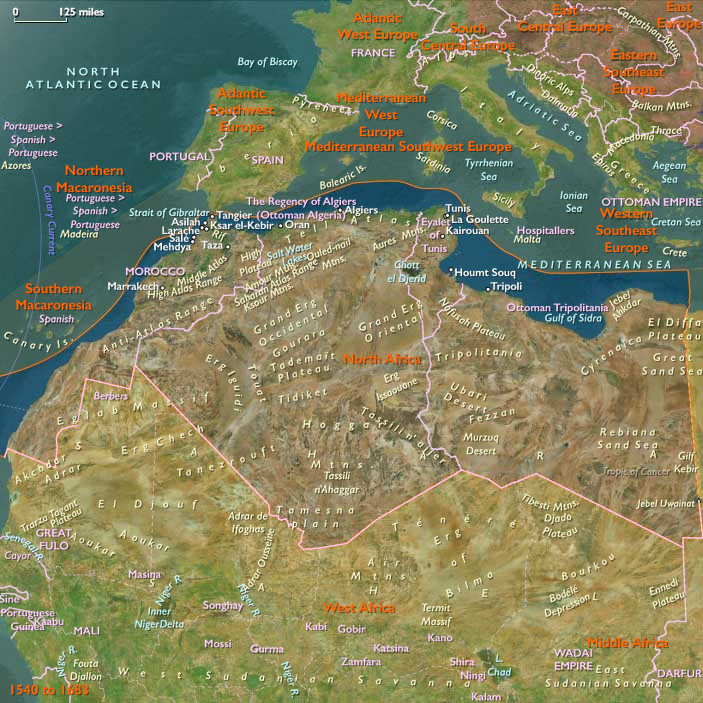
The army attacks Tunis and La Goleta.
The presidio of La Goleta, defended by seven thousand men, falls on August 24. The last Christian troops in a small fort opposite Tunis surrender on September 3.
John of Austria attempts to relieve the siege with a fleet of galleys from Naples and Sicily but failed due to storms.
The Spanish crown, being heavily involved in the Netherlands and short of funds, is unable to offer significant help.
Sinan Pasha, an Italian Muslim, leads the Ottoman capture of Tunis.
Cervantes participates in these events as a soldier, and is among the troops of Don Juan of Austria that try to rescue the city.
He will claim that the Ottomans led twenty-two assaults against the fort of Tunis, losing twenty-five thousand men, while only three hundred Christians survived.
Abd al-Malik, the future Moroccan King, participates in the conquest on the side of the Ottomans.
Gabrio Serbelloni is the commander of the fort of Tunis.
The general of La Goleta, Don Pedro Portocarerro, is taken as a captive to Constantinople, but dies on the way.
The captured soldiers are employed as slaves on galleys.
The capture of Tunis gives the territories of the Hafsid dynasty to the Ottoman Empire.
The battle marks the final establishment of Ottoman rule in Tunis, putting an end to the Hafsid dynasty and the Spanish presence in Tunis.
Selim II had sent his support through a messenger, who had endeavored to put the Dutch in contact with the rebellious Moriscos of Spain and the pirates of Algiers.
Selim also sends a great fleet to attack Tunis in the autumn of 1574, thus succeeding in reducing Spanish pressure on the Dutch.
In the Battle of La Goleta, Selim II musters a fleet of between two hundred and fifty and three hundred warships, with about seventy-five thousand men.
The Ottoman fleet is commanded by Sinan Pasha and Alūj Ali.
The Ottoman fleet combined, with troops sent by the governors of Algiers, Tripoli and Tunis, makes for a total force of about one hundred thousand.
The army attacks Tunis and La Goleta.
The presidio of La Goleta, defended by seven thousand men, falls on August 24. The last Christian troops in a small fort opposite Tunis surrender on September 3.
John of Austria attempts to relieve the siege with a fleet of galleys from Naples and Sicily but failed due to storms.
The Spanish crown, being heavily involved in the Netherlands and short of funds, is unable to offer significant help.
Sinan Pasha, an Italian Muslim, leads the Ottoman capture of Tunis.
Cervantes participates in these events as a soldier, and is among the troops of Don Juan of Austria that try to rescue the city.
He will claim that the Ottomans led twenty-two assaults against the fort of Tunis, losing twenty-five thousand men, while only three hundred Christians survived.
Abd al-Malik, the future Moroccan King, participates in the conquest on the side of the Ottomans.
Gabrio Serbelloni is the commander of the fort of Tunis.
The general of La Goleta, Don Pedro Portocarerro, is taken as a captive to Constantinople, but dies on the way.
The captured soldiers are employed as slaves on galleys.
The capture of Tunis gives the territories of the Hafsid dynasty to the Ottoman Empire.
The battle marks the final establishment of Ottoman rule in Tunis, putting an end to the Hafsid dynasty and the Spanish presence in Tunis.
Locations
People
- Abu Marwan Abd al-Malik I al Saadi
- Charles IX
- Don John of Austria
- Miguel de Cervantes
- Philip II of Spain
- Selim II
- Sinan Pasha
- William I, “the Silent”, Prince of Orange
Groups
- Papal States (Republic of St. Peter)
- Venice, (Most Serene) Republic of
- Tunis, Sultanate of (Hafsid Kingdom)
- Ottoman Empire
- Ottoman Algeria
- Morocco, Sa'di Sharifate of
- Spain, Habsburg Kingdom of
Topics
Commodoties
Subjects
Regions

Subregions
Years: 1574 - 1574
Locations
People
- Abu Marwan Abd al-Malik I al Saadi
- Charles IX
- Don John of Austria
- Miguel de Cervantes
- Philip II of Spain
- Selim II
- Sinan Pasha
- William I, “the Silent”, Prince of Orange
Groups
- Papal States (Republic of St. Peter)
- Venice, (Most Serene) Republic of
- Tunis, Sultanate of (Hafsid Kingdom)
- Ottoman Empire
- Ottoman Algeria
- Morocco, Sa'di Sharifate of
- Spain, Habsburg Kingdom of
Topics
Commodoties
Subjects
Regions
Subregions