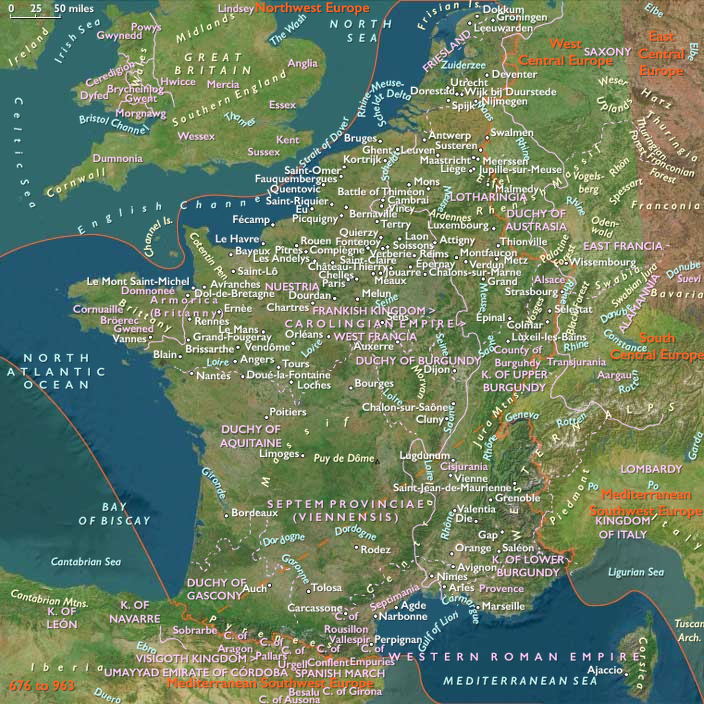
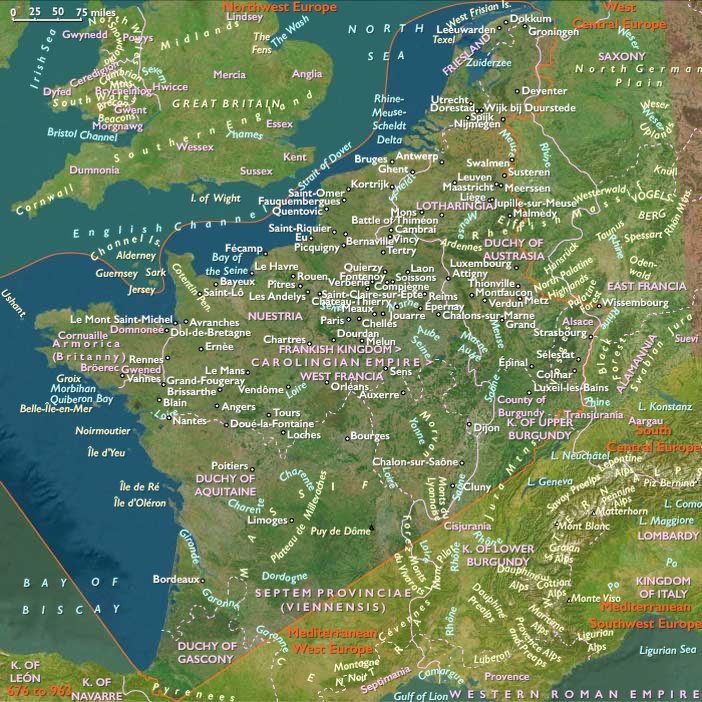
The Death of William Longsword and the Struggle Between Normandy and Flanders (939–942)
William Longsword, the son and successor of Rollo, Duke of Normandy, spent much of his rule expanding and consolidating his duchy. However, his conflicts with Arnulf I, Count of Flanders, and Louis IV, King of West Francia, led to a period of warfare and shifting alliances, culminating in his assassination in 942.
The Conflict Between Normandy and Flanders (939–940)
-
William’s Attack on Flanders (939)
- In 939, William Longsword launches an offensive against Flanders, provoking the wrath of Arnulf I, Count of Flanders.
- In response, Arnulf and King Louis IV retaliate, leading to a West Frankish campaign against Normandy.
-
Arnulf Captures Montreuil-sur-Mer
- As part of this retaliation, Arnulf captures the castle of Montreuil-sur-Mer, expelling its ruler, Herluin, Count of Ponthieu.
-
William and Herluin Retake Montreuil
- William joins forces with Herluin, and together they recapture the fortress, restoring Herluin’s rule over Ponthieu.
- This action further escalates tensions between Normandy and Flanders.
William’s Excommunication and Pledge of Loyalty (940)
- Due to his aggressive military campaigns, including the destruction of Arnulf’s estates, William is excommunicated by the Church.
- In 940, he meets King Louis IV of West Francia to seek reconciliation.
- In exchange for pledging loyalty to the king, William is confirmed in the lands granted to his father, Rollo, ensuring the continued legitimacy of Norman rule.
- This marks a temporary peace, allowing William to consolidate Norman control over the lower Seine region.
The Assassination of William Longsword (942)
- Almost three years later, on December 17, 942, William meets with Arnulf I of Flanders at a peace conference intended to settle their disputes.
- Instead of achieving reconciliation, William is ambushed and killed by Arnulf’s supporters, likely with Arnulf’s direct involvement.
- His murder is a major turning point in Norman history, as it leaves Normandy without a strong ruler, leading to a period of instability.
Consequences of William Longsword’s Death
-
Normandy is Weakened
- William’s death creates a power vacuum, leading to a struggle over Norman succession.
- His young son, Richard I, is left vulnerable to noble factions and external threats.
-
Arnulf Strengthens His Position
- The Count of Flanders eliminates a key rival, ensuring that Normandy is temporarily destabilized.
- However, the Normans will eventually regroup under Richard I and seek revenge for William’s murder.
-
Continued Turmoil in West Francia
- The assassination of William underscores the brutal and unstable nature of feudal politics in the 10th century.
- Normandy, Flanders, and West Francia remain embroiled in conflicts over land, loyalty, and power.
Conclusion: The Murder of William Longsword and the Shifting Balance of Power
The assassination of William Longsword in 942 at the hands of Arnulf of Flanders’ supporters marks a significant turning point in Norman history. Though William had expanded and solidified Norman control, his death throws the duchy into crisis, setting the stage for his son Richard I’s struggle to reclaim power. Meanwhile, Arnulf’s treacherous act further fuels the feudal rivalries that define 10th-century France.