William “Iron Arm” de Hauteville, Norman lord …
Years: 1047 - 1047
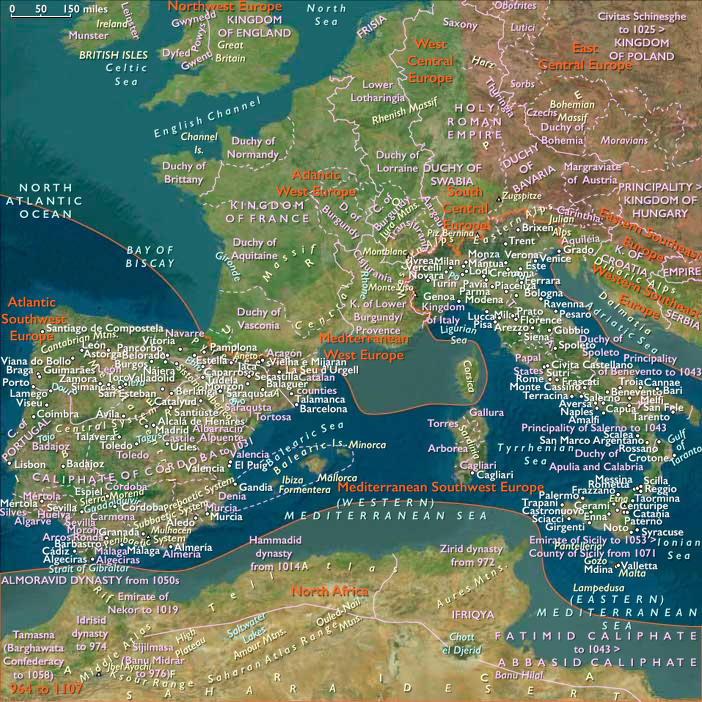
William “Iron Arm” de Hauteville, Norman lord of Apulia, had been succeeded in 1046 by his younger brother Drogo, whose thirty-two-year-old half brother, Robert Guiscard, joins him in Apulia the following year.
Locations
People
Groups
- Lombards (West Germanic tribe)
- Greeks, Medieval (Byzantines)
- Roman Empire, Eastern: Macedonian dynasty
- Normans
- Italy, Kingdom of (Holy Roman Empire)
- Italy, Catepanate of
Topics
Commodoties
Subjects
Regions
Subregions
Related Events
Filter results
Showing 10 events out of 51271 total
Harald and Magnus have separate courts and keep to themselves during their short co-rule, and their only recorded meetings nearly end in physical clashes.
Magnus and Harald go to Denmark in 1047, with their leidang forces.
Magnus, however, dies suddenly on October 25 while in Denmark, either in Zealand or in Jutland, either in an accident or of a disease; accounts vary.
Reports include falling overboard from one of the ships he was mustering to invade England and drowning, falling off a horse, and falling ill while on board a ship.
He is said to have made Sweyn his heir in Denmark, and Harald in Norway; some say in a deathbed statement.
Upon hearing the news of Magnus's death, Harald quickly gathers the local leaders in Norway and declares himself king of Norway as well as of Denmark.
Although Magnus had appointed Sweyn his successor as king of Denmark, Harald immediately announces his plans to gather an army and oust his former ally from the country.
In response, the army and the chieftains, headed by Einar Thambarskelfir, oppose any plans of invading Denmark.
Although Harald himself objects to bringing the body of Magnus back to Norway, the Norwegian army prepares to transport his body to Nidaros (now Trondheim), where they bury him next to Saint Olaf in late 1047.
Einar, an opponent of Harald, claims that "to follow Magnus dead was better than to follow any other king alive". (Tjønn, Halvor (2010). Harald Hardråde. Sagakongene (in Norwegian). p. 103. Saga Bok/Spartacus)
Andrew initially remains allied with the pagan movement as a means of resisting the German Empire.
Having soon broken with his pagan supporters, he restores Christianity and declares pagan rites illegal.
Leo Tornikos, a nephew of Emperor Constantine IX, was born in Adrianople, the scion of the noted noble Armenian/Georgian family of Tornikios, and named patrikios and commander (doux) of Melitene (according to Michael Attaleiates) or Iberia (according to Michael Psellos).
Although favored by Constantine, Tornikios is crafty and ambitious according to Psellos, and had become a devotee of the Emperor's sister Euprepia, who opposes the Emperor's policies.
During Leo's tenure in the East, however, a revolt breaks out in Macedonia by some of his supporters.
Tornikios is swiftly recalled to Constantinople, where he is tonsured but otherwise allowed considerable personal liberty.
Taking advantage of this, he flees the capital to Adrianople on September 14, 1047.
Here he gathers his supporters and a number of disgruntled generals and raises them in revolt against Emperor Constantine's misgovernment.
Proclaiming himself emperor, he marches against the capital with his forces and sets up his camp opposite the Walls of Constantinople on September 25, 1047, easily defeating an ad hoc force of armed citizens who sally out to meet him.
This victory spreads panic to the capital's defenders, who momentarily abandon their posts on the walls and their gates.
Tornikios, however, hesitates, and loses the opportunity to take the city, for that night, Emperor Constantine manages to restore order and reoccupy the walls, awaiting the arrival of the Anatolian army.
The siege lasts four days, from September 25 until September 28.
Two assaults of Tornikios's men on the walls sre turned back by the defenders under the personal leadership of Emperor Constantine, who, despite suffering from gout and having no military experience, shows courage and energy in this extremity.
Following the failure of his assaults, Tornikios is forced to withdraw westwards.
Hoping to retrieve the situation, he attacks Rhaidestos, but is again repulsed.
At this point, his followers start to abandon him.
He finds refuge in a church at Boulgarophygon, but is lured out of it and captured.
On Christmas 1047, at Constantinople, he is blinded along with a certain John Vatatzes, his principal supporter.
Nothing is thereafter known about him.

Abadan, a city on Abadan Island in the Shatt al-Arab, at the head of the Persian Gulf, is settled by 1047.
Abadan is thought to have been further developed into a major port city under the Abbasids' rule.
In this period, it is a commercial source of salt and woven mats.
Peter Damian, extending the area of his activities, has entered into communication with the Emperor Henry III.
He had been present in Rome when Clement II crowned Henry III and his consort Agnes, and he also attends a synod held at the Lateran in the first days of 1047, in which decrees are passed against simony.
Clement II's short pontificate, starting with the Roman synod of 1047, initiates an improvement in the state of affairs within the Roman Church, particularly by enacting decrees against simony.
A dispute for precedence among the Sees of Ravenna, Milan, and Aquileia is settled in favor of Ravenna.
Clement's election is criticized by the reform party within the papal curia due to the royal involvement and the fact that the new Pope is already bishop of another diocese.
Contrary to later practice, Clement keeps his old see, governing both Rome and Bamberg simultaneously.
Clement, proceeding with Henry to Germany, canonizes Wiborada, a nun of St. Gall, martyred by the Hungarians in 925.
On his way back to Rome, he dies near Pesaro in October 1047.
His corpse is transferred back to Bamberg, which he had loved dearly, and interred in the western choir of the Bamberg Cathedral.
His is the only tomb of a Pope north of the Alps.
A toxicologic examination of his remains in the mid-twentieth century confirmed centuries-old rumors that the Pope had been poisoned with lead sugar.
It is not clear, however, whether he was murdered or whether the lead sugar was used as medicine.
Henry and the pope now move south, where his father had created the situation as it was then in his visit of 1038.
Henry reversed many of Conrad's acts.
At Capua, he is received by Prince Guaimar IV of Salerno, also Prince of Capua since 1038.
However, Henry gives Capua back to the twice-deprived Prince Pandulf IV, a highly unpopular choice.
Guaimar had been acclaimed as Duke of Apulia and Calabria by the Norman mercenaries under William Iron Arm and his brother Drogo of Hauteville.
In return, Guaimar had recognized the conquests of the Normans and invested William as his vassal with the comital title.
Henry makes Drogo, William's successor in Apulia, a direct vassal of the imperial crown.
He had done likewise to Ranulf Drengot, the count of Aversa, who had been a vassal of Guaimar as Prince of Capua.
Thus, Guaimar is deprived of his greatest vassals, his principality split in two, and his greatest enemy reinstated.
Henry has lost popularity among the Lombards with his decisions, and Benevento, though a papal vassal, will not admit him.
He authorizes Drogo to conquer it and heads north to reunion with Agnes at Ravenna.
Henry arrives at Verona in May, and the Italian circuit is completed.
William Consolidates Power in Normandy: The Truce of God and Continued Warfare (1047–1060)
Following his victory at the Battle of Val-ès-Dunes (1047), Duke William of Normandy assumed firm control over his duchy, though his struggles were far from over. Seeking to curb further unrest and violence, he promulgated the Truce of God, an ecclesiastical decree aimed at limiting feudal warfare. However, despite his military success, Normandy remained unstable, and William faced continuous resistance from rebellious nobles until 1060.
The Truce of God and William’s Efforts to Pacify Normandy (1047)
- In the aftermath of Val-ès-Dunes, William implemented the Truce of God, a movement that had begun in southern France and was gaining traction in Christendom.
- This decree restricted warfare to certain days of the year, forbidding fighting on Sundays, feast days, and during religious seasons such as Lent and Advent.
- The Truce was meant to stabilize Normandy by reducing private feuds and feudal anarchy, reinforcing William’s authority as a just ruler.
Ongoing Noble Resistance (1047–1054)
- Despite William’s attempts at peace, the Norman nobility remained restless, engaging in almost continuous warfare for the next seven years.
- The period from 1047 to 1054 was marked by rebellions, sieges, and power struggles, as various lords continued to defy William’s rule.
- Among the most persistent challenges were:
- Revolts by powerful barons, particularly in the western regions of Normandy, where ducal control was weakest.
- The rivalry between William and Geoffrey Martel, Count of Anjou, who sought to expand Angevin influence into Normandy.
The Crisis of 1054: The French Invasion
- In 1054, William faced his greatest external threat when King Henry I of France and Geoffrey Martel of Anjou invaded Normandy in a coordinated attack.
- The invasion aimed to overthrow William, but Norman forces decisively defeated the French at the Battle of Mortemer.
- This victory solidified William’s control, forcing Henry I to withdraw and abandon his direct attempts to depose the Norman duke.
Final Struggles for Control (1054–1060)
- Though William had defeated the external invasion, local Norman uprisings continued, particularly in regions loyal to rival factions.
- By 1060, most of the rebellious nobles had been subdued, marking the final consolidation of William’s authority over Normandy.
Legacy and Impact
- The Truce of God was one of William’s early measures to establish order, reflecting his desire for stability and religious legitimacy.
- His continuous warfare from 1047 to 1060 forged him into a battle-hardened ruler, strengthening his military reputation.
- By 1060, William had transformed Normandy from a fractious and unstable duchy into a powerful and centralized state, setting the stage for his invasion of England in 1066.
Though the Battle of Val-ès-Dunes (1047) marked the beginning of William’s true control, it took another decade of relentless campaigning before he fully established his authority over his rebellious vassals and became the undisputed ruler of Normandy.
Years: 1047 - 1047
Locations
People
Groups
- Lombards (West Germanic tribe)
- Greeks, Medieval (Byzantines)
- Roman Empire, Eastern: Macedonian dynasty
- Normans
- Italy, Kingdom of (Holy Roman Empire)
- Italy, Catepanate of