
Filters:
William Consolidates Power in Normandy: The Truce …
Years: 1047 - 1047
William Consolidates Power in Normandy: The Truce of God and Continued Warfare (1047–1060)
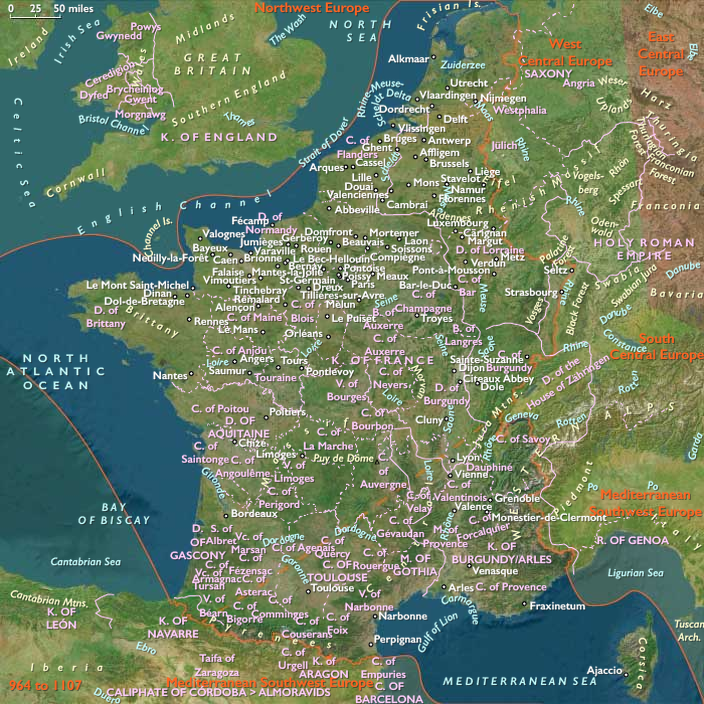
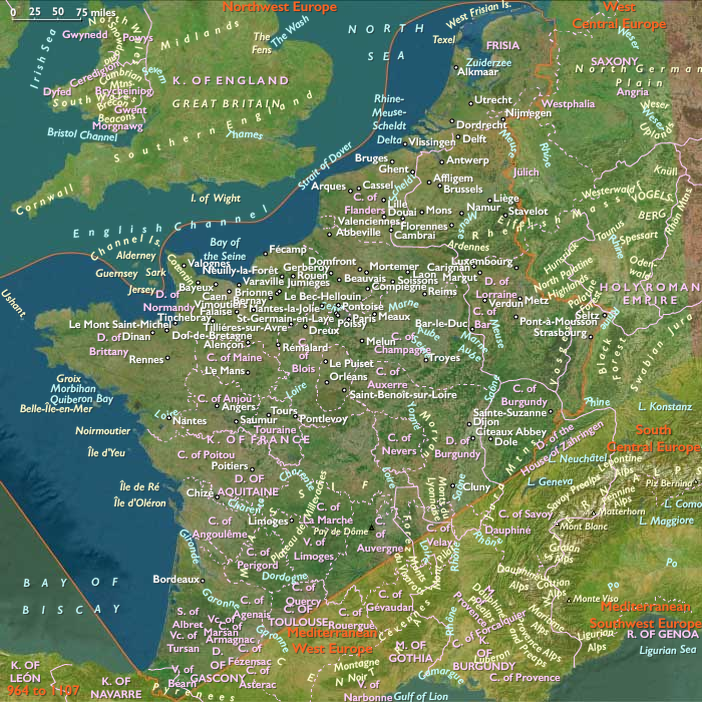
Following his victory at the Battle of Val-ès-Dunes (1047), Duke William of Normandy assumed firm control over his duchy, though his struggles were far from over. Seeking to curb further unrest and violence, he promulgated the Truce of God, an ecclesiastical decree aimed at limiting feudal warfare. However, despite his military success, Normandy remained unstable, and William faced continuous resistance from rebellious nobles until 1060.
The Truce of God and William’s Efforts to Pacify Normandy (1047)
- In the aftermath of Val-ès-Dunes, William implemented the Truce of God, a movement that had begun in southern France and was gaining traction in Christendom.
- This decree restricted warfare to certain days of the year, forbidding fighting on Sundays, feast days, and during religious seasons such as Lent and Advent.
- The Truce was meant to stabilize Normandy by reducing private feuds and feudal anarchy, reinforcing William’s authority as a just ruler.
Ongoing Noble Resistance (1047–1054)
- Despite William’s attempts at peace, the Norman nobility remained restless, engaging in almost continuous warfare for the next seven years.
- The period from 1047 to 1054 was marked by rebellions, sieges, and power struggles, as various lords continued to defy William’s rule.
- Among the most persistent challenges were:
- Revolts by powerful barons, particularly in the western regions of Normandy, where ducal control was weakest.
- The rivalry between William and Geoffrey Martel, Count of Anjou, who sought to expand Angevin influence into Normandy.
The Crisis of 1054: The French Invasion
- In 1054, William faced his greatest external threat when King Henry I of France and Geoffrey Martel of Anjou invaded Normandy in a coordinated attack.
- The invasion aimed to overthrow William, but Norman forces decisively defeated the French at the Battle of Mortemer.
- This victory solidified William’s control, forcing Henry I to withdraw and abandon his direct attempts to depose the Norman duke.
Final Struggles for Control (1054–1060)
- Though William had defeated the external invasion, local Norman uprisings continued, particularly in regions loyal to rival factions.
- By 1060, most of the rebellious nobles had been subdued, marking the final consolidation of William’s authority over Normandy.
Legacy and Impact
- The Truce of God was one of William’s early measures to establish order, reflecting his desire for stability and religious legitimacy.
- His continuous warfare from 1047 to 1060 forged him into a battle-hardened ruler, strengthening his military reputation.
- By 1060, William had transformed Normandy from a fractious and unstable duchy into a powerful and centralized state, setting the stage for his invasion of England in 1066.
Though the Battle of Val-ès-Dunes (1047) marked the beginning of William’s true control, it took another decade of relentless campaigning before he fully established his authority over his rebellious vassals and became the undisputed ruler of Normandy.
Locations
People
Groups
- Christianity, Chalcedonian
- Normandy, Duchy of
- Normans
- French people (Latins)
- France, (Capetian) Kingdom of
- England, (Anglo-Saxon) Kingdom of
Subjects
Regions
Subregions
Years: 1047 - 1047
Locations
People
Groups
- Christianity, Chalcedonian
- Normandy, Duchy of
- Normans
- French people (Latins)
- France, (Capetian) Kingdom of
- England, (Anglo-Saxon) Kingdom of
Subjects
Regions
Subregions