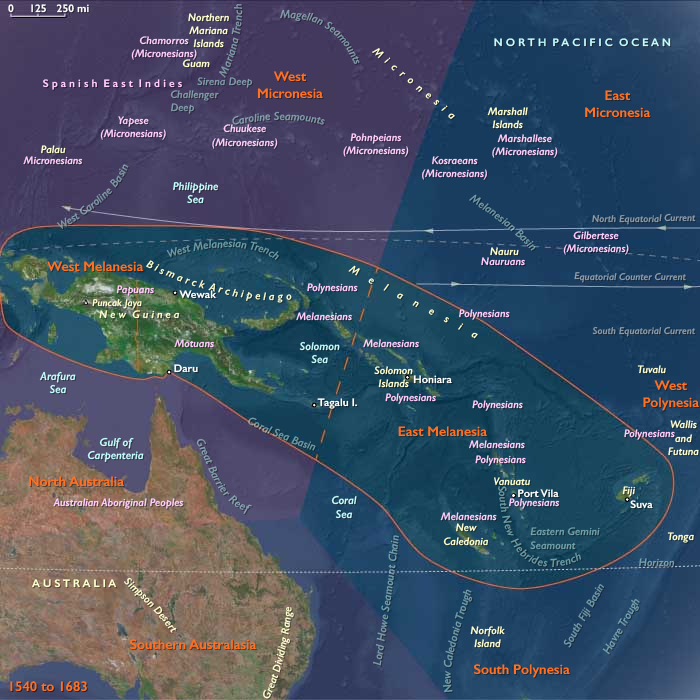
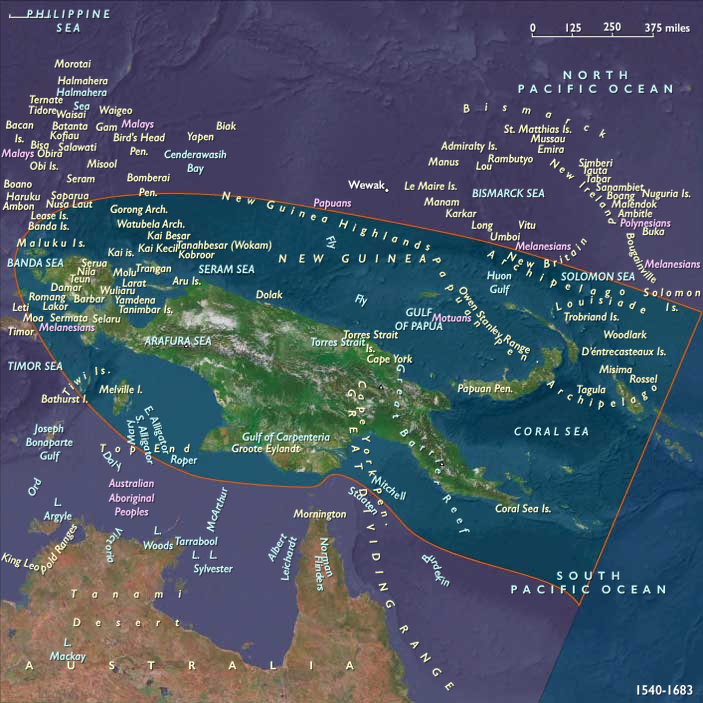
Willem Schouten follows the north coasts of …
Years: 1616 - 1616
Willem Schouten follows the north coasts of New Ireland and ...
Locations
Groups
- Netherlands, United Provinces of the (Dutch Republic)
- Dutch East India Company (Vereenigde Oostindische Compagnie or VOC in Dutch, literally "United East Indies Company")
Topics
Commodoties
Subjects
Regions
Subregions
Related Events
Filter results
Showing 10 events out of 33161 total
Dirk Hartog and crew, at approximately twenty-six degrees latitude south on October 25, 1616, come unexpectedly upon "various islands, which were, however, found uninhabited."
He makes landfall at an island off the coast of Shark Bay, Western Australia, which is now called Dirk Hartog Island after him.
His is the second recorded European expedition to land on the Australian continent (having been preceded by Willem Janszoon), but the first to do so on the western coastline.
Hartog spends three days examining the coast and nearby islands.
He names the area Eendrachtsland after his ship, but this name has not endured.
When he leaves, he affixes a pewter plate to a post, now known as the Hartog plate, on which he has etched a record of his visit to the island.
Finding nothing of interest, Hartog continues sailing northwards along this previously undiscovered coastline of Western Australia, making nautical charts up to about twenty-two degrees latitude south.
He then leaves the coast and continues onwards to Batavia, eventually arriving safely in December 1616, some five months after his expected arrival.
...New Guinea and visits adjacent islands, including what become known as the Schouten Islands.
Manam Volcano erupts in 1616, forming a ten kilometer-wide island in the Bismarck Sea, thirteen kilometers off coast of Papua New Guinea, in the southwestern part of the Pacific Ring of Fire.
Run, one of the smallest of the Banda Islands that are today a part of Indonesia, is only about three kilometers long and less than one kilometer wide but of considerable economic importance due to the value of the spices nutmeg and mace which are obtained from the nutmeg tree (Myristica fragans), at this time only growing on the Banda Islands.
Nutmeg is more valuable than gold at this time.
Sailors of the East India Company of the second expedition of James Lancaster, John Davis and John Middleton who stayed in Bantam on Java had first reached the Island in 1603 and developed good contacts with the inhabitants.
Nathaniel Courthope, hired in 1609 by the East India Company to go to the Spice Islands, had left England with great fanfare and by 1616 is a factor at Sukadana in Borneo.
Courthope lands his ships, Swan and Defence, on Run, on December 25, 1616, in a quest to break the Dutch hold on the nutmeg supply.
He persuades the islanders to enter an alliance with the British for nutmeg.
Schouten has opened an unknown route, but the VOC claims infringement of its monopoly of trade to the Spice Islands.
He is arrested (and later released) and his remaining ship confiscated in Java.
The first recorded eruption of Mayon Volcano, a stratovolcano or composite volcano, occurs on February 19, 1616.
It will erupt frequently in the next four centuries, and is today the Philippines' most active volcano.
The young Nurhaci, born in 1558, had, according to Chinese sources, grown up as a soldier in the household of Ming Dynasty General Li Chengliang in Fushun, where he had learned Chinese.
His father Taksi and grandfather Giocangga were killed in 1582 in an attack on Gure by a rival Jurchen chieftain Nikan Wailan while being led by Li Chengliang.
Nurhaci began the following year to unify the Jurchen bands; when he was twentyifive, he beheaded Nikan Wailan at Tulin to avenge the deaths of his father and grandfather, who are said to have left him nothing but thirteen suits of armor.
The nine allied tribes of Yehe, Hada, Ula, Hoifa, Khorchin, Sibe, Guwalca, Jušeri, and Neyen had attacked Nurhaci in 1593 but all had been completely defeated at the Battle of Gure.
He had had two of his translators, Erdeni Bagshi and Gagai Jarguchi, create the written Manchu language in 1599 by adapting the Mongolian alphabet.
Nurhaci from 1599 has campaigned against the four Hulun tribes, first attacking the Hada and finally conquering them in 1603.
He had been granted the title of Kundulun Khan by the Mongols in 1606.
Nurhaci had then conquered the Hoifa in 1607, followed by the Ula in 1613.
(He will not defeat the Yehe until the Battle of Sarhu in 1619.)
Nurhaci declares himself Khan (King) in 1616, , thus founding the Jin Dynasty (aisin gurun), often called the Later Jin.
He constructs a palace at Mukden (present-day Shenyang) in Liaoning province. (The earlier Jin Dynasty of the twelfth century had also been formed by the Jurchen.)
Jīn will be renamed Qīng by his son Huang Taiji after his death; Nurhaci is usually referred to as the founder of the Qing Dynasty.

English merchants of the East India Company complain that the great troubles and wars in Japan since their arrival have put them to much pains and charges.
Two great cities, Osaka and Sakaii, have been burned to the ground, each one almost as big as London, and not one house left standing, and it is reported above three hundred thousand men have lost their lives, “yet the old Emperor Ogusho Same hath prevailed and Fidaia Same either slain or fled secretly away, that no news is to be heard of him.” Jesuits, priests, and friars are banished by the emperor and their churches and monasteries pulled down; they put the fault on the arrival of the English; it is said if Fidaia Same had prevailed against the emperor, he promised them entrance again, when without doubt all the English would have been driven out of Japan.
Tokugawa Ieyasu dies in June 1616 and is replaced by his xenophobic son Tokugawa Hidetada; Japan moves towards the "Sakoku" policy of isolation.
The Tokugawa shogunate (Bakufu) forbids foreigners other than Chinese from traveling freely or trading outside of ...
...the ports of Nagasaki and ...
...Hirado.
Years: 1616 - 1616
Locations
Groups
- Netherlands, United Provinces of the (Dutch Republic)
- Dutch East India Company (Vereenigde Oostindische Compagnie or VOC in Dutch, literally "United East Indies Company")