Wichmann's lands are confiscated by Otto and …
Years: 967 - 967
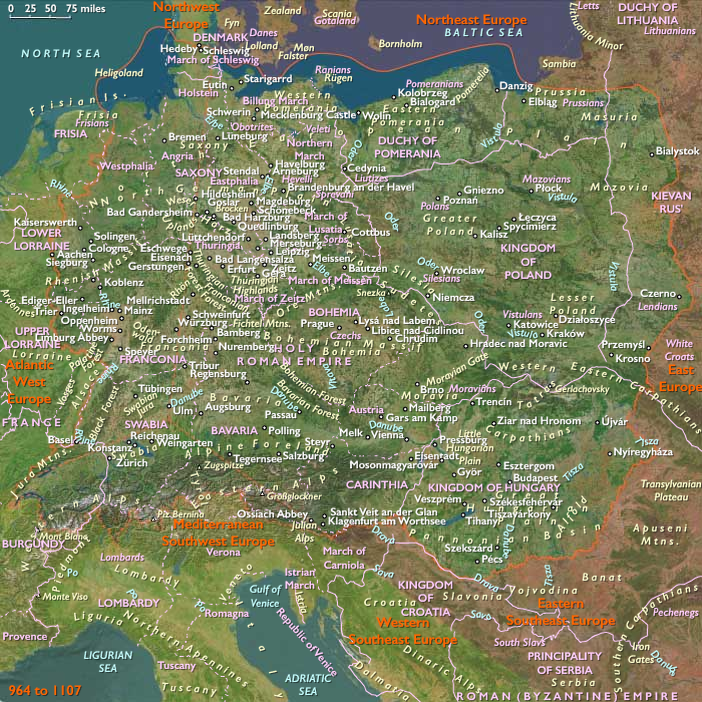
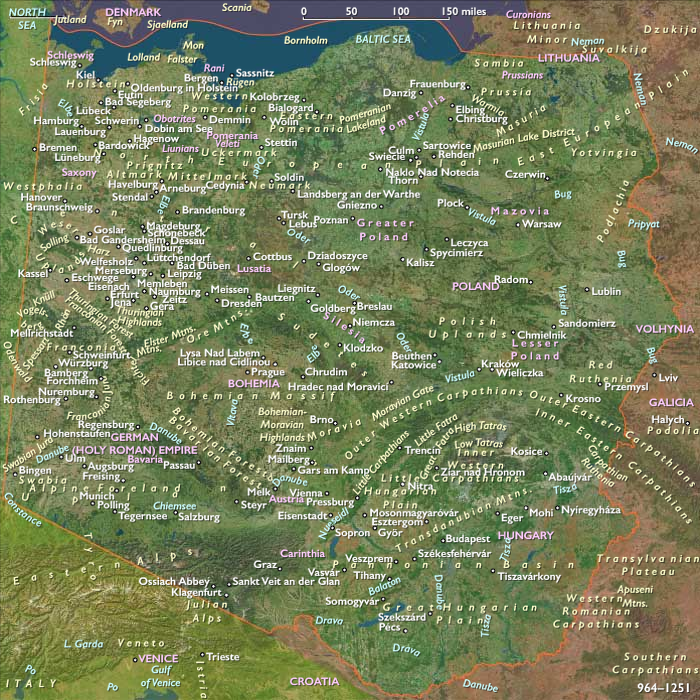
Wichmann's lands are confiscated by Otto and divided in two, the eastern half going to the monastery of Saint Michael founded by Hermann Billung at Lüneburg, and the western half going to found the convent of Keminada (near Bodenwerder) on the Weser.
Locations
People
Groups
- Polabian Slavs (West Slavs)
- Obotrites (Slavic tribal confederation)
- Roman Empire, Eastern: Macedonian dynasty
- Bohemia, Duchy of
- German, or Ottonian (Roman) Empire
- Poland, Principality of
- Northern March
- Eastern March
Commodoties
Subjects
Regions
Subregions
Related Events
Filter results
Showing 10 events out of 52514 total
Banteay Srei or Banteay Srey, a Cambodian temple consecrated on the 22nd of April, 967, is the only major temple at Angkor not built by a monarch; its construction is credited to a courtier named Yajnavaraha / Yajñavarāha, who serves as a counselor to king Rājendravarman II.
The foundational stela says that Yajñavarāha, a grandson of king Harṣavarman I, was a scholar and philanthropist who helped those who suffered from illness, injustice, or poverty.
His pupil is the future king Jayavarman V, who will reign between about 968 to about 1001.
At this time, the temple is surrounded by a town called Īśvarapura.
Yajñavarāha's temple, primarily dedicated to the Hindu god Shiva, originally carries the name Tribhuvanamaheśvara—great lord of the threefold world—in reference to the Shaivite linga that serves as its central religious image.
However, the temple buildings appear to be divided along the central east-west axis between those buildings located south of the axis, which are devoted to Shiva, and those north of the axis, which are devoted to Vishnu.
The temple's modern name, Bantãy Srĕi—citadel of the women, or citadel of beauty—is probably related to the intricacy of the bas relief carvings found on the walls and the tiny dimensions of the buildings themselves.
Some have speculated that it relates to the many devatas carved into the red sandstone walls.
Wichmann the Youger and his brother Egbert the One-Eyed, still feeling deprived of their heritage, had marauded through Saxony and in 955 arrived in the lands of the Slavic Obotrites at Liubice (Lübeck), where they had instigated a revolt under Prince Prince Nako that was suppressed by King Otto at the Battle of Recknitz.
The young Billungs had fled to the court of Duke Hugh the Great of France.
When Hugh died the next year, Wichmann had had to return to Germany; he was, however, pardoned after he had sworn loyalty to King Otto.
He had remained an implacable opponent, attacking the lands of his uncle Hermann several times, until he had to retreat to the Slavic Lutici territories, where he was tolerated by Margrave Gero.
In 963, Wichmann was an outlaw leading a band of West Slavs (likely Pomeranians) in battle against Duke Mieszko I of Poland, defeating him twice and even exacting tribute.
For a brief interlude, he had been allowed to return to Germany and his wife's estates, but he had been exiled once more by his uncle Hermann during Otto's second Italian campaign In 967, he and the western Pomeranians are defeated at Wolin by an alliance of Mieszko and Duke Boleslaus I of Bohemia and Wichmann is killed in action.
Abu Taghlib is the eldest son of al-Hasan, better known by his laqab of Nasir al-Dawla, who had established the Hamdanids as masters of a practically independent emirate encompassing the Jazira and centered on Mosul.
Nasir al-Dawla has engaged in repeated attempts to gain control over the Abbasid caliphs at Baghdad, but in the end had been forced to concede defeat to the more powerful Buyids, recognize their suzerainty and pay them tribute.
At the same time, Nasir al-Dawla's younger brother Ali, better known as Sayf al-Dawla, had managed to establish his control over northern Syria from his two capitals Aleppo and Mayyafariqin, and through his clashes with the Constantinople had quickly overshadowed his brother.
However, the last decade of Sayf al-Dawla's rule, until his death in February 967, has been marked by heavy military defeats at the hands of the Empire, who have occupied much of his domains, and internal turmoil.
It is in this context that Abu Taghlib is first mentioned in 964, when his father had once again been embroiled in a conflict with the Buyids.
The army of the Buyid Mu'izz al-Dawla occupies Mosul and Nasir al-Dawla is once again forced to flee to the hill country of the northern Jazira.
Abu Taghlib leads the resistance against the Buyids, who, unable to maintain themselves there, evacuate Mosul and reach a new agreement with the Hamdanids.
Consequently, Nasir al-Dawla is now increasingly eclipsed by his sons, and is deposed outright and exiled in 967, dying in captivity shortly after.
Abu Taghlib, surnamed "al-Ghadanfar" ("The Lion"), succeeds his father as emir and head of the Jaziran branch of the Hamdanid family, but almost immediately his authority is contested by a younger half-brother, Hamdan.
Nasir al-Dawla had entrusted the latter with the governance of Nisibis, Maridin and Rahba shortly before his deposition, and may have intended to name him as his heir over Abu Taghlib.
Hamdan is indeed the only son of Nasir al-Dawla to protest his father's deposition, and refuses to recognize Abu Taghlib.
With the aid of the new Buyid emir of Iraq, 'Izz al-Dawla Bakhtiyar, Abu Taghlib prevails over Hamdan, who flees to Baghdad.
Al-Hasan (who since the Buyids' entrance into Baghdad in 945 has used the title Rukn al-Dawla) had invaded Tabaristan and Gorgan in 948 and taken them from Vushmgir, the second Ziyarid emir.
While al-Hasan supports the Buyids, Vushmgir relies on his Samanid allies.
Tabaristan and Gorgan had changed hands several times until 955, when in a treaty with the Samanids, Rukn al-Daula had promised to leave Vushmgir alone in Tabaristan.
Peace between the two sides did not last long, however; in 958 Vushmgir had briefly occupied Rey, which was Rukn al-Dawla's capital.
Rukn al-Dawla later made a counterattack, temporarily taking Gorgan in 960, then taking both Tabaristan and Gorgan for a short time in 962.
He may have also taken Tabaristan and Gorgan in 966, but did not hold on to them for long.
Vushmgir’s son Bisutun is the governor of Tabaristan.
Upon the death of his father in 967 during a boar-hunting expedition, Bisutun goes to Gorgan to assume power.
His ascension is contested, however, by a Samanid army which had arrived shortly before Vushmgir's death for a joint campaign against the Buyid Rukn al-Daula.
The army commander supports making Bisutun's brother Qabus as ruler of the Ziyarids.
Bisutun now turns to Rukn al-Daula, recognizing the latter's sovereignty in an attempt to gain support.
The Samanid army soon leaves Gorgan, returning to Khurasan, but …
…Qabus finds the support of al-Hasan ibn al-Fairuzan, who is ruling in Semnan at this time.
Bisutun eventually manages to conquer both Gurgan and Semnan, forcing Qabus to give up his claims.
Izz al-Dawla, born as Bakhtiyar, is the son of Mu'izz al-Dawla.
In the spring of 955, Mu'izz al-Dawla had become very ill and decided to name his son as his successor.
Five years later, the caliph had officially recognized this by granting Bakhtiyar the title of "Izz al-Dawla".
During his father's military expeditions, Izz al-Dawla had ruled in Baghdad.
Mu'izz al-Dawla dies in 967, leaving behind several pieces of advice for his son.
He recommends keeping the services of the Turkish commander Sabuktigin, respecting the wishes of the Turks, recognizing his uncle Rukn al-Dawla, who rules northern Persia, as senior amir, and respecting his cousin 'Adud al-Dawla, who rules from Fars.
He also gives a strategy for dealing with the Hamdanid emir of Mosul, Abu Taghlib.
Two imperial armies had taken Taranto from the Saracens in 880, ending a Muslim dominion of forty years.
Among the first actions taken by Apostyppes, ruling in the name of the emperor, had been the enslavement and deportation of the Latin-Longobard original inhabitants—who had almost completely converted to Islam—and the import of Greek colons, in order to increase the population.
Taranto had soon become one of the most important cities in the Thema Longobardia, the imperial possession in southern Italy.
In 882 the Saracens, having been invited by Duke Radelchis to assist him, had captured it and held it for some time.
The city of Taranto had suffered from other Saracen raids, such as in 922 and in 927, when the Saracens had conquered and destroyed the city, enslaving and deporting to Africa all the survivors.
Taranto thus has had no inhabitants until the reconquest in 967 by Nikephoros II Phokas, who understands the importance of a strong military presence and harbor in southern Italy, and rebuilds the city, adding several military fortifications.
Emperor Otto comes down to Rome in 967 and grants Pandulf the vacant Duchy of Spoleto of Camerino and charges him with prosecuting the war against Constantinople.
Pandulf and his brother Landulf introduce Prince Gisulf of Salerno to the emperor at this time.
Constantinople has been trying to supplant German influence in Salerno and to this end may have engineered the rebellion which had temporarily unseated John XIII, a pro-German pope.
Prince Gisulf of Salerno, however, is allied both to the Greeks and to his Lombard neighbor Pandulf, whom he had rescued some years before and who is, in fact, staunchly pro-German and anti-Greek.
John XIII, after his restoration, works with the Emperor on ecclesiastical improvements.
It is decided in a council held at Rome in the beginning of 967 in the emperor’s presence that Grado is to be the patriarchal and metropolitan church of the whole of the Veneto.
At another council at Ravenna in April 967, Otto again “restored to the apostolic Pope John the city and territory of Ravenna and many other possessions which had for some time been lost to the Popes.” (Mann, Horace K., The Lives of the Popes in the Early Middle Ages, Vol.
IV: The Popes in the Days of Feudal Anarchy, 891-999 (1910); p.289) At around this time he also creates, at Otto’s request, the Archbishopric of Magdeburg.
Then, on Christmas Day in 967, John XIII crowns Otto I's son Otto II as co-Emperor.
Emperor Nikephoros sends to Sviatoslav his agent, Kalokyros, in 967 or 968 with the task of talking Sviatoslav into assisting Constantinople in a war against Bulgaria.
Sviatoslav is paid fifteen thousand pounds of gold and sets sail with an army of fifty thousand men, including thousands of Pecheneg mercenaries.
According to the Russian Primary Chronicle, while Sviatoslav was pursuing this campaign against the First Bulgarian Empire, the Pechenegs (in all probability, bribed by Nikephoros) invade Rus and besiege his capital of Kiev.
While the besieged suffer from hunger and thirst, Sviatoslav's general Pretich deploys his druzhina, his personal guard, on the opposite (left) bank of the Dnieper, not daring to cross the river against the larger Pecheneg force.
Sviatoslav's mother Olga of Kiev (who is in Kiev together with all of Sviatoslav's sons), reduced to extremes, contemplates surrender, if Pretich does not relieve the siege within one day.
She is anxious to send word about her plans to Pretich.
At last, a boy fluent in the Pecheneg language volunteers to venture from the city and urge Pretich to action.
Pretending to be a Pecheneg, he goes about their camp, as if searching for a lost horse.
When he attempts to swim across the Dnieper, the Pechenegs discover his subterfuge and start shooting at him, but to no avail.
When the boy reaches the opposite bank and informs Pretich about the desperate condition of the Kievans, the general decides to make a sally in order to evacuate Sviatoslav's family from the city, for fear of his sovereign's anger.
Early in the morning, Pretich and his troops embark on boats across the Dnieper, making great noise with their trumpets.
The besieged start cheering, and Olga ventures out of the city towards the river.
The Pechenegs, thinking that Sviatoslav is returning with his great army, lifts the siege.
The Pecheneg leader then decides to confer with Pretich and asks him whether he is Sviatoslav.
Pretich admits that he is only a general but warns the Pecheneg ruler that his unit is a vanguard of Sviatoslav's approaching army.
As a sign of his peaceful disposition, the Pecheneg ruler shakes hands with Pretich and exchanges his own horse, sword and arrows for Pretich's armor.
As soon as the Pechenegs retreat, Olga sends a letter to Sviatoslav reproaching him for his neglect of the family and people.
Upon receiving the message, Sviatoslav speedily returns to Kiev and thoroughly defeats the Pechenegs, who are still threatening the city from the south.

Years: 967 - 967
Locations
People
Groups
- Polabian Slavs (West Slavs)
- Obotrites (Slavic tribal confederation)
- Roman Empire, Eastern: Macedonian dynasty
- Bohemia, Duchy of
- German, or Ottonian (Roman) Empire
- Poland, Principality of
- Northern March
- Eastern March