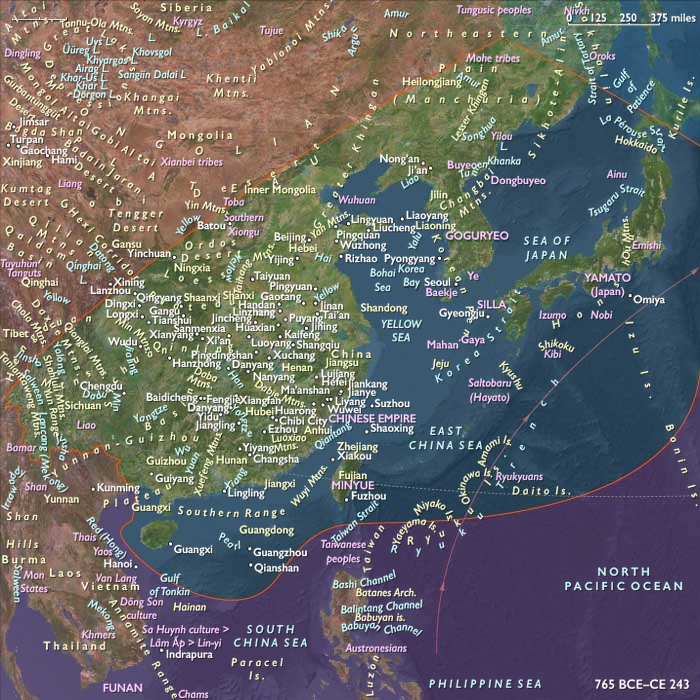
Zhuge Liang grows seriously ill while on …
Years: 234 - 234
Zhuge Liang grows seriously ill while on his final campaign against Wei in 234.
Liu Shan, hearing of Zhuge's illness, sends his secretary Li Fu to the front line to visit Zhuge Liang and to request Zhuge to leave instructions on important state matters.
Among other things, Zhuge recommends that Jiang Wan succeed him, and that Fei Yi succeed Jiang Wan.
Zhuge Liang refused to answer Li Fu's next question—who should succeed Fei Yi.
Zhuge Liang dies soon thereafter.
Liu Shan follows Zhuge's instructions and installs Jiang Wan as the new regent, but Jiang is more interested in domestic affairs than military expansion.
Thus the death of Zhuge Liang ends a huge strategic threat to Cao Wei and the Wei court soon begins development of ambitious public works.
Sima Yi's success and subsequent rise in prominence paves the way for his grandson Sima Yan's founding of the Jin dynasty, which will eventually bring an end to the Three Kingdoms period.
Locations
People
Groups
- Chinese (Han) people
- Cao Wei, (Chinese) kingdom of
- Shu Han (minor Han), (Chinese) kingdom of
- Wu, Eastern, (Chinese) kingdom of
Topics
Commodoties
Subjects
Regions
Subregions
Related Events
Filter results
Showing 10 events out of 60564 total
Sun Quan, in coordination with Zhuge Liang's final northern expedition against Wei, personally leads a major attack against Wei's border city Hefei in 234, while having Lu Xun and Zhuge Jin attack Xiangyang, with the strategy of trying to attract Wei relief forces and then attacking them.
However, Wei generals correctly see the situation and simply let Sun Quan besiege Hefei.
Only after Sun Quan's food supplies run low does Cao Rui personally arrive with reinforcements, and Sun withdraws, as do Lu Xun and Zhuge Jin.
Another serious crisis posed by Eastern Wu occurs in 234, when Eastern Wu, in a semi-coordinated effort with Shu Han, launches an attack against Cao Wei simultaneously with Zhuge Liang's Northern Expeditions.
At the time, many frontline officials are on family leave, so Man Zhong requests Cao Rui to call them back to fight Sun Quan.
Cao Rui refuses to cancel his subordinates' vacations, and orders Man to focus on the defense.
Cao Rui then personally leads the royal army as reinforcement, and acts as an effective coordinator of the various forces that Cao Wei has on Eastern Wu's borders, and Eastern Wu is unable to make substantial gains.
Yang Yi, the Imperial Secretariat of the state of Shu Han, has participated in the Northern Expeditions of Shu under the command of the strategist Zhuge Liang.
He and Wei Yan do not get along well, and it is only the command of Zhuge Liang that keeps them from fighting one another outright.
Zhuge Liang has launched a series of six invasions on Cao Wei between 228 and 234, but has failed each time due to lack of supplies or the incompetence of his officers.
In the spring of 234, Zhuge Liang leads one hundred thousand troops through Xiagu Pass after three years of preparation since his last Northern Expedition.
At the same time, Zhuge Liang sends an emissary to Shu Han's ally state, Eastern Wu, hoping that Wu will attack Cao Wei concurrently.
In April, Shu forces reach the Wuzhang Plains near the Wei River and make camp there.
The Cao Wei commander, Sima Yi, is well-prepared with a two hundred thousand-strong army, which holds a fortified position on the southern bank of the Wei River.
Guo Huai suggests that Sima Yi form a position in the northern part of the Plains, since Zhuge Liang will likely strike there.
Sima Yi agrees, and sends Guo Huai to set camp there.
Shu forces attack the Wei camp there while it is being built, but Guo Huai is able to hold them off.
Sima Yi will not engage the Shu forces, instead trying to make the enemy retreat through attrition.
Zhuge Liang understands the problem, and implements the tuntian system to sustain his troops.
While the tuntian system is made famous by Cao Cao's administration, Cao's writings show that the system had been instituted as early as the Western Han dynasty, during the reign of Emperor Wu, where soldiers on distant expeditions were set to work converting and farming the conquered land, both to provide food for the army and to convert the region into one based around agriculture—in effect, an economic conquest.
After the death of Emperor Wu, however, the system was only used sporadically and therefore less effectively.
The Shu army awaits an agreed offensive by Wu for the moment to strike.
However, Sun Quan's armies in the Huai River region are defeated by forces led by the Wei emperor, Cao Rui, and succumb to an endemic disease.
Thus the stalemate remains in place and continues for hundreds of days.
Shu forces try to engage the Wei forces several times, but Sima Yi remains firmly in camp and refuses to engage the enemy.
In an attempt to provoke Sima Yi to attack him, Zhuge Liang sends women's clothing to Sima, suggesting that Sima should be a woman since he does not dare to attack him.
Sima Yi's subordinates are enraged by the insult, but Sima himself remains calm.
To appease his men, Sima Yi asks Cao Rui for permission to engage the enemy.
Cao Rui understands the situation and sends minister Xin Pi to persuade the Wei army to be patient.
In another attempt to force Sima Yi to go to battle, Zhuge Liang sends an emissary to urge Sima to fight him.
However, Sima Yi refuses to discuss military issues with the messenger, and instead inquires about Zhuge Liang's daily tasks.
The emissary replies that Zhuge Liang has been personally overseeing all affairs in the army, ranging from strategic planning to his men's daily meals, and that Zhuge himself has not been eating and sleeping well.
Sima Yi later tells an aide that Zhuge Liang will not last long.
In August, Zhuge Liang falls ill due to exhaustion, and his condition worsens daily.
News reaches the Shu emperor, Liu Shan, who sends minister Li Fu to ask Zhuge Liang about future plans for Shu.
Zhuge Liang replies that Jiang Wan can succeed him, and Fei Yi can succeed Jiang.
When Li Fu asks again about Fei Yi's successor, Zhuge Liang falls silent.
Li Fu then returns to the capital Chengdu.
Zhuge Liang also gives instructions on how the Shu forces should withdraw back to Hanzhong: Yang Yi and Fei Yi will lead the army while Jiang Wei and Wei Yan will lead a force to defend the rear; if Wei Yan disobeys orders, the army will proceed on without him.
Zhuge Liang eventually dies at the age of 53 in the early autumn of 234.
Yang Yi and Wei Yan argue about whether to follow Zhuge's orders to retreat.
Their disagreement finally breaks out into a full-fledged battle, which Yang Yi eventually wins.
He also slays Wei Yan's entire family shortly after.

Alexander Severus is called to face German invaders in Gaul, who in 234 have breached the Rhine frontier in several places, destroying forts and overrunning the countryside.
Alexander musters his forces, bringing legions from the eastern provinces, and crosses the Rhine into Germany on a pontoon bridge.
Initially on the advice of his mother, he attempts to buy the German tribes off, so as to gain time.
Whether this is a wise policy or not, it causes the Roman legionaries to look down on their emperor as one who is prepared to commit unsoldierly conduct.
Herodian says "in their opinion Alexander showed no honorable intention to pursue the war and preferred a life of ease, when he should have marched out to punish the Germans for their previous insolence". (Herodian, 6:7:10)
Sun Quan is still capable of making proper decisions at times, despite the deterioration in his previous clear thinking.
For example, when, as a sign of contempt, Wei's emperor Cao Rui offers him horses in exchange for pearls, jade, and tortoise shells in 235, Sun Quan ignores the implicit insult and makes the exchange, reasoning that his empire needs horses much more than pearls, jade, or tortoise shells.
The South Pointing Chariot is among the notable technological advances of this era.
A directional compass vehicle that actually has no magnetic function, it is operated by use of differential gears (which applies equal amount of torque to driving wheels rotating at different speeds).
It is because of this revolutionary device (and other achievements) that its inventor, engineer and government official Ma Jun, is known as one of the most brilliant mechanical engineers and inventors of his day (alongside Zhang Heng of the earlier Eastern Han Dynasty).
Considered by many to be as brilliant as his predecessor Zhang Heng, Ma Jun is in 235 the inventor of a hydraulic-powered, mechanical puppet theater designed for Emperor Ming of Wei (Cao Rui), and square-pallet chain pumps for irrigation of gardens in Luoyang.
Yang Yi is later expelled from the court for complaining about his current rank.
Later jailed for his libelous criticism of Shu Han, he commits suicide in prison.
Roman sources tell of larger campaigns east of the Rhine and north of the Danube during the third century, especially for the reigns of emperors Caracalla (in the year 213) and Maximinus Thrax (in the year 235).
While this has been known to historians for a long time, there was never any archaeological proof of any campaign during this time within the Germania Magna.
The sources are unclear on the extent of such military operations.
It was assumed that they took place near the Limes.
The few sources that suggested otherwise were assumed to be unreliable.
The Battle at the Harzhorn, as interpreted by the artifacts found to date, now proves that the Romans went far deeper into Germania during the third century than was thought possible earlier.
There is no explicit date for the battle.
A coin minted under and showing the portrait of emperor Commodus and some specific pieces of military equipment originally dated the battle to after 180.
A hypothesis suggested the early third century, such as the supposed Germanic campaigns of emperors Caracalla and Maximinus Thrax.
Both of these are attested in historical sources, but no archaeological proof had been found so far.
Later coinage finds depicting emperors Elagabal (218-222) and Severus Alexander (222-235) further suggests Maximinus Thrax's campaigns.
The Historia Augusta, a late Roman collection of biographies of the Roman Emperors, mentions that Maximinus Thrax marched north from Moguntiacum (today's Mainz) about three hundred (trecenta) to four hundred (quadringenta) Roman miles.
Since this was thought to be impossible, this passage was often changed to triginta and quadraginta (thirty to forty miles).
Numismatic Frank Berger dates the battle to between 230 and 235.
Germanic tribes had crossed the Rhine and devastated the Roman countryside in 233, in 235, Maximinus Thrax leads the revenge campaign into Germania, which had been prepared by his predecessor Severus Alexander.
The death of Alexander Severus, the last of the Syrian emperors, is considered as the end of the Principate system established by Augustus.
Although the Principate will continue in theory until the reign of Diocletian, Alexander's assassination signals the beginning of the chaotic period known as the Crisis of the Third Century, which will bring the empire to near collapse.
Hippolytus or Rome, who may be considered the first Antipope, has continued to attack his rivals in the Roman bishopric, Pope Urban I and Pope Pontian.
During Pontian’s pontificate, the schism of Hippolytus comes to an end.
Pontian and other church leaders (among them Hippolytus) are exiled by the emperor Maximinus Thrax to Sardinia, and in consequence of this sentence he resigns on September 25 or 28, 235.
It is unknown how long Pontian lived in exile: according to Liber Pontificalis he died due to the inhuman treatment and hardships he received in the Sardinian mines.
According to tradition, he died on the island of Tavolara.
Anterus, the son of Romulus, born in Petilia Policastro, succeeds Pontian as pope for only one month and ten days, creating one bishop for the city of Fondi.
The circumstance on the German frontier have driven the army to look for a new leader.
They choose Gaius Iulius Verus Maximinus, who is most likely of Thraco-Roman origin (believed so by Herodian in his writings).
According to the notoriously unreliable Augustan History (Historia Augusta), he was born in Thrace or Moesia to a Gothic father and an Alanic mother, an Iranian people of the Scythian-Sarmatian branch; this supposed parentage is however highly unlikely, as the presence of the Goths in the Danubian area is first attested after the beginning of the Crisis of the Third Century.
British historian Ronald Syme, writing that "the word 'Gothia' should have sufficed for condemnation" of the passage in the Augustan History, felt that the burden of evidence from Herodian, George Syncellus (an eighth century chronicler) and elsewhere pointed to Maximinus having been born in Moesia.
The references to his "Gothic" ancestry might refer to a Thracian Getae origin (the two populations were often confused by later writers, most notably by Jordanes in his Getica), as suggested by the paragraphs describing how "he was singularly beloved by the Getae, moreover, as if he were one of themselves" and how he spoke "almost pure Thracian".
His background is, in any case, that of a provincial of low birth, and is seen by the Senate as a barbarian, not even a true Roman, despite Caracalla’s edict granting citizenship to all freeborn inhabitants of the Empire.
Maximinus is similar in many ways to the later Thraco-Roman Roman emperors of the third to fifth century (Licinius, Galerius, Aureolus, Leo the Thracian, etc.), who elevate themselves, via a military career, from the condition of a common soldier in one of the Roman legions to the foremost positions of political power.
He had joined the army during the reign of Septimius Severus, but had not risen to a powerful position until promoted by Alexander Severus.
Maximinus had been given command of Legio IV Italica, composed of recruits from Pannonia, who are angered by Alexander's payments to the Alemanni and his avoidance of war.
The troops, among whom include the Legio XXII Primigenia, elect the stern Maximinus on either March 18 or March 19, 235, killing young Alexander and his mother at Moguntiacum (modern Mainz).
These assassinations secure the throne for Maximinus.
The Praetorian Guard acclaims him emperor, and their choice is grudgingly confirmed by the Senate, who are displeased to have a peasant as emperor.
Maximinus hates the nobility and is ruthless towards those he suspected of plotting against him.
He begins by eliminating the close advisors of Alexander.
His suspicions may have been justified; two plots against Maximinus are foiled.
The first is during a campaign across the Rhine, during which a group of officers, supported by influential senators, plot the destruction of a bridge across the river, then leave Maximinus stranded on the other side.
Afterward they plan to elect senator Magnus emperor; the plot is discovered, however, and the conspirators executed.
The second plot involves Mesopotamian archers, loyal to Alexander, who had planned to elevate Quartinus, but their leader Macedo changes sides and murders Quartinus instead, although this is not enough to save his own life.
The accession of Maximinus is commonly seen as the beginning of the Crisis of the Third Century (also known as the "Military Anarchy" or the "Imperial Crisis"), the commonly applied name for the crumbling and near collapse of the Roman Empire between 235 and 284 caused by three simultaneous crises: external invasion, internal civil war, and economic collapse.
Years: 234 - 234
Locations
People
Groups
- Chinese (Han) people
- Cao Wei, (Chinese) kingdom of
- Shu Han (minor Han), (Chinese) kingdom of
- Wu, Eastern, (Chinese) kingdom of