
A devastating Zealot-influenced Jewish revolt, perhaps aided …
Years: 115 - 115
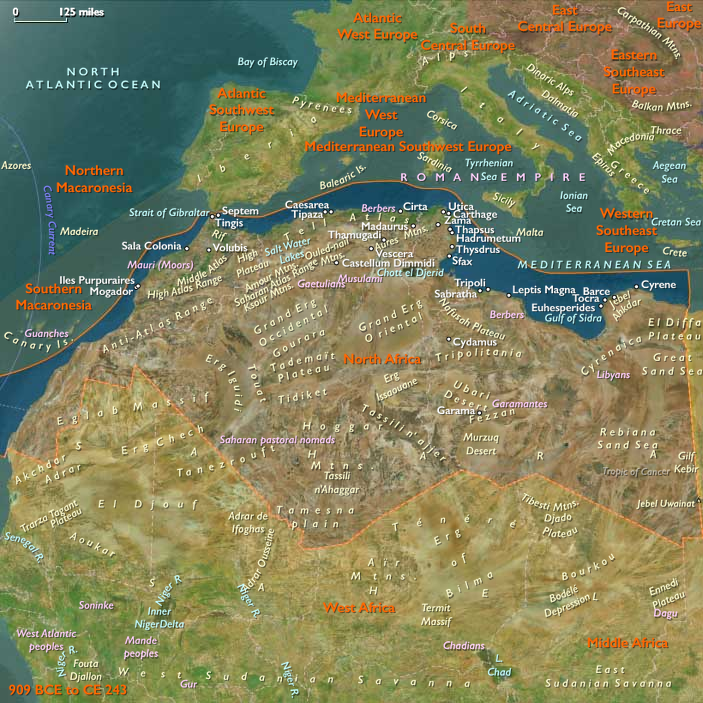
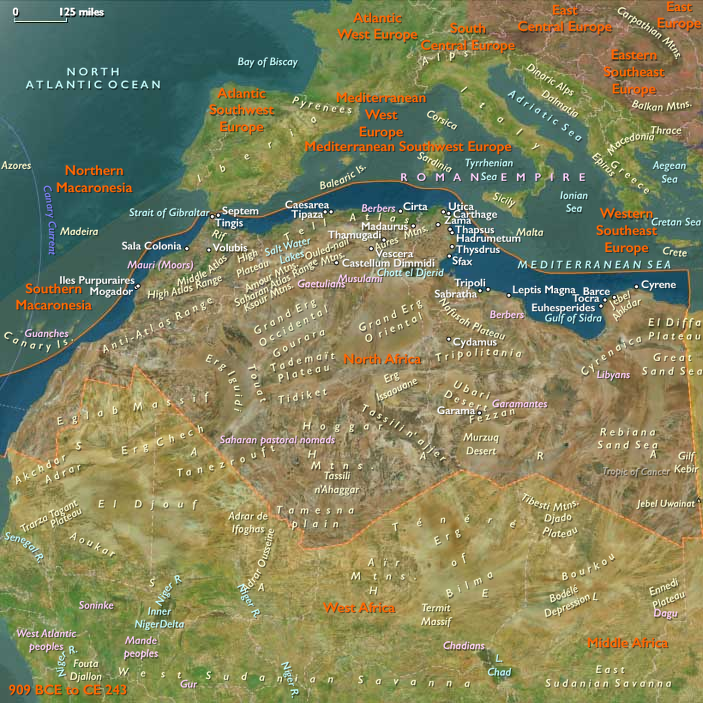
A devastating Zealot-influenced Jewish revolt, perhaps aided and abetted by Parthia, interrupts the prosperity of ungarrisoned Roman Cyrene, home to both a large Greek and large Jewish population, while Trajan is occupied in 115 in fighting the Armenians and the Parthians.
The rebels, led by one named either Lukuas or Andreas, mocked by the Romans as “king of the Jews,” burn buildings and kill or injure a great number of Greeks and Romans, perceiving the Romans to be even worse oppressors than the Greeks.
Lukuas’s group destroyed many temples, including those to Hecate, Jupiter, Apollo, Artemis, and Isis, as well as the civil structures that are symbols of Rome, including the Caesareum, the basilica, and the thermae.
Dio Cassius states of Jewish insurrectionaries: "'Meanwhile the Jews in the region of Cyrene had put one Andreas at their head and were destroying both the Romans and the Greeks.
They would cook their flesh, make belts for themselves of their entrails, anoint themselves with their blood, and wear their skins for clothing.
Many they sawed in two, from the head downwards.
Others they would give to wild beasts and force still others to fight as gladiators.
In all, consequently, two hundred and twenty thousand perished.
In Egypt, also, they performed many similar deeds, and in Cyprus under the leadership of Artemio.
There, likewise, two hundred and forty thousand perished.
For this reason no Jew may set foot in that land, but even if one of them is driven upon the island by force of the wind, he is put to death.
Various persons took part in subduing these Jews, one being Lusius, who was sent by Trajan."
(Dio Cassius, Roman History, Volume V., Book 68, paragraph 32) The Jewish Encyclopedia says this about the Cyrene massacres: "By this outbreak Libya was depopulated to such an extent that a few years later new colonies had to be established there (Eusebius, "Chronicle" from the Armenian, fourteenth year of Hadrian).
Bishop Synesius, a native of Cyrene in the beginning of the fifth century, speaks of the devastations wrought by the Jews ("Do Regno," p.
2)."
(Cyrene".
JewishEncyclopedia.com.)
The Jewish Encyclopedia also says that Dio Cassius's accounts are most likely embellished: "For an account of the Jewish war under Trajan and Hadrian, Dion is the most important source (lxviii.
32, lxix.
12–14), though his descriptions of the cruelties perpetrated by the Jews at Cyrene and on the island of Cyprus are probably exaggerated."
(Dion Cassius".
JewishEncyclopedia.com.)
The revolt, possibly messianic in origin and marked by bloody violence and destruction (Dio Cassius, writing fifty years after the event, claims that the rebels practiced cannibalism and killed two hundred and twenty thousand people), spreads to Jews in Asia Minor, Cyprus, Egypt, Judaea and Mesopotamia.
Locations
People
Groups
- Jews
- Greeks, Hellenistic
- Crete and Cyrenaica (Roman province)
- Roman Empire (Rome): Nerva-Antonine dynasty
Topics
- Classical antiquity
- Roman colonization
- Pax Romana
- Jewish–Roman wars
- Kitos War, or Second Jewish-Roman War, or Jewish Revolt of 115-17
Commodoties
Subjects
Regions
Subregions
Related Events
Showing 10 events out of 61243 total
Years: 115 - 115
Locations
People
Groups
- Jews
- Greeks, Hellenistic
- Crete and Cyrenaica (Roman province)
- Roman Empire (Rome): Nerva-Antonine dynasty
Topics
- Classical antiquity
- Roman colonization
- Pax Romana
- Jewish–Roman wars
- Kitos War, or Second Jewish-Roman War, or Jewish Revolt of 115-17
Commodoties
Subjects
Regions
Subregions