
Apries had contained the mutiny of soldiers …
Years: 573BCE - 562BCE
Apries had contained the mutiny of soldiers from the strategically important Aswan garrison, and in the late 570s had attempted to protect Libya from incursions by Dorian invaders but his efforts here had backfired spectacularly as his forces were mauled by the Greeks.
When the defeated army returned home, a civil war had broken out between the indigenous Egyptian army troops and foreign mercenaries in the Egyptian army.
The native troops suspect that they have been betrayed in order that Apries, the reigning king of the Twenty-sixth Dynasty, might rule more absolutely by means of his mercenaries, and their friends in Egypt fully sympathize with them.
The Egyptians at this time of crisis turn in support towards a victorious general of common origin, who had led Egyptian forces in a highly successful invasion of Nubia in 592 BCE under pharaoh Psamtik II, Apries' father.
The general quickly declares himself pharaoh Amasis II in 570 BCE and Apries, who has now to rely entirely on his mercenaries flees Egypt and seeks refuge in another foreign country.
When Apries marches back to Egypt in 567 BCE with the aid of a Babylonian army to reclaim the throne of Egypt, he is likely killed in battle with Amasis' forces.
Amasis then marries Chedebnitjerbone II, one of the daughters of his predecessor, in order to legitimize his kingship and become the unchallenged ruler of Egypt.
His kingdom consists probably of Egypt only, as far as the First Cataract, but to this he adds Cyprus in 570, and his influence is great in Cyrene.
Amasis cultivates the friendship of the Greek world, and brings Egypt into closer touch with it than ever before.
Herodotus relates that under his prudent administration Egypt reached the highest pitch of prosperity; he adorns the temples of Lower Egypt especially with splendid monolithic shrines and other monuments (his activity here is proved by remains still existing).
To the Greeks, Amasis assigns the commercial colony of Naucratis on the Canopic branch of the Nile, and when the temple of Delphi is burnt he contributes one thousand talents to the rebuilding.
He also marries a Greek princess named Ladice, the daughter of Battus, king of Cyrene, and he makes alliances with Polycrates of Samos and Croesus of Lydia.
In the fourth year of the reign of Amasis II, Babylon’s Nebuchadnezzar II unsuccessfully attacks Egypt; henceforth, the Babylonians experience sufficient difficulties controlling their empire that they are forced to abandon future attacks against Amasis.
Locations
People
Groups
- Egyptians
- Dorians
- Kush, Kingdom of
- Berber people (also called Amazigh people or Imazighen, "free men", singular Amazigh)
- Greece, classical
- Cyprus, Classical
- Greeks, Classical
- Egypt (Ancient), Late Period of
- Neo-Babylonian, or Chaldean, Empire
Topics
- Younger Subboreal Period
- Iron Age, Near and Middle East
- Greek colonization
- Iron Age Cold Epoch
- Classical antiquity
Commodoties
Subjects
Regions
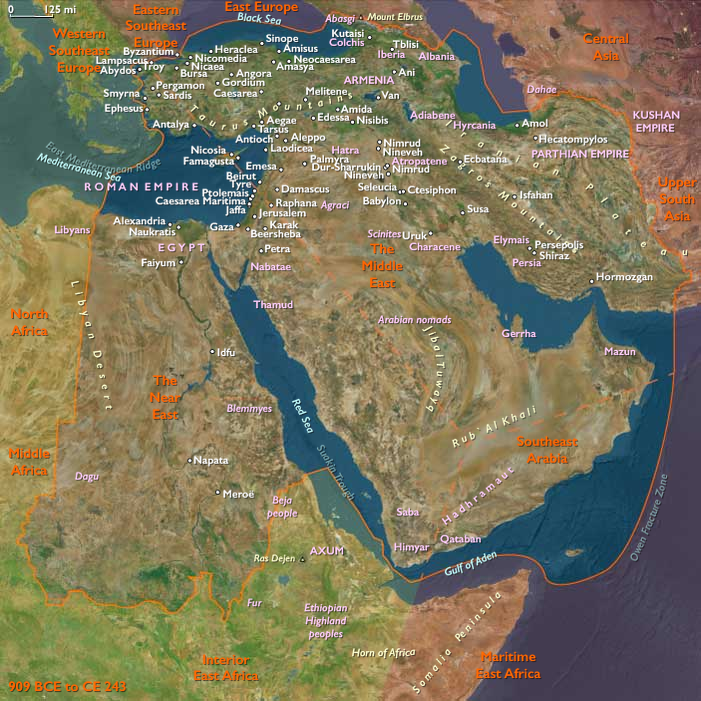
Subregions
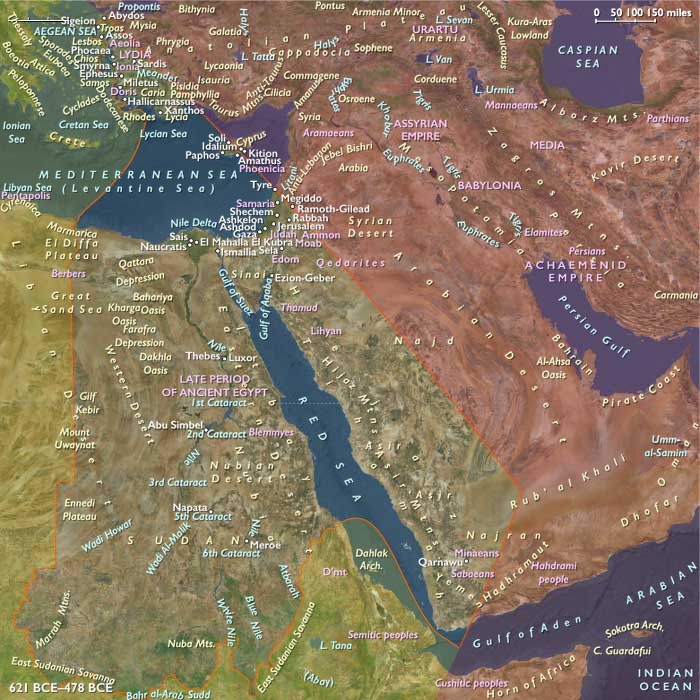
Years: 573BCE - 562BCE
Locations
People
Groups
- Egyptians
- Dorians
- Kush, Kingdom of
- Berber people (also called Amazigh people or Imazighen, "free men", singular Amazigh)
- Greece, classical
- Cyprus, Classical
- Greeks, Classical
- Egypt (Ancient), Late Period of
- Neo-Babylonian, or Chaldean, Empire
Topics
- Younger Subboreal Period
- Iron Age, Near and Middle East
- Greek colonization
- Iron Age Cold Epoch
- Classical antiquity
Commodoties
Subjects
Regions
Subregions