The Oghuz Turks who have captured Seljuq …
Years: 1154 - 1154
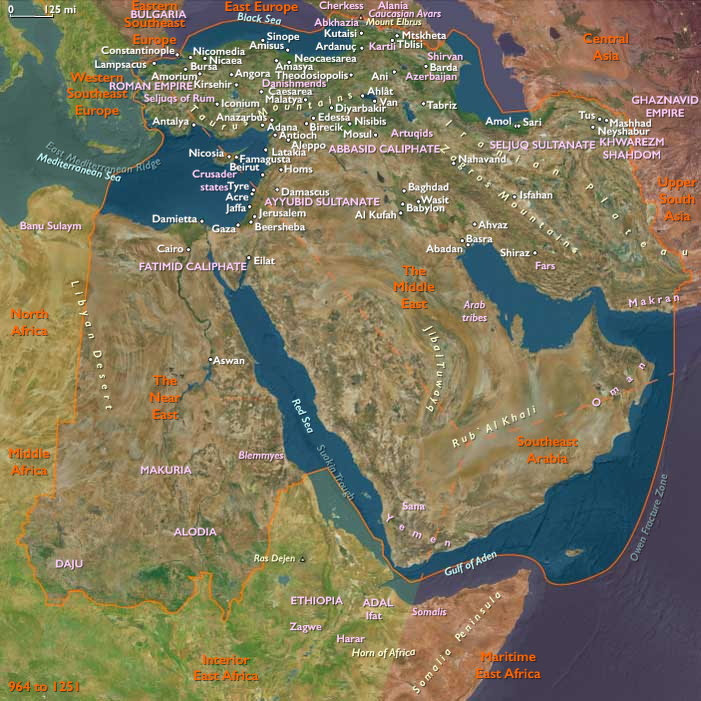
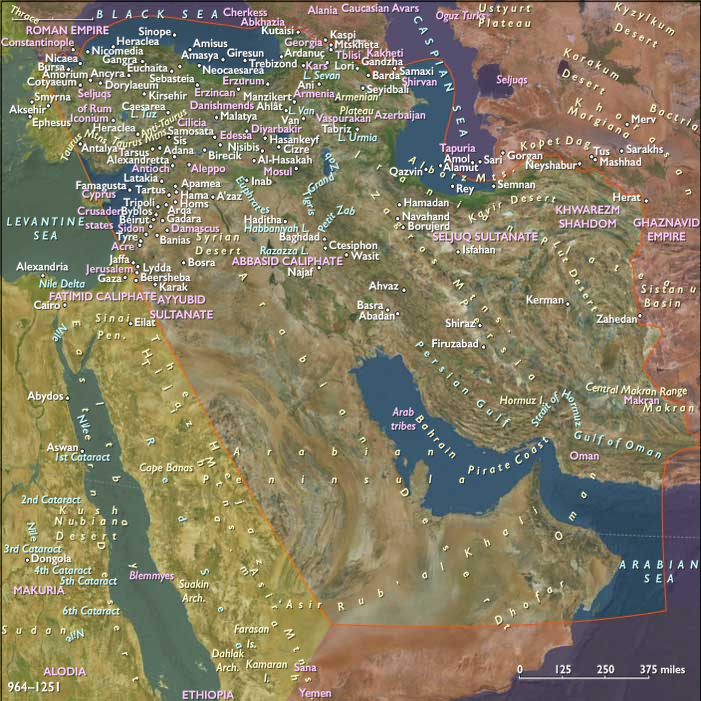
The Oghuz Turks who have captured Seljuq sultan Sanjar sack Nishapur, killing a famous Shafi'i jurist, Muhammad ibn Yahya.
Locations
People
Groups
Commodoties
Subjects
Regions
Subregions
Related Events
Filter results
Showing 10 events out of 48649 total
Tallinn, the capital of Estonia, is first marked on the world map by Al Idrisi.
The beginning of Finland's nearly seven hundred-year association with the Kingdom of Sweden is traditionally connected with the year 1154 and the hypothesized introduction of Christianity by Sweden's King Erik.
However, archaeological evidence points to prior Christian influences in southwestern and southeastern Finland and include both western and eastern Christian artifacts.
For example, Finland had been mentioned together with Estonia in a list of Swedish provinces drawn up for the pope in 1120, apparently as a Swedish missionary area.
Conrad’s successor Frederick Barbarossa, in a move to placate his young Welf rival, confirms Henry’s rights as duke of both Saxony and Bavaria in 1154.
The Greeks find it hard to to accept the fact that their empire, centered on Constantinople, might soon become simply one among a number of Christian principalities.
Emperor Manuel had retained the personal friendship and the alliance of the German emperor Conrad III against the Normans and even planned a joint Greek-German campaign against them in Italy, but after 1152, no such cooperation has been possible with Conrad's successor.
To Frederick, the alliance between the Roman Empire of Germany and what he calls “the kingdom of the Greeks” is not one between equals.
After Roger II of Sicily dies at fifty-eight in 1154, Manuel launches a vain invasion of the Norman kingdom on his own account, in support of the rebel towns and the barons, who have rallied around Robert III of Loritello, the cousin of William, Roger’s fourth but oldest surviving son and thus Sicily’s new king.
Ascalon’s conquest in 1153 by the Crusaders is offset in the next year by the occupation of Damascus under Nur ad-Din: one more stage in the encirclement of the crusader states by a single Muslim power.
Najm ad-Din Ayyub ibn Shadhi, for whom the Ayyubid dynasty will later be named, is a member of a family of Kurdish soldiers of fortune who had early in the twelfth century taken service under the Seljuq Turkish rulers in Iraq and Syria.
In 1137/38, on the night of the birth of his son Saladin—in full Salah Ad-din Yusuf Ibn Ayyub (“Righteousness of the Faith, Joseph, Son of Job”)—Ayyub had gathered his family and moved from Tikrit in Mesopotamia to Aleppo, there entering the service of Zengi.
Upon Ayyub’s appointment as governor of Damascus, he and his brother Asad ad-Din Shirkuh unite Syria in preparation for war against the crusaders.
Saladin had apparently spent an undistinguished youth growing up in Baalbek and Damascus, with a greater taste for religious studies than military training; his formal career begins when he joins Shirkuh’s staff.
Most of Bosnia became vassal to Hungary as well after Croatiaentered personal union with the Hungarian kingdom in in 1102.
King Bela II of Hungary had claimed the Duchy of Rama, a region of northern Herzegovina, since 113.
His title since the Council at Ostrogon in 1138 had included "rex Ramae", likely referring to all of Bosnia.
Bosnia has found itself outside the control of various forces and, beginning with the reign of ban Borić in 1154, emerges as a semi-independent Banate under the sovereignty of the King of Hungary, an independent state under the rule of local bans.
The Zirid Emirate of Granada, the former site of an Iberian settlement, Elibyrge, in the fifth century BCE and of the Roman Illiberis, falls to the Almohads in 1154 after six years of siege.
Roger II of Sicily dies at Palermo on February 26, 1154 and is buried in the Cathedral of Palermo.
He is succeeded by his fourth son, William, who had grown up with little expectation of ruling.
The deaths of his three older brothers Roger, Tancred, and Alfonso between 1138 and 1148 had changed matters, though when his father dies William is still not well-prepared to take his place.
On assuming power, William keeps the administration that had guided his father's rule for his final years.
Only the Englishman Thomas Brun is removed, and the chancellor Maio of Bari is promoted.
The real power in the kingdom is at first exercised by Maio, a man of low birth, whose title ammiratus ammiratorum is the highest in the realm.
Maio continues Roger's policy of excluding the nobles from the administration, and seeks also to curtail the liberties of the towns.
The barons, always chafing against the royal power, are encouraged to revolt by Pope Adrian IV, whose recognition William has not yet sought, by the East Roman Emperor Manuel I Komnenos, and by the Holy Roman Emperor Frederick I, who had had canceled his plan to invade Sicily when Roger died.
Continuing his father’s ambitions, William offers peace to Manuel, is refused, and then makes peace with Venice, thus depriving Constantinople of a war fleet.

Muhammad al-Idrisi, born and raised in Ceuta, had at an early age traveled to Islamic Spain, Portugal, France and England, and visited Anatolia when he was barely sixteen.
Because of conflict and instability in Al-Andalus, al-Idrisi had joined contemporaries such as Abu al-Salt in Sicily, where the Normans had overthrown Arabs formerly loyal to the Fatimids.
Al-Idrisi has incorporated the knowledge of Africa, the Indian Ocean and the Far East gathered by Islamic merchants and explorers and recorded on Islamic maps with the information brought by the Norman voyagers to create the most accurate map of the world in pre-modern times, which serves as a concrete illustration of his Kitab nuzhat al-mushtaq, (Latin: Opus Geographicum), which may be translated A Diversion for the Man Longing to Travel to Far-Off Places.
His atlas of the world, the Tabula Rogeriana, is drawn by Al-Idrisi in 1154 for the Norman King Roger II of Sicily, after a stay of eighteen years at his court, where he has worked on the commentaries and illustrations of the map.
The map, with legends written in Arabic, while showing the Eurasian continent in its entirety, only shows the northern part of the African continent and lacks details of the Horn of Africa and Southeast Asia.
For Roger it is inscribed on a massive disc of solid silver, two meters in diameter.
The Tabula Rogeriana will remain one of the most accurate maps until the Age of Discovery.
Norman buildings in Naples, a Sicilian possession, are, apart from the church of San Giovanni a Mare, mainly lay ones, notably castles, walls and fortified gates.
The Norman rulers begin construction of the Castel Capuano and the Castel dell'Ovo (”Egg Castle”) in 1154.