
Evidence of settlement at present-day Wiesbaden dates …
Years: 6 - 6
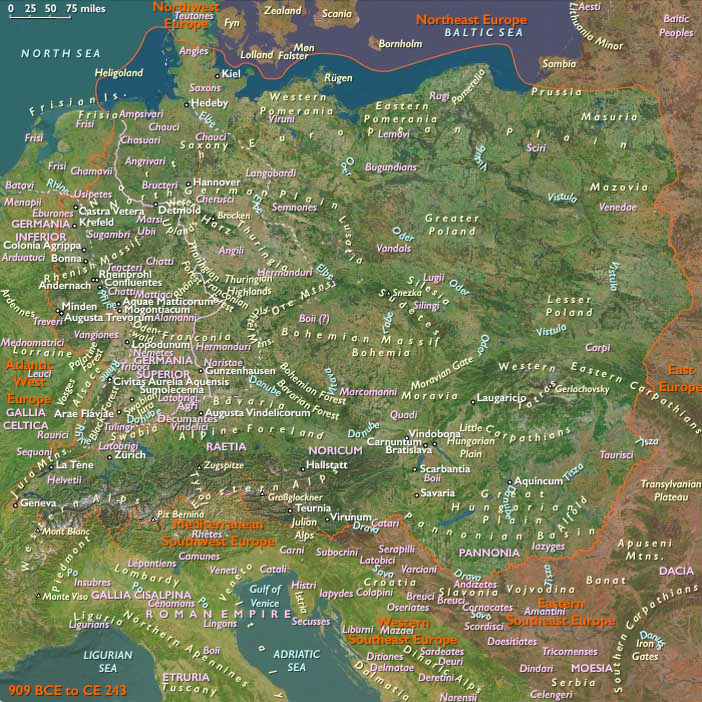
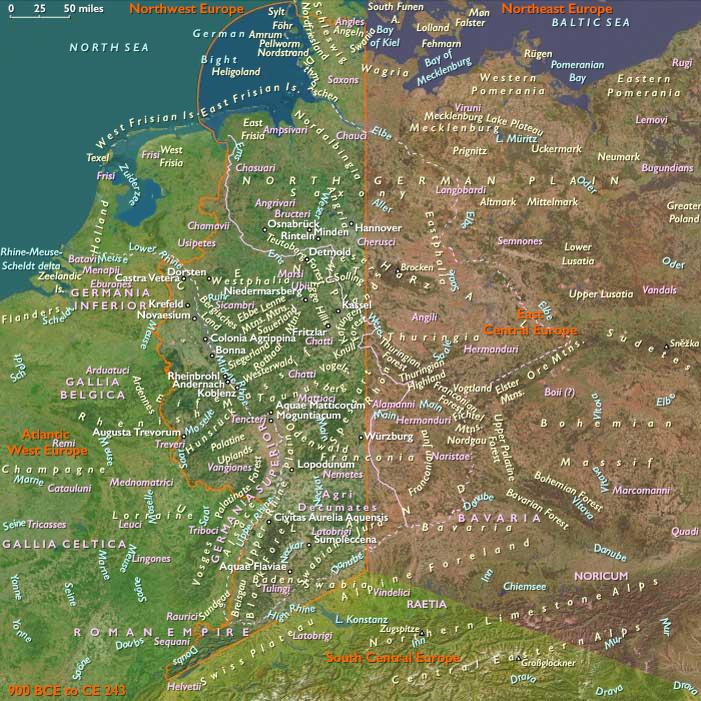
Evidence of settlement at present-day Wiesbaden dates back to the Neolithic era; historical records document continuous occupancy after the erection in CE 6 of a Roman fort, which houses an auxiliary cavalry unit.
The thermal springs of Wiesbaden, first mentioned in Pliny the Elder's Naturalis Historia, are famous for their recreation pools for Roman army horses and as the source of a mineral used for red hair dye (which is very fashionable around the turn of BCE/CE among women in Rome).
The emperor Augustus’ stepsons Tiberius and his brother Drusus, together with Drusus’ son Germanicus (an agnomen that he received in 9 BCE, when it was posthumously awarded to his father in honor of his victories in Germania, the area north of the Upper Danube and east of the Rhine) had in the opening years of the first century conducted a long campaign in an attempt at a further major expansion of the Empire's frontiers, and a shortening of its frontier line.
They had subdued several Germanic tribes, such as the Cherusci.
The region in CE 7 is declared pacified and Publius Quinctilius Varus is appointed to govern Germania, leading three legions and auxiliary troops.
Tiberius, who will later succeed Augustus as Emperor, leaves the region to deal with the Great Illyrian Revolt.
Varus after serving as of Syria had returned to Rome and remained there for the next few years.
Following the death of his first wife, he had married Claudia Pulchra, daughter of Claudia Marcella Minor (daughter of consul Gaius Claudius Marcellus Minor and Octavia Minor, elder sister of Augustus) and consul Aemilius Lepidus Paullus (nephew of Triumvir Marcus Aemilius Lepidus).
She is a great-niece of Augustus, which shows that Varus still enjoys political favor.
They have a son, Quinctilius Varus.
Locations
People
Groups
Topics
- Classical antiquity
- Roman colonization
- Pre-Roman Iron Age of Northern Europe
- Roman Age Optimum
- Pax Romana
- Roman Northern Frontier Wars of 24 BCE-CE 16
Commodoties
Subjects
Regions
Subregions
Related Events
Showing 10 events out of 62050 total
Years: 6 - 6
Locations
People
Groups
Topics
- Classical antiquity
- Roman colonization
- Pre-Roman Iron Age of Northern Europe
- Roman Age Optimum
- Pax Romana
- Roman Northern Frontier Wars of 24 BCE-CE 16
Commodoties
Subjects
Regions
Subregions