
The Venetians in Constantinople, and a Genoese …
Years: 1453 - 1453
April
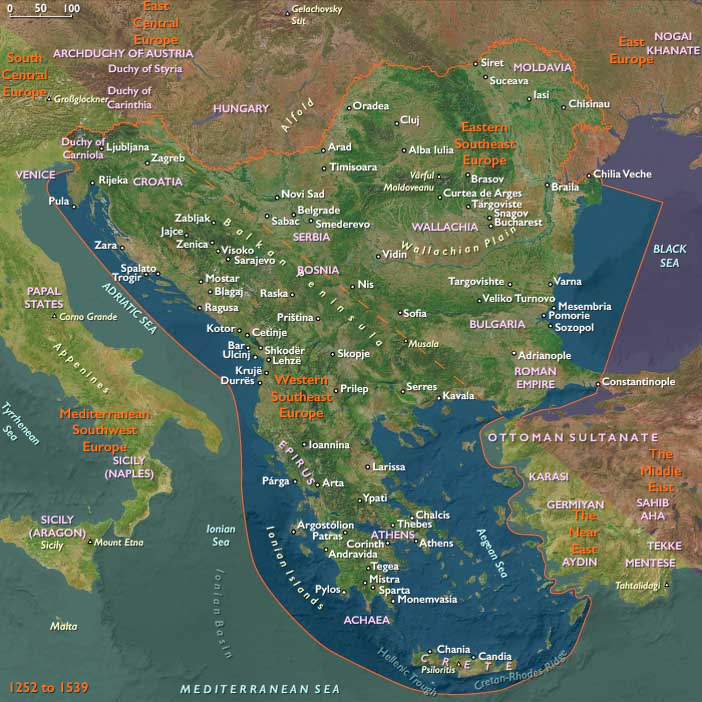
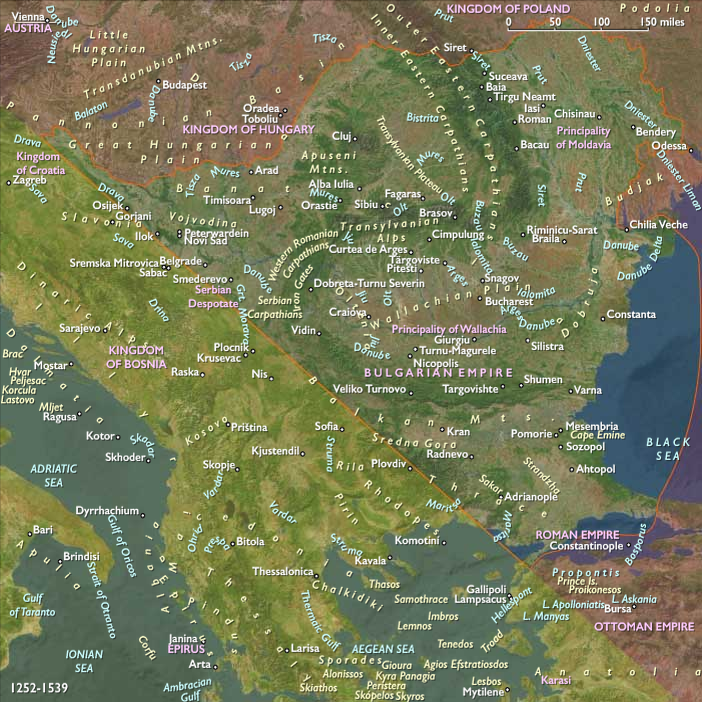
The Venetians in Constantinople, and a Genoese contingent commanded by Giovanni Giustiniani, wholeheartedly cooperate in the defense of the city, however, when the crisis comes.
Constantine commands an army of only ten thousand men, left as the city's sole defenders after the Turkish navy drives off an assisting Venetian naval fleet and erects a blockade.
Mehmed lays siege to the walls in April 1453.
A chain that the Greeks have thrown across the mouth of the Golden Horn obstructs his ships.
The ships are therefore dragged overland to the harbor from the seaward side, bypassing the defenses.
The Sultan's heavy artillery, fifty-six giant, stone-ball-firing cannons and twelve bombards, continually batters the city's massive land walls, which the defenders are finally unable to block off.
Gunpowder thus becomes recognized as a decisive weapon.
During the siege, the opposing views on the Ottoman side are voiced in two war councils convened at critical moments.
Zaganos vehemently rejects the proposal to raise the siege.
He is given the task of preparing the last great assault.
The commander in chief, Mehmed II himself, on the day of the attack personally directs the operations against the breach opened in the city wall by his cannon.
On May 29, some of his soldiers force their way in.
Giustiniani is mortally wounded.
The emperor Constantine is last seen fighting on foot at one of the gates.
The day after the capture of the city, Candarli is arrested and soon afterwards is executed in Edirne.
He is replaced by Zaganos, who has become Mehmed's father-in-law.
Mehmed had had to consent to a three-day sack of the city, but, before the evening of the first day after its capture, he countermands his order.
Entering the city at the head of a procession, he goes straight to Hagia Sophia and converts it into a mosque, adding four minarets at the perimeter of the structure.
Afterward, he establishes charitable foundations and provides fourteen thousand gold ducats per annum for the upkeep and service of the mosque.
The Turks also convert Saint Savior in the Chora to a mosque, calling it Kariye Djami, and whitewash (and thus protect, perhaps inadvertently) its magnificent mosaics and frescoes.
Locations
People
Groups
- Genoa, (Most Serene) Republic of
- Venice, (Most Serene) Republic of
- Roman Empire, Eastern: Palaiologan dynasty
- Ottoman Empire
- Ottoman Empire
Topics
Commodoties
Subjects
Regions
Subregions
Related Events
Showing 10 events out of 41477 total
Years: 1453 - 1453
April
Locations
People
Groups
- Genoa, (Most Serene) Republic of
- Venice, (Most Serene) Republic of
- Roman Empire, Eastern: Palaiologan dynasty
- Ottoman Empire
- Ottoman Empire
Topics
Commodoties
Subjects
Regions
Subregions