
Egypt under the Saite dynasty had at …
Years: 573BCE - 562BCE
Egypt under the Saite dynasty had at the end of the seventh century BCE become the predominant power in the eastern Mediterranean when the Assyrian Empire finally broke up.
The Cypriot kingdoms in about 569 recognize the pharaoh Amasis II as their overlord.
Direct Egyptian influence is not always apparent, but many limestone sculptures reproduce Egyptian conventions in dress, and Egyptian models directly inspire some statues.
Locations
People
Groups
Topics
Subjects
Regions
Subregions
Related Events
Filter results
Showing 10 events out of 65873 total
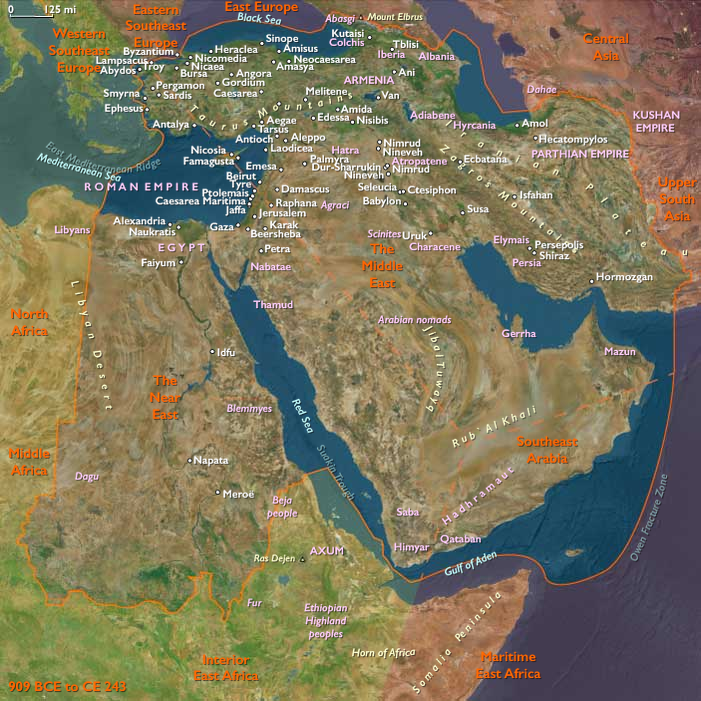
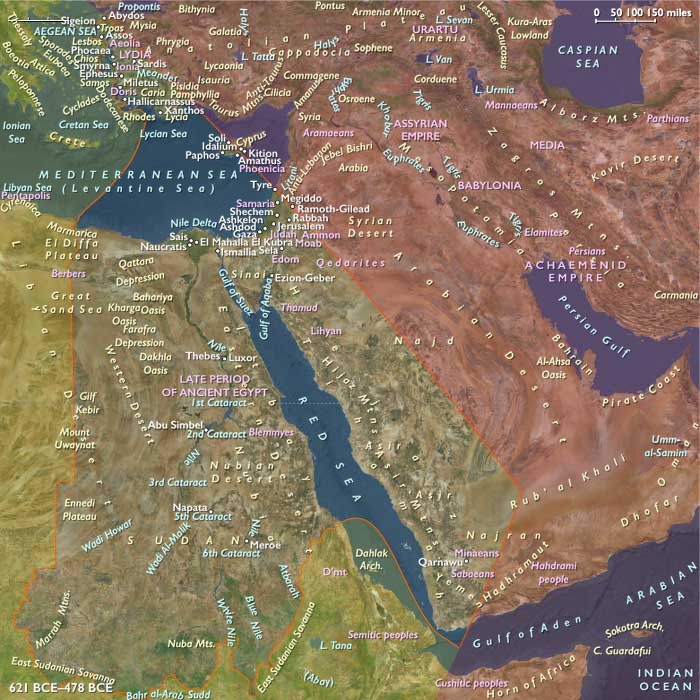
The Middle East: 573–562 BCE
Nebuchadnezzar’s Final Campaigns and Legacy
Following the destruction of Jerusalem and the Judahite exile of 586 BCE, the dispersed community begins emphasizing religious rituals and laws to preserve their identity outside their homeland. Practices such as circumcision, Sabbath observance, dietary restrictions, and cleanliness laws become vital for maintaining cohesion among the scattered Judahites.
After concluding a prolonged thirteen-year siege of Tyre (585–572 BCE) in a negotiated compromise, Nebuchadnezzar II turns his attention toward Egypt. A cuneiform tablet records Nebuchadnezzar’s campaign against Pharaoh Amasis, although the outcome appears indecisive.
The Architectural Grandeur of Babylon
In the twilight of his reign, Nebuchadnezzar focuses extensively on the architectural revival of Babylon. His construction projects are monumental and lavish, including temples, canals, reservoirs, aqueducts, and a remarkable triple line of defensive walls. He also restores Sippar’s Lake and builds a strategic port on the Persian Gulf, significantly enhancing Babylon’s infrastructure and defenses.
Notable among his grand constructions is the legendary Ishtar Gate, which, along with various trophies of war, adorns Babylon. The famed Hanging Gardens, built for his Median queen Amytis, stand as a testament to the opulence of Nebuchadnezzar's Babylon, designed specifically to evoke the lush landscapes of her Median homeland.
Prophecy and Historical Literature
This period witnesses the flourishing of Hebrew prophetic literature. The prophet Jeremiah, residing near Jerusalem, continues to advocate moral reform, repentance, and a profound renewal of spiritual commitment amid ongoing crises. His introspective and deeply spiritual "confessions" influence significantly the Hebrew scriptures. During these years, a significant portion of the Deuteronomistic History, including the narrative found in the Book of Kings, is likely finalized, embedding Jeremiah’s theological perspectives into the historical narrative of Israel and Judah.
Diplomatic Realignments in Media and Lydia
Following the Battle of Halys and the subsequent peace treaty mediated by Babylon and Cilicia, Astyages ascends the Median throne in 585 BCE. His reign solidifies Median dominance in the Iranian plateau, including Persian territories. To reinforce political stability, Astyages arranges the marriage of his daughter Mandane to Cambyses I, a Persian noble from the kingdom of Anshan. Cambyses, known for his peaceful and diplomatic demeanor, strengthens Median-Persian ties significantly.
Thus, the era from 573 to 562 BCE consolidates significant religious, cultural, and political developments, marking the apex of Nebuchadnezzar’s architectural legacy and signaling pivotal shifts in the geopolitical and religious landscapes of the Middle East.
The majority of Judahites live outside the Holy Land following the destruction of the Temple in 586.
Lacking a state and scattered among the peoples of the Near East, the Judahites need to find alternative methods to preserve their special identity.
They turn to the laws and rituals of their faith, which become unifying elements holding the community together.
Thus, circumcision, sabbath observance, festivals, dietary laws and laws of cleanliness become especially important.
After the destruction of Jerusalem, Nebuchadnezzar had engaged in a thirteen year siege of Tyre (585–572 BCE), which ends in a compromise, with the Tyrians accepting Babylonian authority.
Following the pacification of Tyre, Nebuchadnezzar turns again to Egypt.
A clay tablet, now in the British Museum, states: "In the 37th year of Nebuchadnezzar, king of the country of Babylon, he went to Mitzraim (Egypt) to wage war.
Amasis, king of Egypt, collected [his army], and marched and spread abroad."
Having completed the subjugation of Phoenicia, and campaigned against Egypt, Nebuchadnezzar sets himself to rebuild and adorn the city of Babylon, and constructs canals, aqueducts, temples and reservoirs.
Outside Babylon, he is credited with the restoration of the Lake of Sippar, the opening of a port on the Persian Gulf, and the building of the famous Median wall between the Tigris and the Euphrates to protect the country against incursions from the North.
The inscription of the great temple of Marduk implies most probably that captives brought from various parts of Western Asia made up a large part of the labor force used in all his public works.
Events of the last years of Nebuchadnezzar are obscure.
The king figures prominently in the biblical Book of Daniel, which describes Nebuchadnezzar as eating grass and undergoing a physical transformation near the end of his life.
(Conversely, the Dead Sea Scrolls suggest that it was not Nebuchadnezzar, but the last Chaldean king, Nabonidus, who suffered from some such affliction.)
According to Babylonian tradition, towards the end of his life, Nebuchadnezzar prophesied the impending ruin of the Chaldean Empire (Berossus and Abydenus in Eusebius, Praeparatio Evangelica, 9.41).
Old, even senile, perhaps dethroned by his own son, Amel-Marduk, Nebuchadnezzar dies in 562 BCE in Babylon between the second and sixth months of the forty-third year of his reign.
Near East (573–562 BCE): Diplomatic Realignments and Power Shifts
Naukratis and Greek Influence in Egypt
The Ionian city of Miletus had earlier founded Naukratis, a prominent Greek settlement in Egypt’s Nile Delta. By this period, Greeks from various city-states have also settled here, creating a dynamic cultural and commercial hub. As an emporion, or exclusive trading station, Naukratis becomes a pivotal center for Greek-Egyptian interactions, significantly influencing cultural relations in the pre-Hellenistic Mediterranean. To manage Greek influence more carefully, Egyptian Pharaoh Amasis II (reigned 570–526 BCE) confines all Greek merchants to Naukratis, southwest of his capital, strengthening Egyptian control over foreign trade.
Turmoil and Diplomacy in Cyrene
In neighboring Libya, the prosperous Greek colony of Cyrene sees its harmonious Greek-Libyan relations disrupted around 570 BCE due to increased immigration of Greek settlers and internal factional disputes under King Battus III. Conflict escalates, resulting in Cyrene repulsing an Egyptian invasion around the same year. However, this hostility transitions into diplomacy: Pharaoh Amasis II successfully forges an alliance with Cyrene by marrying Ladice, daughter of King Battus, consolidating Egyptian influence and mitigating tensions along Egypt’s western border.
Amasis II’s Rise and Egypt’s Resurgence
Previously a victorious Egyptian general under Pharaoh Psamtik II, Amasis II ascends the throne following a rebellion against Pharaoh Apries (Wahibre), who had disastrously mismanaged conflicts in Libya and internal military tensions. In 570 BCE, Egyptian native soldiers, suspecting betrayal by Apries, rally around Amasis. Following Apries’ defeat and exile, he returns with Babylonian support in 567 BCE but is likely killed in battle against Amasis’ forces. To legitimize his reign further, Amasis marries Apries’ daughter, Chedebnitjerbone II, becoming Egypt's uncontested ruler.
Egypt’s Mediterranean Ambitions and Greek Alliances
Under Amasis, Egypt asserts control over Cyprus around 570 BCE, with the island’s kingdoms formally recognizing him as their overlord. Cypriot art and statuary from this period frequently mirror Egyptian conventions, showcasing Egypt’s wide cultural influence. Amasis diligently cultivates strong alliances within the Greek world, making significant diplomatic gestures, including financial support for the reconstruction of the temple at Delphi. His friendly relations extend notably to Polycrates, tyrant of Samos, and to Croesus, the wealthy king of Lydia.
Nebuchadnezzar II and Babylonian Constraints
Meanwhile, Babylon, under King Nebuchadnezzar II, attempts to challenge Egyptian ascendancy. In the fourth year of Amasis’ reign (ca. 567 BCE), Nebuchadnezzar leads a military campaign against Egypt. This assault fails, forcing the Babylonians to retreat and redirect their energies to stabilizing their vast empire. The unsuccessful invasion underscores Egypt’s resilience and the limitations of Babylonian military capabilities at the empire's farthest reaches.
Edomite and Nabataean Movements in Jordan
The weakening of Judah following the Babylonian captivity provides a political vacuum in the region now known as Jordan. As Edomites increasingly relocate into southern Palestine—where they will later become known as Idumaeans in Roman times—an Arabian people, the Nabataeans, begin moving into traditional Edomite territory. Nabataean inscriptions gradually appear, signaling shifting settlement patterns and foreshadowing the rise of Nabataea as a regional power.
Legacy of the Era
This era notably represents a significant diplomatic and cultural reshuffling in the Near East. Egypt under Amasis II experiences heightened prosperity, expanded regional dominance, and increased integration with the Greek world. Meanwhile, Babylonia, despite its vast territorial holdings, encounters strategic limitations. The dynamics between Greek colonies, local powers, and major empires underline a complex geopolitical landscape that sets the stage for subsequent historical developments.
Milesians had established Naukratis, a Greek settlement in the Nile River delta, on the Canopic (western) branch of the river, in the seventh century BCE, but Greeks from other cities have also settled here.
An emporion (“trading station”) with exclusive trading rights in Egypt, Naukratis is the center of cultural relations between Greece and Egypt in the pre-Hellenistic period.
Friendly relations have existed for some time between the Greeks of Cyrene the local peoples , and there is more intermarriage with non-Greek women than is usual in Greek colonies.
Greek-Libyan relations break down Around 570 BCE after a further influx of Greek colonists who are attracted by Cyrene's increasing prosperity; the new constitution granted under Battus III fails to allay dissension among the rival domestic factions.
Cyrene in 570 also repulses an invasion by the Egyptians.
Pharaoh Amasis II, the former Egyptian general who had seized the throne during a revolt against Apries, had turned to diplomacy, securing an alliance with Cyrene by marrying a woman of that country and seeking alliances in Greece.
Herodotus tells of his friendship with Polycrates, tyrant of Samos, and mentions his donation toward rebuilding the temple at Delphi.
Nonetheless, to regulate Greek influence in Egypt, he confines merchants to the city of Naukratis, southwest of his own capital.
The history of the region now called Jordan under the Neo-Babylonians and Persians is scanty.
The brief Babylonian captivity of the Hebrews that began in 586 BCE opened a minor power vacuum in Judah (prior to the Judahites’ return under the Persian King, Cyrus), and as Edomites moved into open Judaean grazing lands, Nabatean inscriptions began to be left in Edomite territory as the Nabataeans, an Arabian people whose settlements lie in the borderlands between Syria and Arabia, from the Euphrates River to the Red Sea, infiltrate Edom.
The Edomites move into southern Palestine, where they will become known in Roman times as Idumaeans.
Apries had contained the mutiny of soldiers from the strategically important Aswan garrison, and in the late 570s had attempted to protect Libya from incursions by Dorian invaders but his efforts here had backfired spectacularly as his forces were mauled by the Greeks.
When the defeated army returned home, a civil war had broken out between the indigenous Egyptian army troops and foreign mercenaries in the Egyptian army.
The native troops suspect that they have been betrayed in order that Apries, the reigning king of the Twenty-sixth Dynasty, might rule more absolutely by means of his mercenaries, and their friends in Egypt fully sympathize with them.
The Egyptians at this time of crisis turn in support towards a victorious general of common origin, who had led Egyptian forces in a highly successful invasion of Nubia in 592 BCE under pharaoh Psamtik II, Apries' father.
The general quickly declares himself pharaoh Amasis II in 570 BCE and Apries, who has now to rely entirely on his mercenaries flees Egypt and seeks refuge in another foreign country.
When Apries marches back to Egypt in 567 BCE with the aid of a Babylonian army to reclaim the throne of Egypt, he is likely killed in battle with Amasis' forces.
Amasis then marries Chedebnitjerbone II, one of the daughters of his predecessor, in order to legitimize his kingship and become the unchallenged ruler of Egypt.
His kingdom consists probably of Egypt only, as far as the First Cataract, but to this he adds Cyprus in 570, and his influence is great in Cyrene.
Amasis cultivates the friendship of the Greek world, and brings Egypt into closer touch with it than ever before.
Herodotus relates that under his prudent administration Egypt reached the highest pitch of prosperity; he adorns the temples of Lower Egypt especially with splendid monolithic shrines and other monuments (his activity here is proved by remains still existing).
To the Greeks, Amasis assigns the commercial colony of Naucratis on the Canopic branch of the Nile, and when the temple of Delphi is burnt he contributes one thousand talents to the rebuilding.
He also marries a Greek princess named Ladice, the daughter of Battus, king of Cyrene, and he makes alliances with Polycrates of Samos and Croesus of Lydia.
In the fourth year of the reign of Amasis II, Babylon’s Nebuchadnezzar II unsuccessfully attacks Egypt; henceforth, the Babylonians experience sufficient difficulties controlling their empire that they are forced to abandon future attacks against Amasis.
The sacred precinct of Nemea, in a valley about twelve miles (nineteen kilometers) from Argos in the Peloponnesus, is famous in Greek myth as the cave-home of the Nemean Lion, which was killed by the hero Heracles and as the place where the infant Opheltes, lying on a bed of wild celery, was killed by a serpent while his nurse fetched water for the Seven on their way from Argos to Thebes.
In his memory, the Seven found the Nemean Panhellenic Games, the fourth of Greece’s great athletic and artistic festivals.
Neméa hosts the games, held in honor of Zeus, establishing the sanctuary of Nemean Zeus to inaugurate them from at least 573 BCE.
The city constructs a palaestra, baths, hotel, and stadium to accommodate the athletic competitions, which include footraces, jumping and throwing events, boxing, wrestling, and chariot races.
The games occur biennially, in the same years as the Isthmian Games, i.e., in the second and fourth years of each Olympiad.
Winners receive crowns of wild celery and the judges wear black robes as a sign of mourning for Opheltes.
The presidency of the Neméan games is held by the city of Cleonae, a small town of Argolis, situated on the road from Argos to Corinth (until about 460 BCE; thereafter it will be held by Argos).
Poverty, though not eliminated, will never again in Attica be the evil that it had been before Solon's reforms.
Solon's new political constitution abolishes the monopoly of the eupatridae and substitutes for it government by the wealthy citizens.
He institutes a census of annual income, reckoned primarily in measures of grain, oil, and wine, the principal products of the soil, and divides the citizens into four income groups, accordingly. (He must rate those whose income is in other forms, including money, on a system of equivalents.)
Henceforth, political privilege will be allotted based on these divisions, without regard to birth.
All citizens are entitled to attend the general Assembly (Ecclesia), which becomes, at least potentially, the sovereign body, entitled to pass laws and decrees, elect officials, and hear appeals from the most important decisions of the courts.
All but those in the poorest group might serve, a year at a time, on a new Council of Four Hundred, which is to prepare business for the Assembly.
The higher governmental posts are reserved for citizens of the top two income groups.
Thus, the foundations of the future democracy are laid, but a strong conservative element remains in the ancient Council of the Hill of Ares (Areopagus), and the people themselves will for a long time prefer to entrust the most important positions to members of the old aristocratic families.
Solon's third great contribution to the future good of Athens is his new code of laws.
He revises every statute except that on homicide and makes Athenian law altogether more humane. (His code, though supplemented and modified, will remain the foundation of Athenian statute law until the end of the fifth century, and parts of it will be embodied in the new codification made at that time.)
When Solon has completed his task, complaints come in from all sides, but the Athenians, though discontented, stand by their promise to accept Solon's dispositions; they are given validity for one hundred years and posted for all to see on revolving wooden tablets.
To avoid having to defend and explain them further, Solon sets off on a series of travels, undertaking not to return for ten years. (He certainly visits Egypt and Cyprus, and reportedly visits the court of Croesus, King of Lydia, but chronological grounds cast doubt on this account).
Solon's reforms prove only temporarily successful, and civil strife soon breaks out again.
Although Solon has improved the economic position of the Athenian lower classes, his reorganization of the constitution has not eliminated bitter aristocratic contentions for control of the archonship, the chief executive post.
Athenian potters, who have experimented with different techniques, such as silhouette, outline drawing, and the use of white in their vase paintings, gradually concentrate on black figure, borrowing the technique from the Corinthian animal style.
Practitioners of the black-figure style paint figures in silhouette on a light ground and then incise details in the black with a fine instrument, decorating vases with scenes from mythology as well as from daily life.
The black-figure style, particularly suited to a decorative medium such as pottery, is used by a number of excellent artists, some of whom, like Cleitias, the painter of the “Francois Vase,” sign their work.
Elis, the region of the northwestern corner of the Peloponnese bounded on the north by Achaea, on the east by Arcadia, and on the south by Messenia, consists of three districts from north to south: Hollow Elis, which occupies the basin of the Peneus River; Pisatis, occupying the north bank of the Alpheus River; and Triphylia, a hilly area stretching south from the Alpheus to the northern border of Messenia.
The city of Elis, located in Hollow Elis, has engaged in a long struggle with the Pisatians for control of the games, but in 572 BCE, the Eleans decisively subjugate the Pisatians.
Years: 573BCE - 562BCE
Locations
People
Groups
Topics
Subjects
Regions
Subregions