
Caracalla and Geta, proclaimed joint emperors when …
Years: 211 - 211
December
Caracalla and Geta, proclaimed joint emperors when Septimius Severus dies in Eboracum (now York) in the beginning of 211, return to Rome.
As both brothers want to be sole ruler, relations between them become increasingly hostile.
When they try to rule the Empire jointly they actually consider dividing it in halves, but are persuaded not to do so by their mother.
The shared throne is not a success: the brothers argue about every decision, from law to political appointments.
Later sources speculate about the desire of the two of splitting the empire in two halves.
By the end of the year, the situation is unbearable.
Caracalla tries to murder Geta during the festival of Saturnalia without success.
Later in December, he arranges a meeting of reconciliation with his brother in his mother's apartments, and has him murdered in her arms by by members of the Praetorian Guard loyal to him.
Following Geta's assassination, Caracalla orders a damnatio memoriae pronounced by the Senate against his brother's memory, his name to be removed from all inscriptions and his images erased.
Geta's image is simply removed from all coinage, paintings and statues, leaving a blank space next to Caracalla's.
The now sole emperor also takes the opportunity to get rid of his political enemies, on the grounds of conspiracy with the deceased.
Cassius Dio states that around twenty thousand persons of both sexes were killed or proscribed during this time.
Among those killed are Caracalla's ex-wife, Fulvia Plautilla, and her brother and other members of the family of his former father-in-law Gaius Fulvius Plautianus.
Plautianus had already been executed for alleged treachery against emperor Severus in 205 and succeeded by Aemilius Papinianus as Prefect Commander of the Praetorian Guard.
Little is known about Papinianus, who was perhaps of Syrian birth and a native of Emesa, for he is said to have been a kinsman of Septimius Severus' second wife, Julia Domna.
One source shows him as a follower of the casuistry of Quintus Cervidius Scaevola, another shows him to have been his pupil.
A concurring (but dubious) passage in the Augustan History claims that he studied law with Severus under Scaevola.
An intimate friend of the emperor Severus, Papinianus had accompanied him to Britain during 207,where he served in "the forum of York" in response to an uprising by Scottish Highlanders.
He was at some time made a master of petitions (requests), magister libellorum, by Severus.
He also served as Treasurer and Captain of the Guard for the Emperor.
Before the emperors' death, he had commended his two sons Caracalla and Geta into the lawyers' charge.
Sharing in the governship of the Roman Empire with Geta proves unsatisfactory for Caracalla, who decides at sometime to usurp his brother.
Papinian’s efforts at keeping peace between the brothers only proves to encourage the hatred of Caracalla, who consequently passes an order to have the lawyer beheaded (Spart.
Caracall.
4), and his body dragged through the streets of Rome.
His death follows the fratricide of Geta, among the general slaughter of his friends and those perceived associated with him.
The author of the 1911 Encyclopædia Britannica article though states that the details of Papinianus' death "are variously related, and have undergone legendary embellishment."
Much of his output has been lost, as what we have is small compared to other jurists such as Ulpian or Paul.
The principal works of Papinianus include: Quaestiones in thirty-seven books (written before 198); nineteen books of Responsa (written sometime between 204 and his death); two books of Definitiones; two books De adulteriis, and other works, the shortest of these being a manual on the duties for commissioner's of streets and bridges.
Papinianus will become one of the most revered of Roman Jurists by the Romans, as third year law students were given the title "Papinianistae" ("they that are worthy to study Papinian").
Locations
People
Groups
Topics
Commodoties
Subjects
Regions
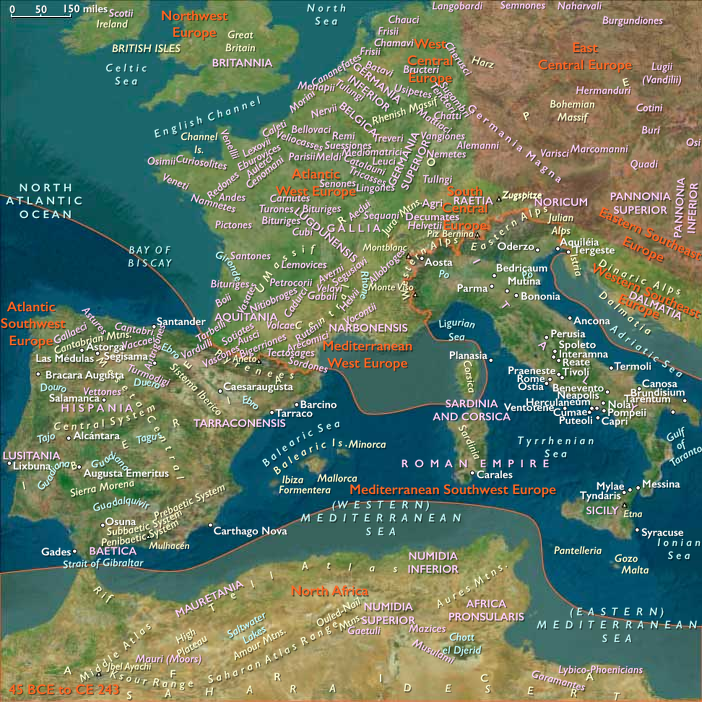
Subregions
Years: 211 - 211
December
Locations
People
Groups
Topics
Commodoties
Subjects
Regions
Subregions