
The Walker party's discovery of gold in …
Years: 1864 - 1864
December
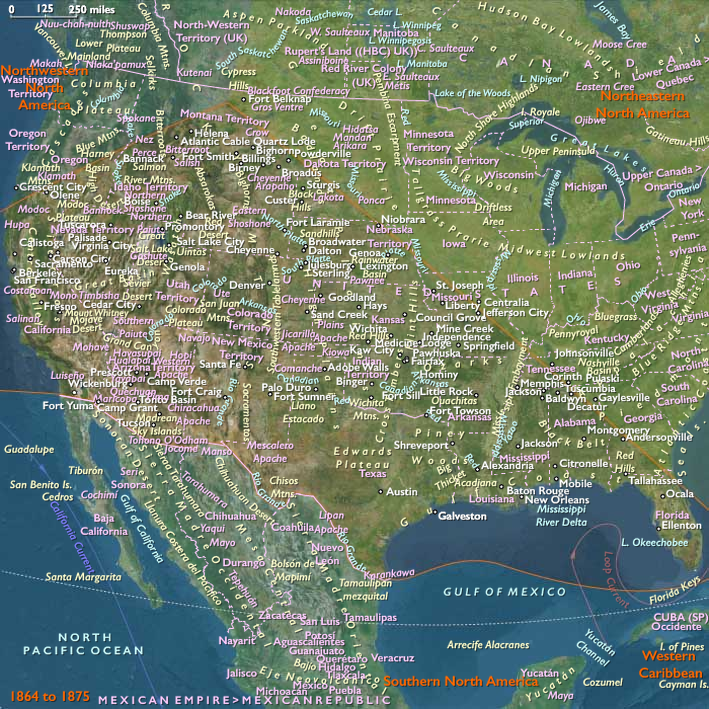
The Walker party's discovery of gold in Lynx Creek (near present-day Prescott, Arizona) in early 1863 had set off a chain of events that would have white settlements along the Hassayampa and Agua Fria Rivers, the nearby valleys, as well as in Prescott, and Fort Whipple would be built, all by the end of the year, and all in traditional Yavapai territory.
With the Mohave people's power greatly diminished, the Tolkepaya branch of the Yavapai had seen that they need to make new alliances to protect their safety.
In April 1863, Quashackama, a well-known Tolkepaya, had met with Arizona Territory superintendent of Indian affairs Charles Poston, along with representatives of the Pimas, Mohaves, Maricopas and Chemehuevis, at Fort Yuma, to sign an agreement intended "to promote the commerce in safety between the before mentioned tribes and the Americans."
However, the agreement was not an official treaty, so therefore not legally binding in any way. (Braatz, Timothy (2003). Surviving Conquest: a history of the Yavapai peoples. Lincoln, Nebraska: University of Nebraska Press.p. 87)
Despite this, the growing numbers of settlers (very quickly outnumbering Yavapai) have begun to call for the government to do something about the people occupying the land that they wanted to occupy and exploit themselves.
The editor of a local newspaper, the Arizona Miner, said "Extermination is our only hope, and the sooner it is accomplished the better." (Braatz, p. 89) Early in January 1864, the Yavapai raid a number of ranches that supply cattle to the miners in the Prescott and Agua Fria area.
As a result of this and a series of recent killings, a preemptive attack is organized to discourage future depredations.
Therefore, a group of well-armed volunteers are quickly outfitted with King S. Woolsey as their leader.
Their mission is to track the raiding party back to their ranchería.
What follows is an infamous footnote in Arizona history known today as the Bloody Tanks incident.
According to Braatz, "In December 1864, soldiers from Fort Whipple attacked two nearby Yavapé camps, killing 14 and wounding seven."
The following month, Fort Whipple soldiers attack another group of Yavapé, this time killing twenty-eight people, including their headman, Hoseckrua.
Included in the group are employees of Prescott's US Indian agent John Dunn.
In 1864, Arizona Territory Governor John Goodwin advises the territorial legislature that all tribes be subdued and sent to reservations. (Campbell, Julie A. (1998). Studies in Arizona History. Tucson, Arizona: Arizona Historical Society.
p 104) The same year, a dispatch from the US Army states "All Apache [Yavapai are routinely lumped in with their neighboring Apache] Indians in that territory are hostile, and all Apache men large enough to bear arms who may be encountered in Arizona will be slain whenever met, unless they give themselves up as prisoners.” (Gifford, Edward (1936).
Northeastern and Western Yavapai.
Berkeley, California: University of California Press.
p. 265-26) Not long after, in retaliation for the murder of a Pai headman by Americans, a group of Pai attacks some wagon trains, and closes the road between Prescott and Fort Mohave to all traffic.
In response, the US Army declares all Indians in lands beyond 75 miles (121 km) east of the Colorado River (the great majority of traditional Yavapai territory) to be "hostile" and "subject to extermination".
(Braatz, pg.
92)
Locations
People
Groups
- Apache (Na-Dené tribe)
- Paiute, Northern (Amerind tribe)
- United States of America (US, USA) (Washington DC)
Topics
- Indian Wars in Upper North America
- American Civil War & Reconstruction; 1864 through 1875
- Yavapai War
Commodoties
Subjects
Regions
Subregions
Related Events
Showing 10 events out of 14241 total
Years: 1864 - 1864
December
Locations
People
Groups
- Apache (Na-Dené tribe)
- Paiute, Northern (Amerind tribe)
- United States of America (US, USA) (Washington DC)
Topics
- Indian Wars in Upper North America
- American Civil War & Reconstruction; 1864 through 1875
- Yavapai War
Commodoties
Subjects
Regions
Subregions