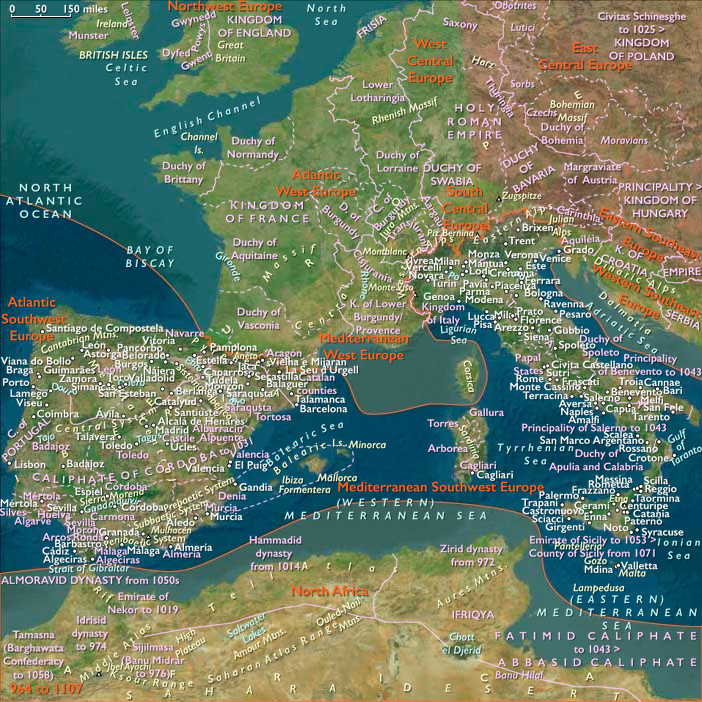
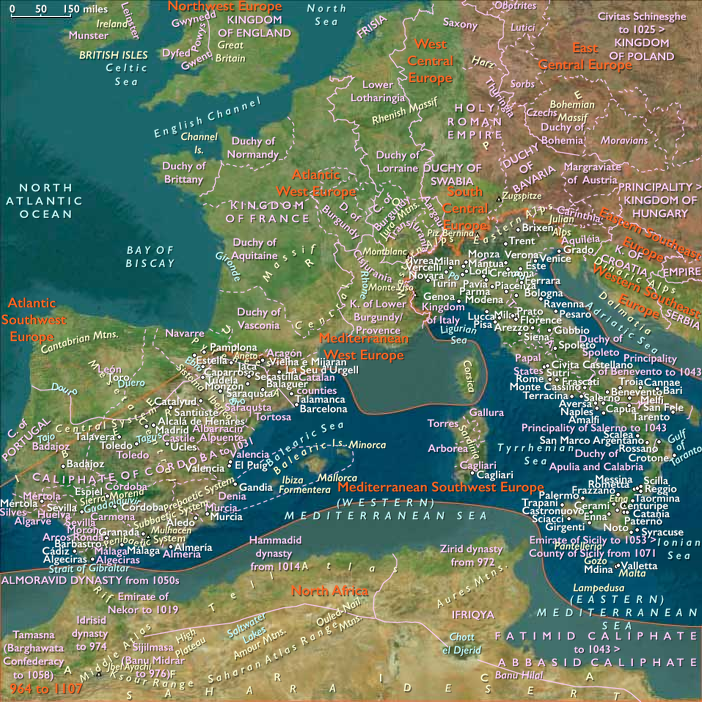
The conflict between church and state over …
Years: 1080 - 1080
The conflict between church and state over the right to make ecclesiastical investitures has become more intense by 1080, when Robert Guiscard chooses to reconcile himself with Gregory VII, entering into the Concordat of Ceprano, which confirms the commitments of the earlier Council of Melfi.
Locations
People
Groups
- Papal States (Republic of St. Peter)
- Saxony, Duchy of
- Tuscany, Margravate of
- Swabia, Duchy of
- German, or Ottonian (Roman) Empire
- Italy, Kingdom of (Holy Roman Empire)
- Christians, Roman Catholic
Topics
Commodoties
Subjects
Regions
Subregions
Related Events
Filter results
Showing 10 events out of 50559 total
Champa had ceded its three northern border provinces to its Dai Viet occupiers as ransom for its captive king, Rudravarman III.
King Harivarman IV had taken the Cham throne in 1074, restoring the temples at My Son and ushering in a period of relative prosperity.
Harivarman had made peace with the Đại Việt, but provoked war with the Khmer of Angkor.
A Khmer army attacks Vijaya and other centers in northern Champa in 1080.
Temples and monasteries are sacked; cultural treasures are carried off.
After much misery, Cham troops under King Harivarman are able to defeat the invaders and restored the capital and temples.
The Khmer Empire in the eleventh century is a time of conflict and brutal power struggles.
A new dynasty from the Korat Plateau in modern Thailand occupies the throne of Angkor in Cambodia around 1080.
Harald, born around 1040, as a son of king Sweyn II Estridsson, had taken part in Sweyn's 1069 raid of England alongside his uncle Jarl Asbjørn and his brother Canute, the later king Canute IV the Saint.
After the death of his father, Harald had been elected king in competition with his younger brother, Canute, at the Zealand Assembly at Isøre near Odsherred.
Accounts of the year include both 1074 and 1076, with the Monarchy of Denmark officially setting the year as 1074, two years before the death of Sweyn.
In order to get elected, he had taken the vows called Harald's laws, declaring his will to uphold the existing rule of law.
During his rule, Harald has met opposition from a number of his brothers, likely including Canute, who had enlisted the support of Olaf III of Norway.
Pope Gregory VII had mediated, advising Olaf not to take sides, and for Harald to share power with his brothers.
Canute, born around 1042 as one of the many illegitimate sons of Sweyn II Estridsson, is first noted as a member of Sweyn's raid of England in 1069.
The Anglo-Saxon Chronicle reports that Canute was one of the leaders of another raid against England in 1075.
When returning from England in 1075, the Danish fleet had stopped in the County of Flanders.
Because of its hostility towards William I of England, Flanders was a natural ally for the Danes.
He also led successful campaigns to Sember and Ester, according to skald Kálfr Mánason.
At the election of Harald III, Canute had gone into exile in Sweden, having possibly been involved in the active opposition to Harald, who, dependent on the great nobles of Denmark for his election, has done little to oppose them.
As a result, he has fought no major wars and spends his energy improving the few things that lie in his purview.
He is best known for improving and standardizing Danish coinage, and establishes mints at Ribe, Viborg, Lund, and Schleswig.
He institutes public use of the royal forests.
Harald also seeks to change Danish legal customs.
He deplores the ancient customs of trial by combat and the jernbyrd trial by ordeal of holding red-hot iron bars, and introduces a system used by the English of calling upon honorable men to swear oaths on behalf of the parties in a trial.
He allegedly continues Sweyn's politic of seeking a Danish Archbishopric with the Pope, but is not successful.
However, the legal reforms of Harald will not be fully accepted until the reign of Valdemar II the Victorious in the thirteenth century.
The historicity of his coinage reform has also been called into question.
Harald dies on April 17, 1080, and is interred at Dalby Church in Scania.
He is succeeded as king by his brother Canute IV, later called the Saint.
On his accession, he marries Adela, daughter of Count Robert I of Flanders.

Wladyslaw Herman, as the second son, was not destined for the Polish throne.
However, due to the flight from Poland of his older brother Boleslaw II the Bold in 1079, he had been elevated to the rank of Duke of Poland.
Opinions vary on whether Wladyslaw played an active role in the plot to depose his brother or whether he was handed the authority simply because he was the most proper person, being the next in line in the absence of the king and his son Mieszko Boleslawowic.
In order to improve the relations between Poland and Bohemia, Wladyslaw marries Judith, the daughter of the Duke (and first King from 1085) Vratislaus II, in 1080.
After this, the foreign policy of the Duke will gravitate strongly towards appeasement of the Holy Roman Empire.
The foundation of Wartburg castle had been laid about 1068 by the Thuringian count of Schauenburg, Louis the Springer, a relative of the Counts of Rieneck in Franconia.
Together with its larger sister castle Neuenburg in the present-day town of Freyburg, the Wartburg secures the extreme borders of his traditional territories.
According to tradition, the castle (Burg) got its name when its founder first laid eyes on the hill upon which the castle now sits; enchanted by the site, he is supposed to have exclaimed, "Warte, Berg—du sollst mir eine Burg tragen!"
("Wait, mountain—you shall bear a castle for me!").
It is a German play on words for mountain (Berg) and fortress (Burg).
In addition, Louis the Springer is said to have had clay from his lands transported to the top of the hill, which was not quite within his lands, so he might swear that the castle was built on his soil.
In fact, the name probably derives from German: Warte, a kind of watchtower as stated in the above source.
The castle is first mentioned during the Investiture Controversy in a 1080 deed, when Louis's henchmen attack a military contingent of King Henry IV of Germany.
Nikephoros meanwhile defeats a later pretender, Nikephoros Basilakios, who had succeeded Bryennios in Albania.
In 1080, another usurper, Nikephoros Melissenos, appears in Asia Minor and seeks Turkish assistance.
As a result of such constant internal strife, with one faction or another requesting aid from the Turks, there have been no troops to defend the eastern frontier, and most of Asia Minor is lost to the Empire.
Voluntary immigrations of the Armenians into the Empire had begun as early as the sixth century; from the reign of Emperor Maurice (582–602) onward, they have been solidly incorporated into the military fabric of the imperial army.
The Armenian migration to the southwest had begun when the Seljuq invasions made life in the Araxes valley and by Lake Van no longer secure.
By the mid-eleventh century, large numbers of Armenian settlements were well underway in Cilicia.
Greater Armenia had been ruled by the Bagratids in relative peace and prosperity from the ninth century until 1045 when their capital city of Ani fell.
In 1045, King Gagik II had been invited to Constantinople; upon arrival there, he had been taken captive and under duress had been forced to abdicate his throne and relinquish all his right in Armenia in exchange for lands in Cappadocia.
Thus Ani was relinquished to Emperor Constantine IX Monomachos, who began the resettlement of large numbers of Armenians in Byzantine Cilicia.
The Seljuqs also play a significant role in the Armenian immigration into Cilicia.
In 1071, Sultan Alp Arslan had put an end to Constantinople’s dominance in the east at the battle on the plains of Manzikert, where Emperor Romanos IV Diogenes had been taken captive.
Gagik had received as compensation for his Kingdom the district of Lycandus in Asia Minor and the town of Bizou, in the vicinity of Caesarea.
He has been also granted the use of a palace on the Bosporus in Constantinople and a pension from the Imperial treasury.
Several seals testify Kakikios Aniotes (Gagik of Ani) as duke of the thema of Charsianon.
Michael Iasites, duke of Iberia, has been entrusted with the government of Ani.
The Bishop of Caesarea, named Marcus, loses no occasion to express his scorn towards Gagik whom he considers a heretic.
After several insults by Marcus directed against him, Gagik eventually murders the Bishop, an act that makes Gagik even more unpopular among the locals.
As the story goes, it is said the Bishop had a dog named Armenen, so as to scorn the Armenians.
One day, Gagik visites the Bishop, has the dog put in a canvas bag and beaten with sticks.
He then has the Bishop seized and placed in the same bag with the dog, now maddened by pain.
The bishop dies in pain from the wounds inflicted by his own dog.
Later, Gagik is killed by the imperial governors (three brothers) of Kyzistra, who have his body mutilated and hanged from the fort for others to see.
His body is later buried outside the fort but is later said to have been secretly conveyed by an Armenian from Ani named Banik to a convent he had built in a city called Piza.
Shortly after Gagik is killed, his youngest son David is poisoned by his father-in-law for suspected treachery.
Gagik's eldest son Johannes had married the daughter of the governor of Ani and still lives there, but had been in Georgia when it was captured.
Johannes has a son Ashot who is poisoned and his body brought to Piza.
Johannes does not survive his son by long, at which time the posterity of the male Bagratian line of kings of Armenia is extinct.
Many Armenians have emigrated on the collapse of Greater Armenia to Georgia, Poland, and Galicia, while others have crossed into Cilicia, where some colonies had already settled at the end of the tenth century.
One of Gagik II's lieutenants, a certain Ruben, establishes himself about 1080 at Pardzrbert in the Taurus Mountains, and another noble named Oshin at Lambron: the former becomes the founder of the Rubenid dynasty of barons and kings who will rule Cilicia until 1226, and the latter is the ancestor of the Hetumid dynasty, which will succeed them and rule until 1342.
Ruben, according to the general consensus of the Armenian chroniclers, had been a commander in the king’s armies.
After the surrender of Ani to Constantine IX, a number of King Gagik II’s princes and loyal adherents, among them Ruben, had faithfully followed the king’s court into exile and resettled in the district of Caesarea in Cappadocia.
However, upon the murder of Gagik II, Ruben had gathered his family, fled to the Taurus Mountains, and taken refuge in the fortress of Kopitar (Kosidar) situated north of Sis (today Kozan in Turkey).
The territory of the Armenians in the Taurus is difficult of access and easy to defend.
Ruben declares the independence of Cilicia from the Empire in 1080.
George, harassed by the massive Turkic influx, known in Georgian history as didi turkoba, or the Great Turkish Invasion, from 1079/80 onward, is pressured into submitting to Malik-Shah to ensure a precious degree of peace at the price of an annual tribute.
George is even able to garner Seljuq military support in his campaign aimed at bringing the eastern Georgian principality of Kakheti, which has long resisted the Bagratid attempts of annexation, within a unified Georgian realm.
However, tired with a protracted siege of the Kakhetian stronghold of Vezhini, George abandons the campaign when snow falls, and headed for the Ajameti forests to ease his disappointment by hunting.
The Seljuq auxiliaries also lift the siege and plunder the fertile Iori Valley in Kakheti.
Aghsartan I, king of Kakheti, goes to the sultan to declare his submission, and in token of loyalty embraces Islam, thus winning Seljuq protection against the aspirations of the Georgian crown.
The Turks had begun moving into northern Syria in greater numbers, forcing Mahmud, the Mirdasid amir of Aleppo, to convert to Sunni Islam and become a vassal of the Seljuq sultan.
Mahmud's death in 1075, followed by that of his son and successor Jalal al-Daula Nasr in 1076, had resulted in the late Nasr's brother Sabiq ibn Mahmud becoming amir.
Conflicts between him and members of his family, along with several different Turkish groups, leave the Mirdasid domains devastated, and in 1080, prompted by Sabiq, the Uqailid Sharaf al-Daula Muslim takes over Aleppo when its inhabitants offer to hand the city over to him in the hopes that he can protect its citizens from Seljuq raids.
The Mirdasids will maintain a level of influence in the region after the loss of Aleppo, and will tempt to stem the advance of the First Crusade.
Years: 1080 - 1080
Locations
People
Groups
- Papal States (Republic of St. Peter)
- Saxony, Duchy of
- Tuscany, Margravate of
- Swabia, Duchy of
- German, or Ottonian (Roman) Empire
- Italy, Kingdom of (Holy Roman Empire)
- Christians, Roman Catholic