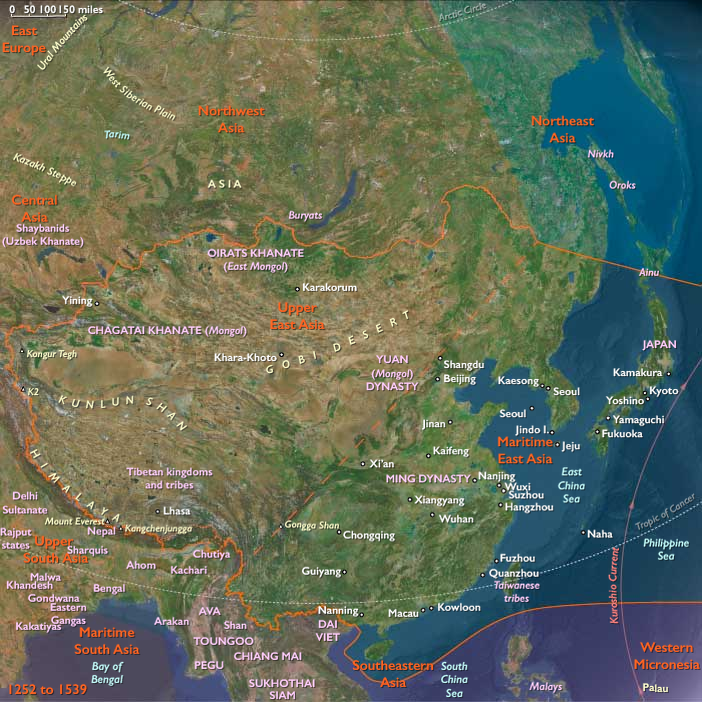
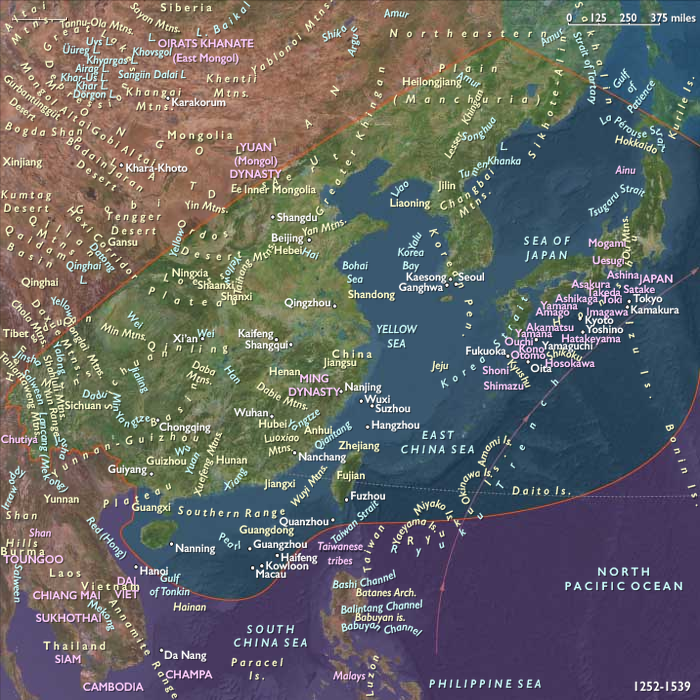
Some fifty thousand leaders and citizens of …
Years: 1277 - 1277
Some fifty thousand leaders and citizens of the Southern Song Dynasty of China become the first recorded inhabitants of Macau, as they seek refuge from the invading armies of the Yuan Dynasty when Fuzhou falls in 1277,
They also stay for a short period in …
Locations
People
Groups
- Chinese (Han) people
- Mongols
- Chinese Empire, Nan (Southern) Song Dynasty
- Mongol Empire
- Kublai Khan, Empire of
- Chinese Empire, Yüan, or Mongol, Dynasty
Topics
Commodoties
Subjects
Regions
Subregions
Related Events
Filter results
Showing 10 events out of 45604 total
A twenty-kilometer stone wall defending the coast of Hakata Bay in Fukuoka is completed in 1277; it is built in response to the attempted invasion of Japan by the Yuan Dynasty in 1274.
The Mongols had conquered Yunnan in 1253, and in 1271 under instructions from Kublai Khan, the new military governors of Yunnan had sent envoys to Pagan demanding tribute.
The Burmese king had refused.
At Beijing, the Mongol emperor again sent another mission on March 3, 1273.
This time the king had ordered the envoys executed.
The Mongols then systematically invaded the country.
Elephant-mounted soldiers of Narathihapate, the Burmese king of Pagan, advance into the Mongol-ruled Yunnan region in southwestern China following successful raids along the border.
Mongol archers on horseback engage the Burmese invaders in 1277 at the Battle of Ngasaunggyan in April 1277.
Dismounting when the elephants frighten their horses, the Mongol soldiers regroup on foot, disperse the elephants, remount, and, although outnumbered three to one, make a victorious charge.
Defeating the Burmese, the Mongols secure their hold of Kanngai (modern-day Yingjiang, Yunnan, one hundred and twelve kilometers north of Bhamo).
…Kowloon.
The exiled Chinese dynasty flees from Fuzhou to Quanzhou, where Zhang Shijie, the Grand General of Song, hopes to borrow boats to continue their flight.
However, the Muslim merchant Fu Shougeng refuses their request, prompting Zhang to confiscate Fu's properties and flee on stolen boats with the Song court.
In fury, Fu slaughters the imperial clan and many officials in Quanzhou and surrenders to the Yuan, strengthening the Mongols' naval power.
At this point of the war it is obvious the Song do not stand a chance when fighting the Yuan head-on.
Zhang Shijie decides to build a vast fleet with what remains, to allow the Song court and soldiers to move from place to place until the situation improves.
The Teutonic Knights had planned to advance against Samogitia after conquering Scalovia, but the outbreak of a new rebellion engineered by Skomantas, or Skalmantas, of the Sudovians had delayed the campaign.
Skomantas is first mentioned by Peter von Dusburg during the Great Prussian Uprising (1260–1274) as a leader of the 1263 raid on Chelmno, a stronghold of the Teutonic Knights.
He has also led campaigns against Pinsk and other Slavic territories and therefore could not fully support the uprising.
The Sudovians and Lithuanians have raided Culmerland in 1276-77 and burned settlements near the castles of Rehden, Marienwerder, Zantir, and Christburg.
Theodoric of Samland has been able to convince the Sambians not to rebel, and the Natangians and Warmians have followed suit.
The central Prussian tribes surrender to the crusaders by 1277.
Conrad von Thierberg the Elder leads fifteen hundred men into Kimenau in summer 1277, and crushes a Sudovian army of three thousand near the Winse forest.
Many Pogesanians flee to the Lithuanians and are resettled at Gardinas (in present Belarus), while the ones who remain in Prussia are resettled by the crusaders, probably near Marienburg (Malbork).
This new brick castle, built to replace Zantir, guards against further rebellions with Elbing and Christburg.
The Norwegian royal succession is an important and prickly matter, the last of the civil wars, fought for decades over disputed successions to the throne, having finally ended only in 1240.
In 1273, Magnus had given his eldest son, five-year-old Eirik, the name of king, and his younger brother Håkon the title of duke, thus making unequivocally clear what the royal succession would be.
Although Magnus is by all accounts a personally very pious king, his work with the law-codes brings him into conflict with the archbishop, who resists temporal authority over the church, and seeks to preserve the church's influence over the kingdom.
The Tønsberg Concord (Sættargjerden in Tønsberg) signed in 1277 between King Magnus and Jon Raude, Archbishop of Nidaros, confirms certain privileges of the clergy, the freedom of episcopal elections and similar matters.
The church preserves considerable independence in judicial matters, but gives up its old claim that the Norwegian kingdom is a fief under the ultimate authority of the Catholic Church.
In cultural terms, Magnus continues his father's policy of introducing European courtly culture to Norway.
In 1277 he replaces the old Norse titles lendmann and skutilsvein with the European titles baron and riddar (knight), at the same time giving them certain extra privileges and the right to be addressed as lord (herra).
Magnus is probably also the first Norwegian king to have named himself using an ordinal number—he calls himself "Magnus IV" (he did not count Magnus Haraldsson (II) and Magnus Sigurdsson (IV)).
Henry V, Duke of Legnica, had been present as a youth at the court of King Ottokar II of Bohemia in Prague, where he became a knight.
Henry's father had in 1273 given him the town of Jawor (Jauer) as an independent duchy.
Henry's father Boleslaw II the Bald, acting four years later on behalf of his ally, king Rudolph of Habsburg, r, kidnaps his own nephew Henry IV, the ruler of the Duchy of Wrocław.
This act arouses the anger of the nobility in Lesser Poland and the neighbors of Henry IV, who then organize an expedition to free him and punish Boleslaw.
At the head of the Greater Poland-Głogów-Wroclaw coalition are Dukes Przemysł II of Greater Poland and Henry III of Głogów.
The armies fight at Zabkowice Slaskie near Stolec in one of the most bloody battles of the Polish Middle Ages.
Boleslaw, suspecting in the course of the action that the battle is about to be lost, flees the field.
At this point, however, the young Henry leads a charge, turns the tide of battle, and achieves a great victory, taking both Dukes Przemysl II and Henry III as prisoners.
Thanks to the action of the young Duke of Jauer, his father and family are saved from disastrous defeat.
The Bulgarian monarch Constantine I, in the last years of his reign, has been partly paralyzed from a fall off his horse and suffers from unspecified ailments.
The government is firmly in the hands of Maria Kantakouzene, who had crowned their son Michael Asen II co-emperor soon after his birth in about 1272.
She presides over relations with Constantinople in the 1270s and had engineered first the submission and then the murder (by poisoning) of the despotēs Yakov Svetoslav of Vidin in 1276.
Due to the expensive and unsuccessful wars, repeated Mongol raids, and economic instability (Constantine is the first Bulgarian ruler to mint his own coins on a vast scale), the government is faced with a revolt in 1277.
Its true character is elusive, but what is clear is that a swineherd or swine-owner named Ivaylo became a leader of the discontented and attracted many followers, asserting his control over a significant area.
According to some sources, Ivaylo began his life living humbly and herded swine for payment.
Other sources indicate he was a peasant farmer with no land of his own.
He allegedly saw visions of himself grounded in the medieval Christian tradition, accomplishing great deeds and ridding Bulgaria of its troubles, including above all the frequent incursions by the Mongols of the Golden Horde under Nogai Khan.
By 1277, Ivaylo has put his words into actions, and has acquired leadership of an army composed largely of discontented peasants.
Among his close associates and military commanders is Hranislav, who will later enter imperial service after being captured by Constantinople’s forces.
An attempt to subdue Ivaylo by Constantine I ends in utter failure, and Ivaylo is credited with personally killing the tsar in his chariot.
Although Ivaylo is able to extend his authority across much of the country at the helm of his peasant army, he also meets with resistance, and the capital Tarnovo remains under the control of the legitimate emperor Michael Asen II and his mother Maria Kantakouzena.
Despite his victory against the Mongols in the North, Ivailo pursues the more conciliatory vassal status when it comes to making policy with the Mongol khanate.
Baibars marches from Syria into the Mongol-dominated Seljuq Sultanate of Rûm on April 15, 1277, and attacks the Mongol occupation force in the Battle of Elbistan (Abulustayn).
Upon reaching Elbistan with at least ten thousand horseman, Baibars makes ready for battle with the Mongols, expecting them to be around thirty thousand.
However, although the Mongol forces are smaller than the Mamluk army, the Georgians and Rumis help bolster their numbers.
The Mongols attack first and charge the Mamluk heavy cavalry.
At the start of the battle many of the Bedouin irregulars in the Mamluk army are also killed.
Their attack is concentrated on the left flank of the Mamluk army, which results in the Sultan's standard bearers (sanjaqiyya) being killed.
The Mamluks, however, are able to regroup and launch a counterattack.
Baibars himself goes with a few troops to deal with the Mongol right flank that is pounding his left flank.
Baibars orders a force from the army from Hama to reinforce his left.
The large Mamluk numbers are able to overwhelm the Mongol force, who, instead of retreating, dismount from their horses.
Some Mongols are able to escape and take up positions on the hills.
Once they become surrounded they again dismount and fight to the death.
During the battle, the Mongols destroy the Mamluk left wing, consisting of many Bedouin irregulars, but are ultimately defeated.
It seems that both sides were expecting assistance from the army o Pervâne and his Seljuqs.
Pervâne had attempted to ally himself with both factions to keep his options open, but had led the battle with the Seljuq Sultan to Tokat.
The Seljuq army had been present near the battle, but did not take part.
After the battle, many Rumi soldiers are taken captive; others join the Mamluks willingly.
Pervane's son Muhadhdhab al-Din is captured; in addition, many Mongol officers and common soldiers are taken prisoner.
Two of the soldiers captured, Qipchaq and Salar, will become mamluks of Qalawun and will become very important amirs.
The Mongol officers' lives are spared as well.

Following his victory at Elbistan, Baibars marches unopposed to Kayseri (Qaysariyya) in the heart of Anatolia in triumph and enters it on April 23, 1277; just over a month after the battle.
The Muslim festival of Eid al-Adha happens around this time.
Years: 1277 - 1277
Locations
People
Groups
- Chinese (Han) people
- Mongols
- Chinese Empire, Nan (Southern) Song Dynasty
- Mongol Empire
- Kublai Khan, Empire of
- Chinese Empire, Yüan, or Mongol, Dynasty