
New Zealand's indigenous Māori had quickly recognized …
Years: 1814 - 1814
New Zealand's indigenous Māori had quickly recognized the great advantages in trading with European and American strangers, whom they call tauiwi, whose ships had begun visiting New Zealand in the early 1800s.
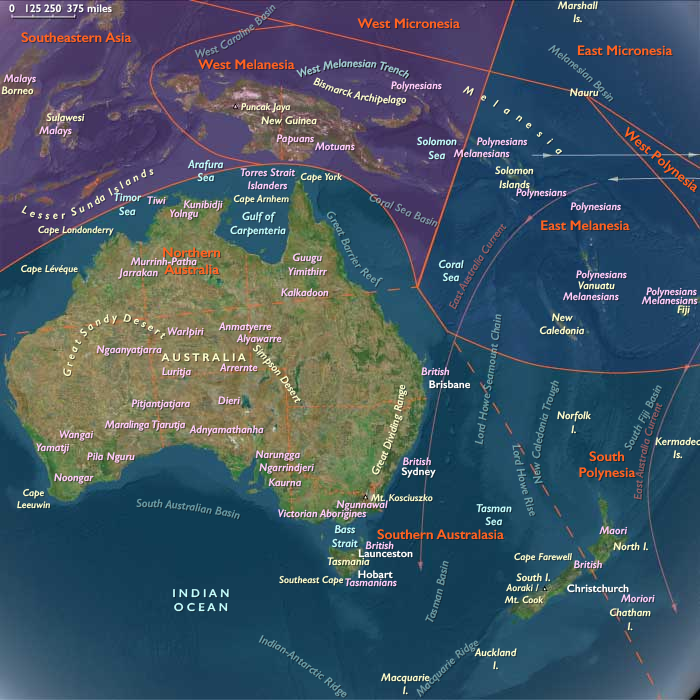
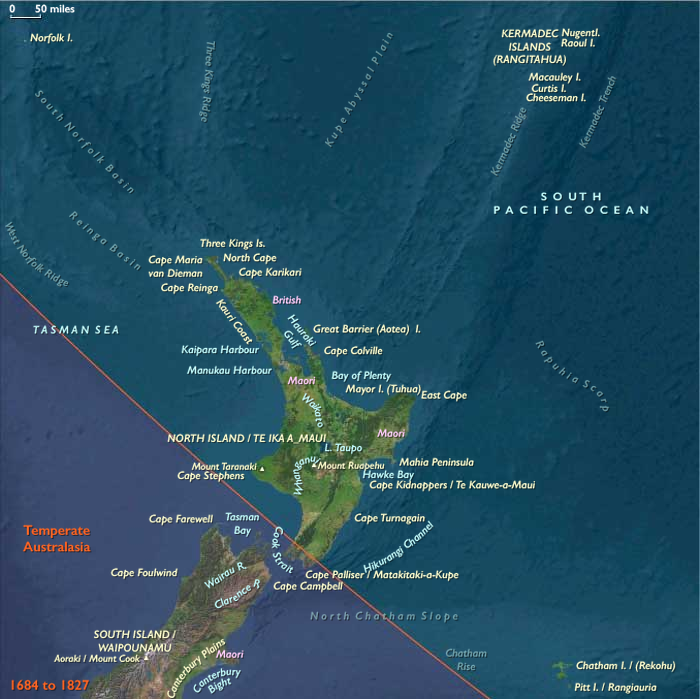
The Bay of Islands offers a safe anchorage and has a high Māori population.
Māori had begun to supply food and timber to attract ships.
What Māori want are respect, plus firearms, alcohol, and other goods of European manufacture.
Kororareka (present Russell) had developed as a result of this trade but had soon earned a very bad reputation, a community without laws and full of prostitution, and has become known as the "Hell Hole of the Pacific", despite the translation of its name being "How sweet is the penguin", (korora meaning blue penguin and reka meaning sweet).
European law has no influence and Māori law is seldom enforced within the town's area.
The Ngāpuhi control the Bay of Islands, the first point of contact for most Europeans visiting New Zealand in the early nineteenth century.
Hongi Hika has protected early missionaries and European seamen and settlers, arguing the benefits of trade.
He has befriended Thomas Kendall—one of three lay preachers sent by the Church Missionary Society to establish a Christian toehold in New Zealand.
In 1814 Hongi Hika and his uncle Ruatara, the then-leader of the Ngāpuhi, had visited Sydney, Australia, with Kendall and met the local head of the Church Missionary Society, Samuel Marsden.
Ruatara and Hongi Hika invited Marsden to establish the first Anglican mission to New Zealand in Ngapuhi territory.
Marsden had remained based in New South Wales.
By the early nineteenth century there had been increasing contact between Māoris and Europeans, mainly by the many whalers and sealers around the coast of New Zealand and especially in the Bay of Islands.
A small community of Europeans has formed in the Bay of Islands made up of explorers, flax traders, timber merchants, seamen, ex-convicts who had served their sentence, and some escaped convicts.
Marsden, concerned that they are corrupting the Māori way of life, had become determined to find a mission station in New Zealand.
Marsden had lobbied the Church Missionary Society successfully to send a mission to New Zealand.
Lay missionaries John King, William Hall and Thomas Kendall had been chosen in 1809, but it is not until March 14, 1814, that Marsden had taken his schooner, the Active (captained by Thomas Hansen), on an exploratory journey to the Bay of Islands with Kendall and Hall, during which time he claims to have conducted the first Christian service on New Zealand soil.
He had met Māori Rangatira, or chiefs from the iwi or tribe Ngapuhi, who control the region around the Bay of Islands, including the chief of the Ngapuhi, Ruatara, and a junior war leader, Hongi Hika, who had helped pioneer the introduction of the musket to Māori warfare in the previous decade.
Hongi Hika had returned with them to Australia on August 22.
At the end of the year Kendall, Hall and King return to start a mission to the Ngapuhi under Ruatara's (and, later, Hongi Hika's) protection in the Bay of Islands.
Hongi Hika returns with them, bringing a large number of firearms from Australia for his warriors.
Locations
People
Groups
- Maori people
- Anglicans (Episcopal Church of England)
- Britain (United Kingdom of Great Britain and Ireland)
Topics
Commodoties
Subjects
Regions
Subregions
Related Events
Showing 10 events out of 21089 total
Years: 1814 - 1814
Locations
People
Groups
- Maori people
- Anglicans (Episcopal Church of England)
- Britain (United Kingdom of Great Britain and Ireland)
Topics
Commodoties
Subjects
Regions
Subregions