
The French army under Marshal Soult is …
Years: 1813 - 1813
November
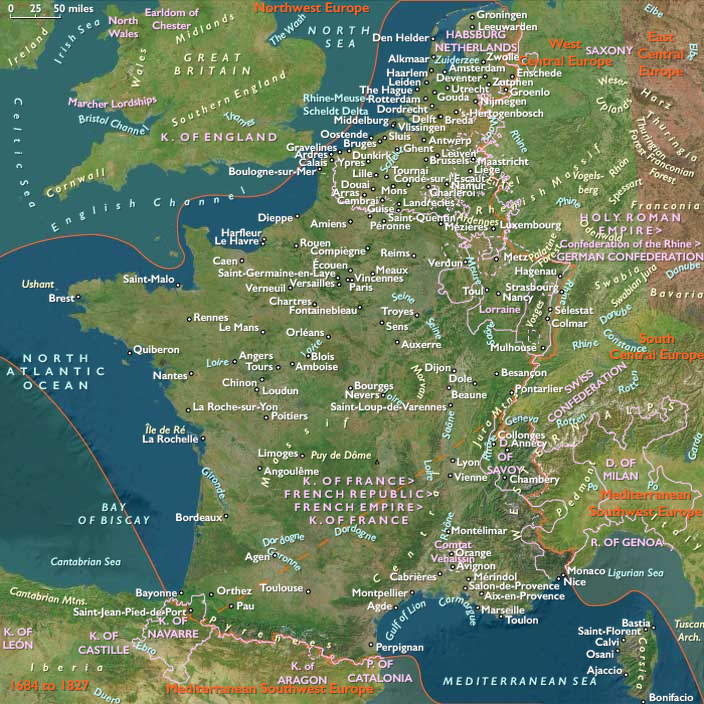
The French army under Marshal Soult is arrayed in front of the course of the River Nivelle, whose route is marked by a series of hills on which the French had built strong defensive positions or redoubts.
Soult's lines stretch from the shores of the Atlantic on the French right flank to the snow-covered pass of Roncesvalles on the left, a perimeter of about twenty miles.
With only sixty thousand men, Soult is stretched to an almost impossible point.
This also means that he cannot hold troops back as reserves, a factor that may have turned the tide of the battle.
As Soult moves back to his base at Bayonne, his position strengthens but he is not quick enough and Wellington, with his Peninsular army of eighty thousand, catches up to him on November 10.
By two o'clock, Soult is in retreat and the British are in a strong offensive position.
Soult has lost four thousand three hundred and fifty-one men to Wellington's twenty-four hundred and fifty.
Soult's lines stretch from the shores of the Atlantic on the French right flank to the snow-covered pass of Roncesvalles on the left, a perimeter of about twenty miles.
With only sixty thousand men, Soult is stretched to an almost impossible point.
This also means that he cannot hold troops back as reserves, a factor that may have turned the tide of the battle.
As Soult moves back to his base at Bayonne, his position strengthens but he is not quick enough and Wellington, with his Peninsular army of eighty thousand, catches up to him on November 10.
By two o'clock, Soult is in retreat and the British are in a strong offensive position.
Soult has lost four thousand three hundred and fifty-one men to Wellington's twenty-four hundred and fifty.
Locations
People
Groups
- Portugal, Bragança Kingdom of
- Britain (United Kingdom of Great Britain and Ireland)
- France, (first) Empire of
- Spain, Bonapartist Kingdom of
- Spain, Bourbon Kingdom (first restoration) of
Topics
Commodoties
Subjects
Regions
Subregions
Related Events
Showing 10 events out of 21229 total
Years: 1813 - 1813
November
Locations
People
Groups
- Portugal, Bragança Kingdom of
- Britain (United Kingdom of Great Britain and Ireland)
- France, (first) Empire of
- Spain, Bonapartist Kingdom of
- Spain, Bourbon Kingdom (first restoration) of
Topics
Commodoties
Subjects
Regions
Subregions