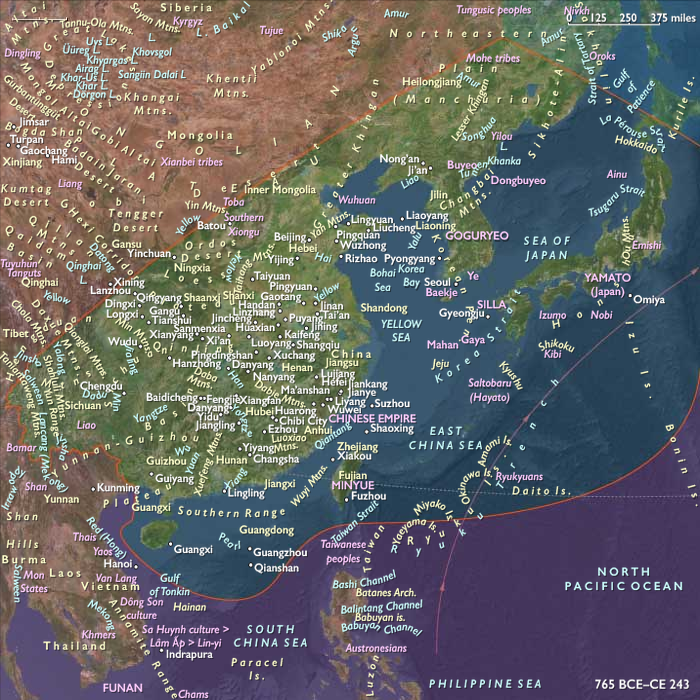
It had been commonly expected when Cao …
Years: 227 - 227
It had been commonly expected when Cao Rui became emperor that his wife, Princess Yu, would be created empress, but she was not.
Rather, he creates a favorite concubine, Consort Mao, empress in 227.
Princess Yu is exiled back to their original palace.
He loves Empress Mao dearly, and a number of her relatives, including her father and brother, become honored officials (but without actual powers).
Locations
People
Groups
Topics
Commodoties
Subjects
Regions
Subregions
Related Events
Filter results
Showing 10 events out of 60621 total
Bardaisan shows great literary activity against Marcion and Valentinus, the Gnostics of the day.
Bardaisan mixes his Babylonian pseudo-astronomy with Christian dogma and originates a Christian sect, which is vigorously combated by St. Ephrem.
Various opinions have been formed as to the real doctrine of Bardesanes.
As early as Hippolytus (Philosoph., VI, 50) his doctrine was described as a variety of Valentinianism, the most popular form of Gnosticism.
Adolf Hilgenfeld in 1864 defended this view, based mainly on extracts from St. Ephrem, who devoted his life to combating Bardaisanism in Edessa.
The strong and fervent expressions of St. Ephrem against the Bardaisanites of his day are not a fair criterion of the doctrine of their master.
The extraordinary veneration of his own countrymen, the very reserved and half-respectful allusion to him in the early Church Fathers, and above all the "Book of the Laws of the Countries", suggest a milder view of Bardaisan's aberrations.
He cannot be called a Gnostic in the proper sense of the word.
Like the Early Christians, he believes in an Almighty God, Creator of heaven and earth, whose will is absolute, and to whom all things are subject.
God endowed man with freedom of will to work out his salvation and allowed the world to be a mixture of good and evil, light and darkness.
All things, even those we now consider inanimate, have a measure of liberty.
In all of them the light has to overcome the darkness.
After six thousand years this earth shall have an end, and a world without evil shall take its place.
However, Bardaisan also thinks the sun, moon and planets are living beings, to whom, under God, the government of this world is largely entrusted; and though man is free, he is strongly influenced for good or for evil by the constellations.
Bardaisan's catechism must have been a strange mixture of Christian doctrine and references to the signs of the Zodiac.
Led by the fact that "spirit" is feminine in Syriac, he seems to have held unorthodox views on the Trinity.
He apparently denies the Resurrection of the Body, but thinks Christ's body was endowed with incorruptibility as with a special gift.
The Romans under Caracalla, taking advantage of the anti-Christian faction in Edessa, capture Abgar IX and send him in chains to Rome.
Thus the Osrhoenic kingdom, after 353 years' existence, comes to an end.
Though he is urged by a friend of Caracalla to apostatize, Bardaisan stands firm, saying that he fears not death, as he would in any event have to undergo it, even though he should now submit to the emperor.
Bardaisan is forced at the age of sixty-three to take refuge in the fortress of Ani in Armenia, where he tries to spread the Gospel, but with little success.
He will die five years later, either at Ani or at Edessa.
Bardaisan apparently was a voluminous author, and though nearly all his works have perished, we find notices of the following: • Dialogues against Marcion and Valentinus.
• Dialogue "Against Fate" addressed to an Antoninus.
Whether this Antoninus is merely a friend of Bardaisan or a Roman emperor and, in the latter case, which of the Antonini is meant, is matter of controversy.
It is also uncertain whether this dialogue is identical with "The Book of the Laws of the Countries".
• A "Book of Psalms", one hundred and fifty in number, in imitation of David's Psalter.
These psalms will become famous in the history of Edessa, their words and melodies living for generations on the lips of the people.
Only when St. Ephrem composes hymns in the same pentasyllabic meter and has them sung to the same tunes as the psalms of Bardaisan, will the latter gradually lose favor.
• Astrologico-theological treatises, in which his peculiar tenets were expounded.
• A "History of Armenia", a history of the Armenian kings.
• "An Account of India".
Bardaisan obtained his information from the Indian Sramana (wandering monks) ambassadors to the Roman Emperor Heliogabalus.
A few extracts are preserved by Porphyry and Stobaeus.
• "Book of the Laws of the Countries".
Against a questioning disciple called Abida, Bardaisan seeks to show that man's actions are not entirely necessitated by Fate, as the outcome of stellar combinations.
From the fact that the same laws, customs and manners often prevail among all persons living in a certain district, or though locally scattered living under the same traditions, Bardaisan endeavors to show that the position of the stars at the birth of individuals can have but little to do with their subsequent conduct, hence the title "Book of the Laws of the Countries."
Alexander, under the influence of his mother, has done much to improve the morals and condition of the people, and to enhance the dignity of the state.
His advisers are men like the famous jurist Ulpian, the historian Cassius Dio and a select board of sixteen senators; a municipal council of fourteen assists the urban prefect in administering the affairs of the fourteen districts of Rome.
Julia Mamaea calls on Origen, the Alexandrian Christian leader, to provide her with instruction in Christian doctrine.
Julia has watched over the development of her son's character and improved the tone of the administration.
On the other hand, she is inordinately jealous.
In 225, she had arranged for Alexander to marry Sallustia Barbia Orbiana, the daughter of a noble Patrician family, whose father had been made Caesar or co-ruler.
After Orbiana was given the title of Augusta, Mamaea, due to her desire for complete ownership of all feminine imperial titles, grew jealous of the strong bond that developed between Orbiana and Severus.
She treats Orbiana cruelly, forcing her to seek refuge with her father, Sallustius, who is believed to have been appointed as a Caesar.
Sallustius consults with the Praetorian Guard for protection of Orbiana, but the act is determined to be treasonous.
In August 227, Sallustius is executed, and Orbiana is stripped of her title, divorced and exiled to the province of Libya in North Africa.
Severus Alexander has the power to intervene, but chooses not to.
Each of the three competing regimes—Cao Wei, Shu Han and Eastern Wu—have the purpose of reunifying the empire of the fallen Han Dynasty.
Beginning in 228, Zhuge Liang launches the first of Shu Han’s five Northern Expeditions against Wei.
The strategic thinking behind these ventures can be traced back as early as 207, when the tweny-seven-year-old Zhuge Liang outlined his Longzhong Plan to his lord Liu Bei.
In it, he explained in very general terms the need to gain a viable geographical base, and then went on to detail a two-pronged strike north for mastery of the north.
One advance would be from Yi Province in the west (covering the Sichuan Basin), north through the Qin Mountains, debouching into the Wei River valley and achieving a strategic position at the great metropolis Chang'an from which to dominate the great bend of the Yellow River.
The second advance would be from Jing Province (covering present-day Hubei and Hunan) north toward the political center of Luoyang.
After Liu Bei established himself in Yi Province in 215, the essential prerequisites of the plan had been completed.
The geopolitical arrangement envisaged by Zhuge Liang proved, however, to be a militarily unstable one.
The alliance with the state of Wu in the east had broken down over the issue of the occupation of Jing Province.
By 223, the province had been lost and Liu Bei, as well as some of his top generals, were dead.
Even after Zhuge Liang reestablished friendly relations with Wu, his original plan has been markedly altered since only the left prong could be executed.
In Zhuge Liang's much quoted memorial Chu Shi Biao of 227, submitted to Liu Shan before his departure for the north, the prime minister explains in highly ideological terms the reasoning for the expedition against Wei: "We should lead the three armies to secure the Central Plain in the north.
Contributing my utmost, we shall exterminate the wicked, restore the house of Han and return to the old capital.
Such is this subject's duty in repaying the Former Emperor and affirming allegiance to Your Majesty."
The Chu Shi Biao, which also advised Liu Shan on governing the kingdom, can be roughly divided into four different sections.
Zhuge Liang first addressed the dangerous situation of Shu Han, still the weakest out of the Three Kingdoms.
In the second, he gave three main pieces of advice: transparency and willingness to accept criticism, fair judgment, and the avoidance of petty and corrupt officials.
In the third section, Zhuge Liang illustrated his own history and in the fourth addressed the roles of Liu Shan.
All except one of the five expeditions will be military failures (albeit not military disasters) in that Zhuge Liang's forces run out of food before they are able to inflict significant damage on Wei and therefore are forced to withdraw.
The one major victory that Wu has over Wei during this period comes in 228, when, with Sun Quan's approval, his general Zhou Fang pretends to surrender to Wei after pretending to have been punished repeatedly by Sun Quan.
This gambit deceives the Wei general Cao Xiu, who leads a large army south to support Zhou Fang.
According to legend, Cao Xiu did not believe Zhou Fang at first.
Zhou Fang cut off his famous locks of hair to prove his "loyalty".
In any case, Zhou Fang knew the territory, so he started to lead Cao Xiu into a clearing, where Cao could set up camp.
However, before they left, Cao Xiu had been advised not to trust Zhou Fang by one of his advisers, Jia Kui.
Cao Xiu had not heeded his words; however, and had not only bought Zhou Fang's ploy, but removed Jia Kui from the campaign and decided to march with seventy thousand troops.
On the way to the designated camping area, Cao Xiu is ambushed as planned.
Unable to gain the upper hand in battle, he thus retreats to make camp at Shiting (present-day Qianshan County, Anhui).
However, the camp is disturbed in the middle of night, and the soldiers run away in disarray.
Many sets of armor and carts of supplies are abandoned.
Cao Xiu sends in a memorial acknowledging his fault.
Many of his men are killed.
When he looks around for Zhou Fang, Zhou is nowhere to be found; he now realizes knew he had been duped.
Too ashamed to turn back, and believing that he has more troops and supplies than the enemy, he chooses to engage Lu Xun's army.
Lu Xun personally leads the central force and orders Zhu Huan and Quan Cong to take the left and right flanks.
The three armies advance simultaneously, and decisively take on Cao Xiu's ambushing troops.
Following that, the Wu troops pursue the fleeing Cao army until they reach Jiashi, where they annihilate some ten thousand men and win over ten thousand spoils of war; in addition, all of the Wei army's equipment and weaponry are looted.
Lu Xun regroups his men; and when he passes by Wuchang, Sun Quan instructs his attendants to shield Lu Xun with his own canopy when entering and leaving the palace doors.
Sun Quan bestows upon Lu Xun as reward precious items of the finest grade, honors received by no one else in this era.
Cao Xiu had barely escaped the battlefield with his life; he will die a few months later of an ulcer on his back, even after having been pardoned by the Emperor of Wei, Cao Rui.
Jia Kui, who had come along with Cao Xiu, had helped Cao retreat from the ambush.
For this, Jia Kui is highly praised by Cao Rui himself, and given many promotions.
He will live the last years of his life in happiness.

Julia has also alienated the army by her extreme parsimony, and neither she nor her son are strong enough to impose military discipline.
Mutinies become frequent in all parts of the Empire; in Rome, the Praetorian Guard becomes infuriated by the actions of the praetorian praefect Ulpian, whose curtailment of the privileges granted to the Praetorian Guard by Elagabalus has provoked their enmity, and he has narrowly escaped their vengeance; ultimately he is murdered in the palace at the feet of the Emperor, in the course of a three-day riot between the soldiers and the mob.
Another mutiny forces the retirement of Cassius Dio from his command.
Fresh mutinies perpetually break out in the provinces of the Empire—in Illyricum, in Mauretania, in Armenia, in Mesopotamia and in Germania—as his officers are murdered and the emperor’s authority is disregarded.
Sun Quan declares himself emperor in 229, an act that almost damages the alliance with Shu, as many Shu officials see this as a sign of betrayal of the Han Dynasty—to which Shu claims to be the legitimate successor.
However, Zhuge Liang opposes ending the alliance and in fact confirms it with a formal treaty later this year, in which the two states pledge to support each other and divide Wei equally if they can conquer it.
Later this year, he moves his capital from Wuchang (in present-day Ezhou, Hubei) to …
…Jianye, leaving his crown prince Sun Deng, assisted by Lu Xun, in charge of the western empire.
Kushan emperor Vasudeva I is recorded in the Chinese historical chronicle Sanguozhi to have sent tribute to the Chinese emperor Cao Rui of the Wei in 229 CE (third year of Taihe): "The king of the Da Yuezhi, Bodiao (Vāsudeva), sent his envoy to present tribute and His Majesty granted him a title of "King of the Da Yuezhi Intimate with Wei.” He is the last Kushan ruler to be mentioned in Chinese sources.
His rule corresponds to the retreat of Chinese power from Central Asia, and it is thought that Vasudeva may have filled the power vacuum in this area.
The great expansion of the Dharmaguptaka Buddhist group in Central Asia during this period has also been related to this event.
Excessive luxury and extravagance at the imperial court have been diminished under Alexander.
Upon his accession, he had reduced the silver purity of the denarius from 46.5% to 43%—the actual silver weight dropping from 1.41 grams to 1.30 grams; however, he revalues the denarius in 229, increasing the silver purity and weight to 45% and 1.46 grams respectively.