
The trading companies of both Britain and …
Years: 1744 - 1744
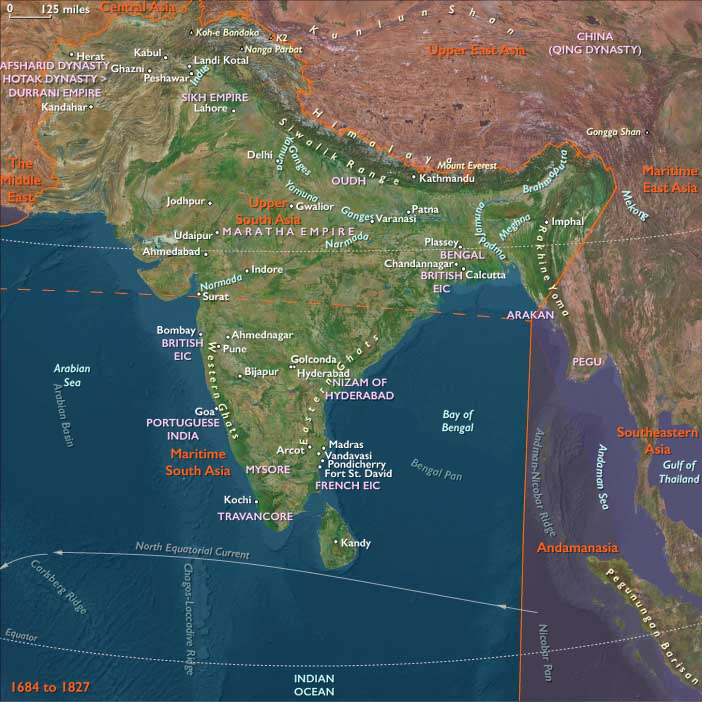
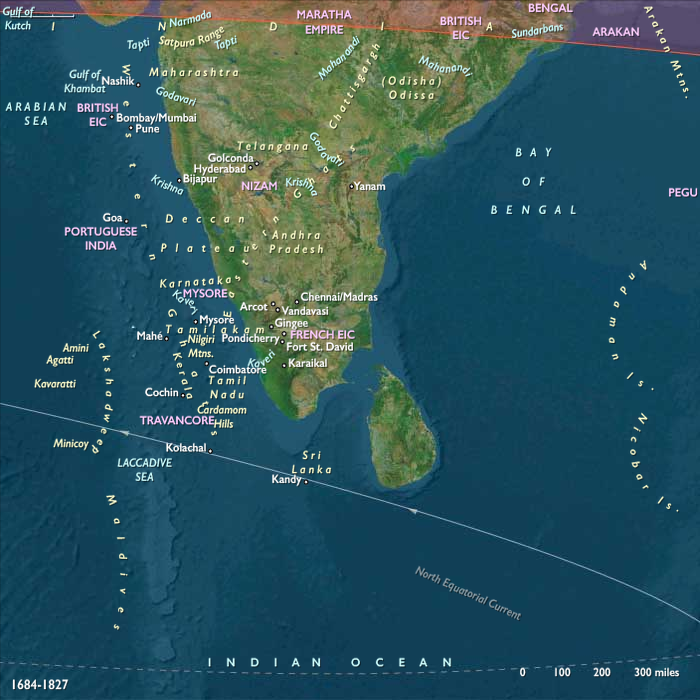
The trading companies of both Britain and France have maintained cordial relations among themselves in India while their parent countries are bitter enemies on the European continent, having gone to war in 1740 over the succession to the throne of Austria.
H. H. Dodwell writes, "Such were the friendly relations between the English and the French that the French sent their goods and merchandise from Pondicherry to Madras for safe custody." (Dodwell, H. H. (ed), Cambridge History of India, Vol. v.)
Joseph François Dupleix was born in Landrecies, France.
His father, François Dupleix, a wealthy farmer, wished to bring him up as a merchant, and, in order to distract him from his taste for science, had sent him on a voyage to India in 1715 on one of the French East India Company's vessels.
After making several voyages to the Americas and India, he had in 1720 been named a member of the superior council at Pondicherry.
Displaying great business aptitude, he had made large ventures on his own account and acquired a fortune in the course of discharging his official duties.
He had been made superintendent of French affairs in 1730 in the town of Chandernagore, which had prospered under his administration and grown to great importance.
He had married Pondicherry-born Jeanne Albert, widow of one of the councilors of the company, in 1741.
Her father had been Company surgeon; her mother, also known as Rosa de Castro, was a creole of partly Italian, partly Portuguese and Indian parentage from Madras.
Albert, known to the Hindus as Joanna Begum, had soon proved of great help to her husband in his negotiations with the native princes.
His reputation had resulted in his appointment in 1742 as governor general of the French establishment in India, succeeding Pierre Benoît Dumas as the French governor of Pondicherry.
His ambition now is to acquire for France vast territories in India, and for this purpose he has entered into relations with the native princes, and adopted a style of oriental splendor in his dress and surroundings.
He has built an army of native troops, called sepoys, who had been trained as infantrymen men in his service, including Hyder Ali, later to become famous as the de facto ruler of Mysore.
Locations
People
- Anwaruddin Muhammed Khan
- Chanda Sahib
- Hyder Ali
- Joseph-François, Marquis Dupleix
- Robert Clive, 1st Baron Clive
Groups
- Mysore, Kingdom of
- France, (Bourbon) Kingdom of
- Carnatic, Nawabs of the
- Britain, Kingdom of Great
- East India Company, British (United Company of Merchants of England Trading to the East Indies)
- French Company of the Indies
- Hyderabad, State of
Topics
- Colonization of Asia, French
- Colonization of Asia, British
- Austrian Succession, War of the
- Carnatic Wars
Commodoties
Subjects
Regions
Subregions
Years: 1744 - 1744
Locations
People
- Anwaruddin Muhammed Khan
- Chanda Sahib
- Hyder Ali
- Joseph-François, Marquis Dupleix
- Robert Clive, 1st Baron Clive
Groups
- Mysore, Kingdom of
- France, (Bourbon) Kingdom of
- Carnatic, Nawabs of the
- Britain, Kingdom of Great
- East India Company, British (United Company of Merchants of England Trading to the East Indies)
- French Company of the Indies
- Hyderabad, State of
Topics
- Colonization of Asia, French
- Colonization of Asia, British
- Austrian Succession, War of the
- Carnatic Wars
Commodoties
Subjects
Regions
Subregions