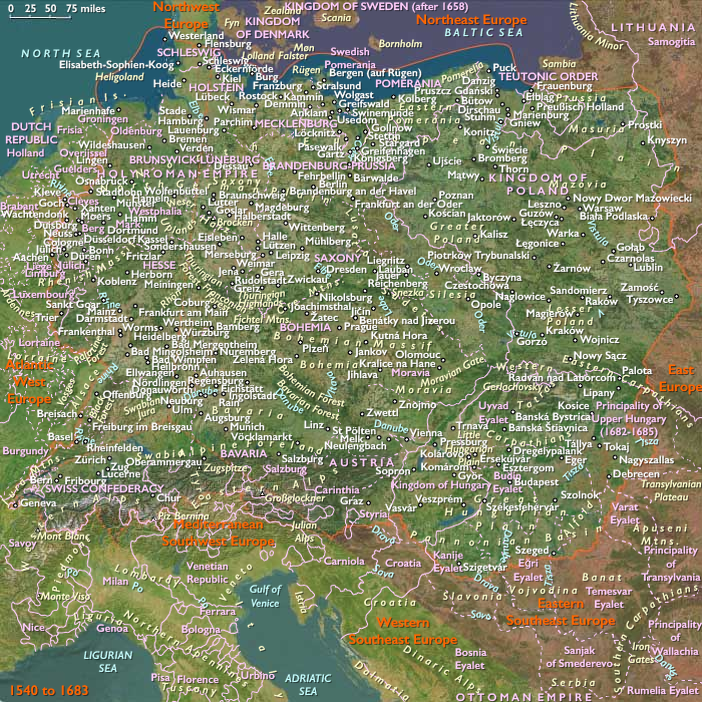
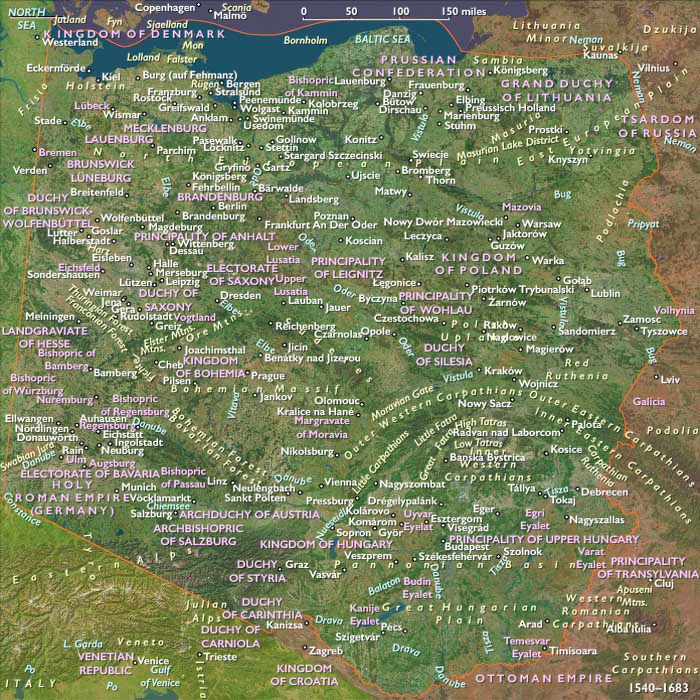
...western Poland, making their centers of activity …
Years: 1549 - 1549
...western Poland, making their centers of activity Poznán and ...
Locations
Groups
Topics
Subjects
Regions
Subregions
Related Events
Filter results
Showing 10 events out of 36399 total
Pinto leaves the port of Kagoshima in 1549 but takes with him a Japanese fugitive known as Anjiro and introduces him to the forty-three-year-old Spanish-Basque Jesuit missionary Francis Xavier, who, after working for seven years in Goa, Travancore, Malacca, the Molucca Islands, and Sri Lanka, travels to Japan to preach the Roman Catholic faith.
Tsar Ivan appoints an advisory council and, in 1549, establishes a national assembly, enacting reforms in local government approved by the council.
The Protestant, or Calvinist, College of Debrecen (now the University of Debrecen) is founded in the Turkish occupied, but semiautonomous, Hungarian city of Debrecen in 1538.
The University of Debrecen is today the oldest continuously operating institution of higher education in Hungary.
The reforms of Jan Hus, which had included providing the Scriptures to the people in their own language, and that both elements of communion should be available to the people, had been popular with the Czech people, but had met extreme opposition from church authorities.
Hus had been executed in 1415, but his teachings led to the formation of the Hussite movement.
One of the later branches of the Hussitism is the Unity of the Brethren.
The roots of this radical and pacifistic stream within the early Reformation movement go back to 1457 in a small village in the northeast part of Bohemia called Kunvald near Žamberk, on the Litice lordship of George of Poděbrady, the Hussite leader who would soon after rule Bohemia as king until his death in 1471.
Theologians and thinkers who provided inspiration for the future Unity of the Brethren were Hussite churchman Jan Rokycana, Archbishop of Prague, and Petr Chelčický, a politician and author.
Many members of the Unity of the Brethren, the Christian denomination whose roots are in the pre-reformation work of the martyred Jan Hus, emigrate after 1548 from Bohemia
...Leszno.
A settlement first mentioned in historical documents in 1393, Leszno was at that time the property of Stefan z Karnina of Clan Wieniawa.
The family adopted the surname of Leszczyński from the name of their estate according to the medieval custom of the Polish nobility.
Earlier in the century, a community of Unity of the Brethren refugees from Bohemia had settled in Leszno on the invitation of the Leszczyński family, who have since 1473 been imperial counts and have converted to Calvinism.
The arrival of the Bohemian Protestants as well as weavers from nearby Silesia has helped the settlement to grow and made it possible to become a town in 1547 under a privilege granted by Poland’s King Sigismund I the Old.
The Taleju temple is built in 1549 in the Nepalese city of Kathmandu as a part of the palace of the Malla king Raja Mahindra; it soon becomes a pilgrimage site for Tibetan Buddhists.
Over the next few centuries, Kathmandu will not only remain a pilgrimage site but become one for pilgrims of many kinds from around the world.
It is today the capital and largest metropolitan city of Nepal.
Rama Raya had aided Burhan Nizam Shah of Ahmadnagar in taking a fort from Bidar in 1548.
After seven or eight years of rule, Rama Raya also assumes royal titles.
Heinrich Bullinger had been drawn to join the Reformation through the reading of Scripture, the Fathers of the Church, and the writings of the time.
Having succeeding slain Protestant leader Huldreich Zwingli as the chief pastor at Zürich, Bullinger promotes various educational, social, and ecclesiastical reforms.
In 1549, the forty-five-year-old Bullinger joins reformer Calvin in producing the Consensus Tigurinus, a statement setting forth their doctrine of the Eucharist.
Marguerite de Navarre, also known as Margaret d’Angoulême, a sister of the late king Francis and the queen consort of King Henry II of Navarre, expresses her intensely felt religious views in poetry and plays.
As patron of humanists and reformers, and as an author in her own right, she is an outstanding figure of the French Renaissance.
Marguerite, who has written many poems and plays, has also written penned the classic collection of stories, the Heptameron, as well as a remarkably intense religious poem, Miroir de l'âme pécheresse or Mirror of the Sinful Soul.
This particular poem is a first-person mystical narrative of the soul as a yearning woman calling out to Christ as her father-brother-lover.
That her work was passed to the royal court of England provides the basis for conjecture that Marguerite had influence on the Protestant reformation in England.
Anne Boleyn, future second wife and Queen to Henry VIII of England, had been a lady-in-waiting to Queen Claude during her years in France before returning to England.
There is conjecture that the court of Queen Claude and the court of Marguerite overlapped and that, perhaps, Anne was in service to Marguerite rather than to Claude, as well as that Anne Boleyn may have become a friend, admirer, and disciple to Marguerite, who absorbed Marguerite's radical views about Christianity.
A written letter by Anne Boleyn after she became queen exists in which Boleyn makes strong expressions of affection to Marguerite.
It is conjectured that Marguerite had given Anne the original manuscript of Miroir de l'âme pécheresse at some point.
It is certain that in 1545, sometime after Anne Boleyn's execution by her husband Henry VIII, that Anne's daughter, who will become Elizabeth I (1533–1603), had translated this very same poem by Marguerite into English when she was twelve years old and presented it, written in her own hand, to her then-stepmother, the English Queen Catherine Parr.
This literary connection among Marguerite, Anne, Catherine Parr, and the future Queen Elizabeth I suggests a direct mentoring link between the legacy of reformist religious convictions and Marguerite.
As a generous patron of the arts, Marguerite befriends and protects many artists and writers, among them Rabelais, Marot and Ronsard.
Marguerite is also a mediator between Roman Catholics and Protestants (including Calvin).
Although Marguerite espouses reform within the Catholic Church, she is not a Calvinist.
She does, however, do her best to protect the reformers and had dissuaded her brother from intolerant measures as long as she could.
She dies on December 21, 1549, at the age of fifty-seven.

Galeazzo Alessi had received his architectural training in Rome, probably as a pupil of Michelangelo, from about 1536 to 1542.
Thirty-six in 1548, Alessi had settled in Genoa around this time.
An enthusiastic student of ancient architecture, his style wins him a European reputation.
He begins construction in 1549 on the domed church of Santa Maria di Carignano in Genoa, basing its centralized plan on Donato Bramante's designs for St. Peter's Basilica in Rome.