
Micronesia (1828–1971 CE) Empires, War, and …
Years: 1828 - 1971
Micronesia (1828–1971 CE)
Empires, War, and the Long Road to Self-Determination
Geography & Environmental Context
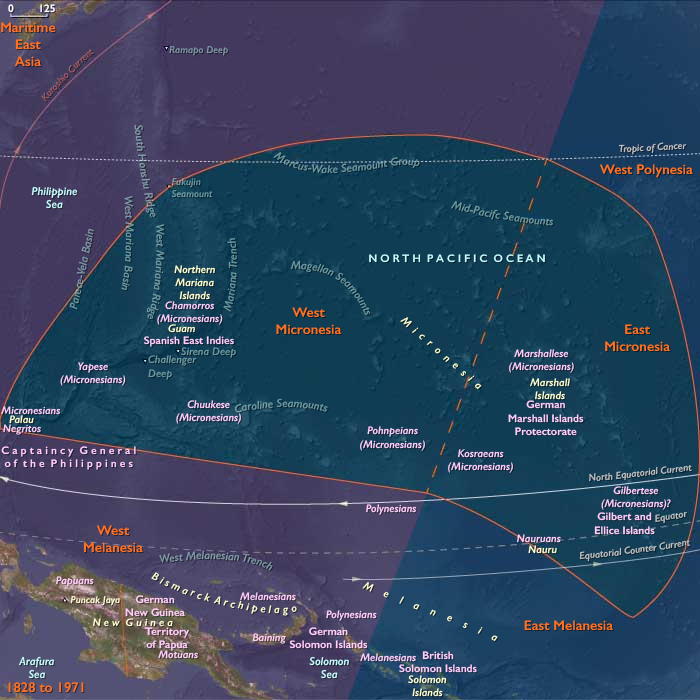
Micronesia comprises two fixed subregions:
-
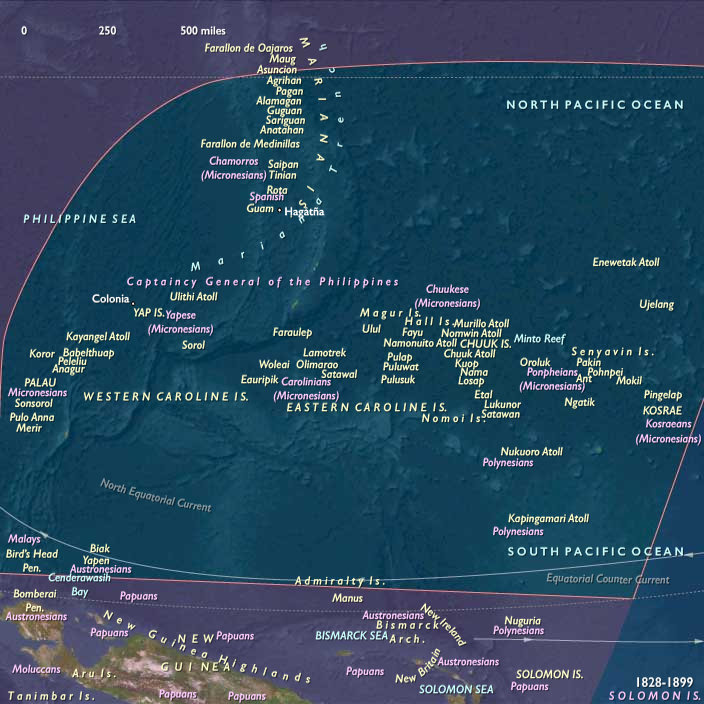
West Micronesia: the Mariana Islands (including Guam and Saipan) and the Caroline Islands (Palau, Yap, Chuuk, Pohnpei, Kosrae).
-
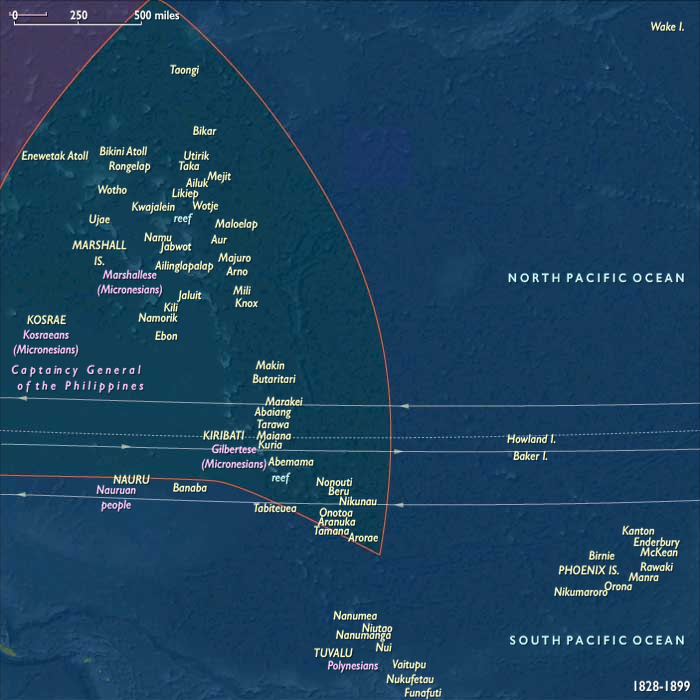
East Micronesia: the Marshall Islands, Kiribati (Gilbert Islands), and outlying eastern Carolines.
Together they form a constellation of volcanic high islands, coral atolls, and low reef platforms spread across millions of square kilometers of the western and central Pacific. Each relied on fragile freshwater lenses, breadfruit and coconut groves, and rich reef fisheries.
Climate & Environmental Shifts
Tropical trade winds and the oscillating El Niño–Southern Oscillation (ENSO) produced alternating droughts and heavy rains. Cyclones occasionally destroyed breadfruit and coconut trees; droughts threatened taro pits on atolls. Colonial copra plantations and wartime construction damaged fragile ecosystems. In the mid-20th century, U.S. nuclear testing in the Marshalls (1946–58) contaminated land and sea, while population displacement and coastal erosion worsened under new infrastructure and population pressure.
Subsistence & Settlement
Traditional horticulture—taro, breadfruit, pandanus, bananas, and coconuts—remained central. Fishing and inter-atoll exchange provided protein and salt. Colonial rule reoriented economies toward copra and later wage labor:
-
Spanish rule lingered until the late 19th century, followed by German administration (1899–1914) emphasizing copra.
-
Japanese mandate (1914–1944) industrialized sugar, fishing, and shipping networks, and established schools, ports, and airfields, drawing Japanese settlers to Saipan, Palau, and Chuuk.
-
After World War II, the United States Trust Territory of the Pacific Islands (TTPI, 1947) unified most of Micronesia under U.N. mandate, bringing cash employment, U.S. education, and aid dependence.
Technology & Material Culture
Indigenous canoe and navigation traditions persisted in parts of Yap, Palau, and the Marshalls. Missions and colonial governments introduced iron tools, printed cloth, and concrete housing. Japanese period architecture—sugar mills, piers, and warehouses—left enduring marks. After 1945, U.S. administration introduced radios, diesel generators, prefabricated schools, and modern shipping. Traditional arts—canoe carving, weaving, shell ornament—continued, increasingly as symbols of identity.
Movement & Interaction Corridors
-
Maritime networks: Islanders maintained canoe routes linking atolls for kinship and trade; colonial steamers later replaced them.
-
Labor migration: Men traveled to work on plantations, ships, and military bases; after WWII, educational and labor programs sent Micronesians to Guam, Hawai‘i, and the continental U.S.
-
Military geography: The islands formed a key Pacific battleground during WWII—Guam, Saipan, Palau, and the Marshalls endured fierce fighting. Postwar bases at Kwajalein, Guam, and Yap tied the region to Cold War strategy.
Cultural & Symbolic Expressions
Christianity—Catholic and Protestant—became dominant but intertwined with traditional cosmologies. Oral histories, navigation chants, and lineage rituals survived under mission influence. Japanese schools spread literacy before 1945; after 1947, U.S. schooling in English created a new educated elite. Political identity coalesced through the Congress of Micronesia (1965), foreshadowing later independence movements.
Environmental Adaptation & Resilience
Atoll dwellers preserved breadfruit fermentation and inter-island reciprocity to withstand famine. After cyclones, communities replanted coconuts and taro and relied on church networks for relief. Environmental knowledge of winds, reefs, and tides remained central even as modern technology arrived. In the nuclear-test zones of Bikini and Enewetak, displaced islanders rebuilt new villages on distant atolls, maintaining cohesion through shared rituals and appeals for restitution.
Political & Military Shocks
-
Colonial succession: Spain → Germany → Japan → United States.
-
World War II: Devastation from battles at Saipan, Palau, Truk Lagoon, and Tarawa; massive civilian displacement.
-
Nuclear testing: Bikini and Enewetak atolls (1946–58) used for U.S. weapons tests, displacing populations and spreading radiation.
-
Postwar governance: The Trust Territory (1947) placed Micronesia under U.S. administration with U.N. oversight; by the 1960s, local legislatures and constitutional conventions moved toward self-government.
-
Strategic islands: Guam and Saipan integrated as U.S. territories; Palau and the Marshalls negotiated special compacts; Kiribati moved toward British-led independence (achieved 1979).
Transition
Between 1828 and 1971, Micronesia journeyed from missionized atolls and colonial plantations to a fragmented constellation of Cold War dependencies and emerging nations. The 19th century brought European and Japanese imperial control; World War II brought devastation; the U.S. Trust Territory introduced education and aid but also dependency and nuclear trauma. Through it all, Micronesian societies retained core resilience—canoe voyaging, clan solidarity, and spiritual reciprocity with land and sea. By 1971, the region stood poised for decolonization, its people navigating between the legacies of empire and the assertion of renewed island sovereignty.
Groups
- Yap
- Palau
- Kiribati
- Marianas, the
- Micronesians
- Marshall Islands
- Chamorro people
- Kosrae
- Chuuk
- Marshall Islands
- Spain, Bourbon Kingdom (first restoration) of
- Gilbert Islands
- Japan, Empire of (Meiji Period)
- German Empire (“Second Reich”)
- Marshall Islands (Spanish colony)
- Spain, Bourbon Kingdom (second restoration) of
- German Pacific Possessions
- Marshall Islands (German colony)
- Gilbert Islands, British protectorate of
- Guam (United States insular area of)
- Marshall Islands (Japanese occupied)
- Marshall Islands (South Pacific Mandate)
- Marshall Islands (Trust Territory of the Pacific Islands)
- Pacific Islands, Trust Territory of the
Topics
- Oceania, Settlement of
- Little Ice Age, Warm Phase I
- Little Ice Age (LIA)
- World War, Second (World War II)
- Second World War in the Pacific
Commodoties
Subjects
Regions
Subregions
Years: 1828 - 1971
Groups
- Yap
- Palau
- Kiribati
- Marianas, the
- Micronesians
- Marshall Islands
- Chamorro people
- Kosrae
- Chuuk
- Marshall Islands
- Spain, Bourbon Kingdom (first restoration) of
- Gilbert Islands
- Japan, Empire of (Meiji Period)
- German Empire (“Second Reich”)
- Marshall Islands (Spanish colony)
- Spain, Bourbon Kingdom (second restoration) of
- German Pacific Possessions
- Marshall Islands (German colony)
- Gilbert Islands, British protectorate of
- Guam (United States insular area of)
- Marshall Islands (Japanese occupied)
- Marshall Islands (South Pacific Mandate)
- Marshall Islands (Trust Territory of the Pacific Islands)
- Pacific Islands, Trust Territory of the
Topics
- Oceania, Settlement of
- Little Ice Age, Warm Phase I
- Little Ice Age (LIA)
- World War, Second (World War II)
- Second World War in the Pacific
Commodoties
Subjects
Regions
Subregions