
Melanesia (1828–1971 CE) Missions, Empires, and …
Years: 1828 - 1971
Melanesia (1828–1971 CE)
Missions, Empires, and the Road to Independence
Geography & Environmental Context
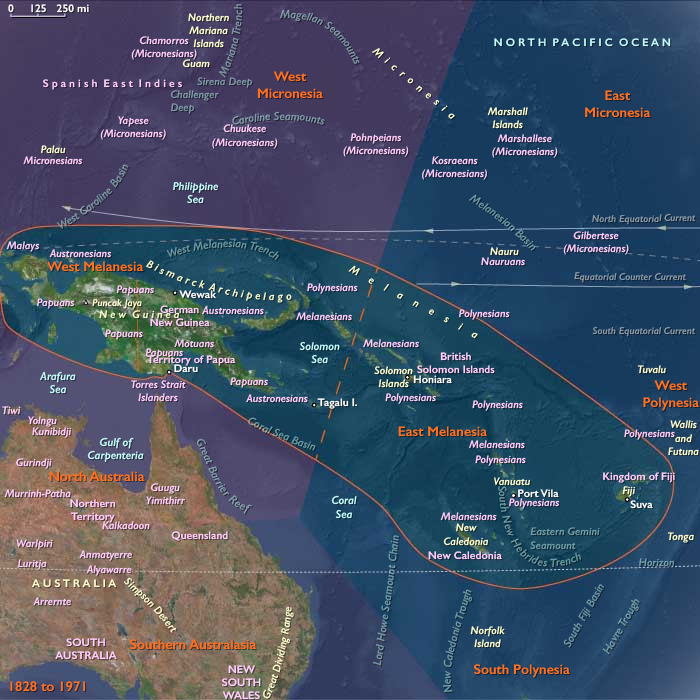
Melanesia comprises two fixed subregions:
-
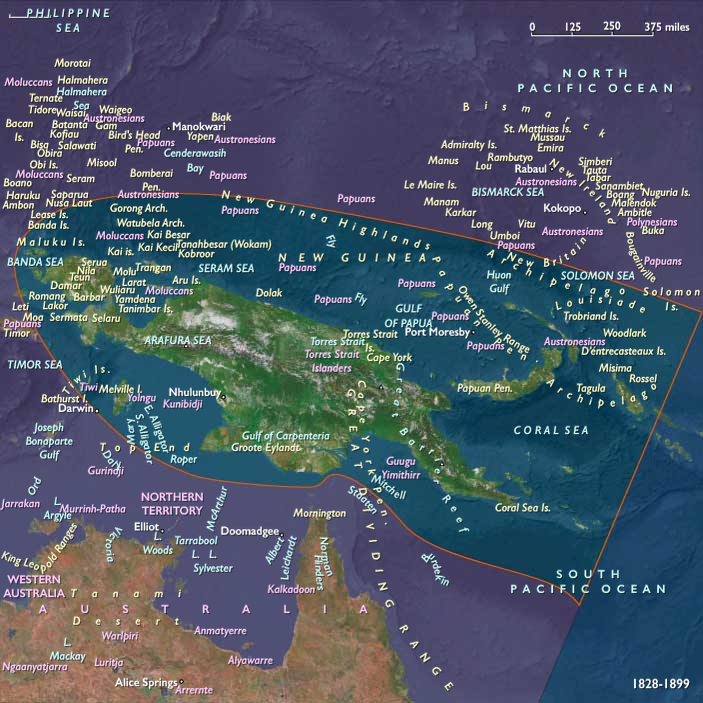
West Melanesia: the western half of New Guinea (Dutch New Guinea, later West Papua), Papua New Guinea’s northern islands, Bougainville, and Buka.
-
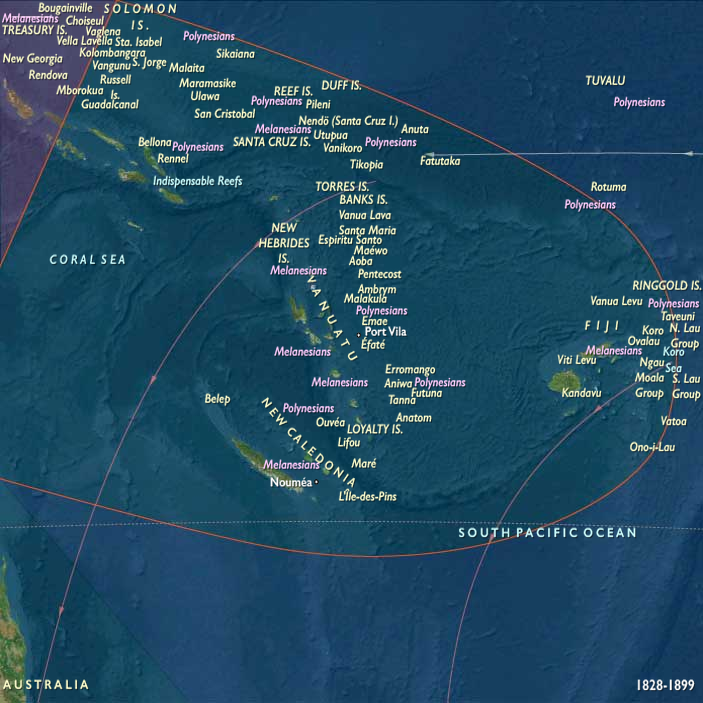
East Melanesia: Vanuatu, Fiji, New Caledonia, and the Solomon Islands (excluding Bougainville and Buka).
Stretching from the rugged mountains of New Guinea through the volcanic and coral archipelagos of the southwest Pacific, Melanesia is a zone of humid tropical climate, high rainfall, and rich biodiversity. Active volcanoes, earthquake belts, and cyclones shaped settlement and agriculture. Coastal plains supported coconut and yam cultivation, while interior valleys relied on terraced gardens and pig husbandry.
Climate & Environmental Shifts
Rainfall patterns varied sharply between windward and leeward coasts. The late 19th century brought destructive cyclones and volcanic eruptions (e.g., Rabaul 1878, Yasur’s continuous activity). In the 20th century, deforestation and mining accelerated erosion and sedimentation. European logging, plantation clearing, and later mechanized agriculture intensified land-use pressures, while population growth increased demand for arable land.
Subsistence & Settlement
-
Traditional systems: Root crops (taro, yam, sweet potato), bananas, and coconuts remained staples; fishing, pig raising, and exchange networks sustained communities.
-
Colonial plantation economies:
-
West Melanesia—Dutch missions and later Australian administration emphasized copra, cocoa, and rubber.
-
East Melanesia—France developed nickel mining in New Caledonia, Britain and France jointly ruled the New Hebrides (Vanuatu), and the British Solomon Islands and Fiji turned to copra and sugar.
-
Indentured labor: Thousands of Melanesians (“Kanakas”) were recruited or coerced into plantation work in Queensland, Fiji, and Samoa through the 1870s–1900s.
-
-
Urban growth: Colonial capitals like Suva, Nouméa, Port Vila, and Honiara emerged as administrative and commercial centers.
Technology & Material Culture
Missions and traders introduced steel tools, firearms, textiles, and literacy. Wooden canoes, bark cloth, and intricate carvings persisted, now often produced for both ritual and trade. By the 20th century, radios, sewing machines, and prefabricated housing reached towns. Mining infrastructure in New Caledonia and later Bougainville (1960s) transformed landscapes.
Movement & Interaction Corridors
-
Inter-island exchanges linked coast and highlands via shell money, pigs, and ritual feasting.
-
Colonial networks connected Melanesia to global routes: French shipping through New Caledonia, British through Fiji and the Solomons, Dutch and later Australian governance through New Guinea.
-
Labor migrations—both forced and voluntary—created diaspora communities across Queensland, Samoa, and Fiji.
-
War corridors: During World War II, Melanesia became a major Pacific theater—especially Guadalcanal (1942–43)—bringing roads, airfields, and new wage labor opportunities.
Cultural & Symbolic Expressions
-
Religious transformation: Christianity spread widely through mission schools and translations of scripture. Indigenous cosmologies endured, often syncretized into new denominations.
-
Art & ritual: Canoe prows, masks, drums, and carved ancestor figures remained expressions of spiritual lineage. Postwar movements such as the John Frum cult in Vanuatu and other “cargo cults” reflected both resistance and adaptation to colonial disruption.
-
Music & oral tradition: Polyphonic singing, slit drums, and storytelling preserved histories of migration and conflict, while new church choirs and brass bands reflected hybrid modernity.
Environmental Adaptation & Resilience
Subsistence diversity, intensive gardening, and kin-based land tenure sustained resilience. Cyclones and volcanic disasters were met with reciprocal exchange and ceremonial redistribution. Postwar agricultural cooperatives and education projects sought to stabilize economies, though inequality persisted between rural and plantation sectors.
Political & Military Shocks
-
Colonial partition:
-
New Caledonia annexed by France (1853).
-
New Hebrides became an Anglo-French Condominium (1906).
-
Solomon Islands declared a British protectorate (1893).
-
Fiji annexed by Britain (1874).
-
Dutch New Guinea under Netherlands rule until Indonesian takeover (1963).
-
Papua and New Guinea administered by Britain, Germany, and later Australia (1884–1906–1949).
-
-
World War II: Devastated many islands; Indigenous labor and knowledge were crucial to Allied logistics.
-
Postwar nationalism: Education, missions, and wartime experience fostered independence movements.
-
Fiji moved toward self-government; Vanuatu saw rising nationalist movements; Papua New Guinea and Solomon Islands followed suit; New Caledonia retained strong French control.
-
West Papua was transferred to Indonesia (1963), sparking continuing conflict.
-
Transition
Between 1828 and 1971, Melanesia was transformed from a world of autonomous island polities and ritual economies into a colonized, missionized, and increasingly mobilized region. The 19th century brought labor exploitation and partition; the 20th century added war, resource extraction, and the stirrings of independence. Yet throughout, Melanesian societies retained deep-rooted resilience through kinship, exchange, and spirituality. By 1971, new elites were emerging, nationalism was taking form, and the memory of ancestors, land, and ritual exchange continued to guide communities toward self-determination in a rapidly globalizing Pacific.
Groups
- New Caledonia
- Fiji
- Vanuatu/New Hebrides
- Austronesian peoples
- Solomon Islands
- New Guinea, indigenous peoples of, aka Papuans
- New Guinea, Netherlands (or Dutch)
- New Caledonia and Dependencies (French overseas Territory)
- Fiji, Kingdom of
- Fiji, Crown Colony of
- Solomon Islands (German protectorate)
- New Guinea, German, Territory of
- Solomon Islands (British protectorate)
- New Guinea, Territory of
- Fiji, Dominion of
Topics
- Oceania, Settlement of
- Little Ice Age, Warm Phase I
- Little Ice Age (LIA)
- World War, Second (World War II)
- Second World War in the Pacific
- Guadalcanal campaign
Commodoties
- Fish and game
- Glass
- Domestic animals
- Oils, gums, resins, and waxes
- Grains and produce
- Ceramics
- Strategic metals
- Sweeteners
- Lumber
- Money
- Aroma compounds
Subjects
- Commerce
- Symbols
- Watercraft
- Environment
- Decorative arts
- Conflict
- Mayhem
- Faith
- Government
- Custom and Law
- Technology
- Human Migration
Regions
Subregions
Years: 1828 - 1971
Groups
- New Caledonia
- Fiji
- Vanuatu/New Hebrides
- Austronesian peoples
- Solomon Islands
- New Guinea, indigenous peoples of, aka Papuans
- New Guinea, Netherlands (or Dutch)
- New Caledonia and Dependencies (French overseas Territory)
- Fiji, Kingdom of
- Fiji, Crown Colony of
- Solomon Islands (German protectorate)
- New Guinea, German, Territory of
- Solomon Islands (British protectorate)
- New Guinea, Territory of
- Fiji, Dominion of
Topics
- Oceania, Settlement of
- Little Ice Age, Warm Phase I
- Little Ice Age (LIA)
- World War, Second (World War II)
- Second World War in the Pacific
- Guadalcanal campaign
Commodoties
- Fish and game
- Glass
- Domestic animals
- Oils, gums, resins, and waxes
- Grains and produce
- Ceramics
- Strategic metals
- Sweeteners
- Lumber
- Money
- Aroma compounds
Subjects
- Commerce
- Symbols
- Watercraft
- Environment
- Decorative arts
- Conflict
- Mayhem
- Faith
- Government
- Custom and Law
- Technology
- Human Migration
Regions
Subregions