
West Africa (7,821 – 6,094 BCE) …
Years: 7821BCE - 6094BCE
West Africa (7,821 – 6,094 BCE) Early Holocene — Wet-Phase Abundance and Proto-Horticulture
Geographic and Environmental Context
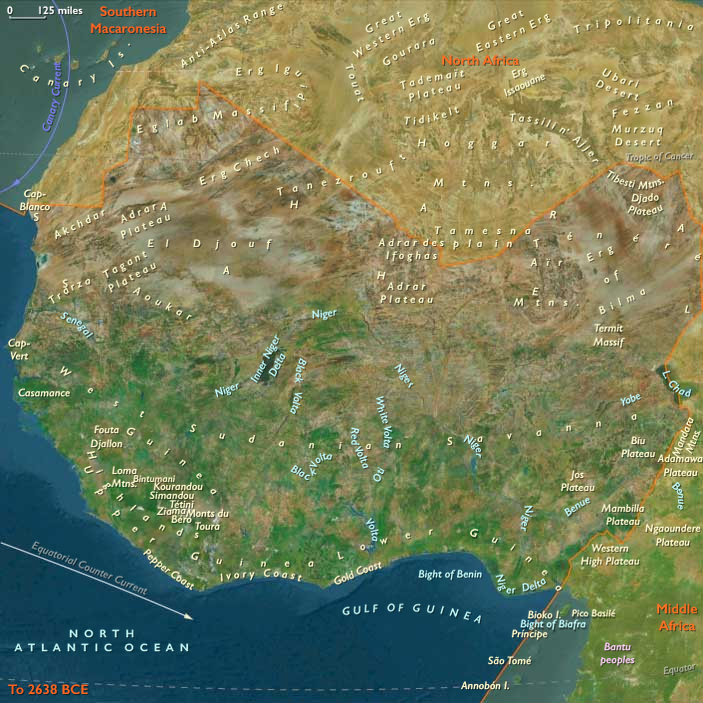
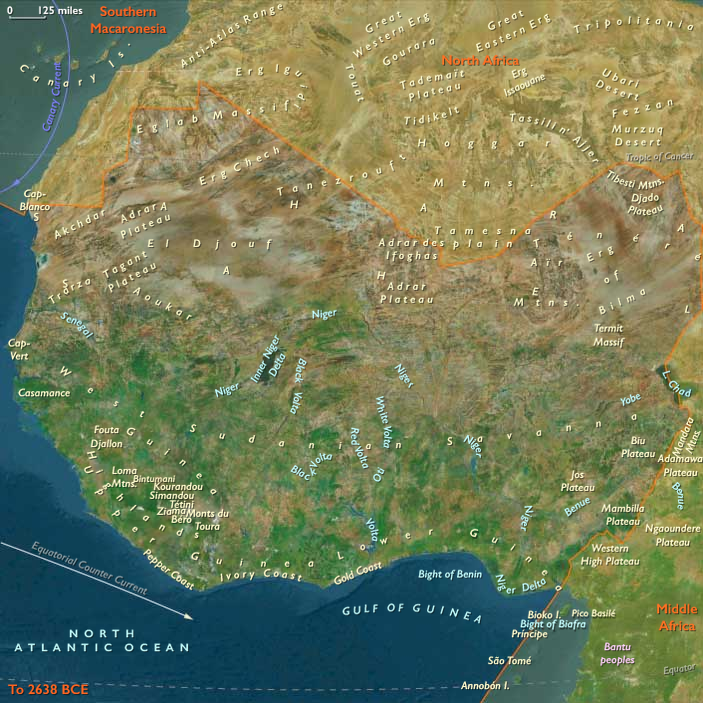
The Atlantic and inland belt from Senegal and Mauritania east through Mali, Niger, Burkina Faso, and Nigeria (western and central), plus the forest–savanna margins of Guinea, Sierra Leone, Liberia, Côte d’Ivoire, Ghana, Togo, and Benin.
Anchors: Senegal–Gambia valleys, Inland Niger Bend and Inland Delta (Timbuktu, Mopti, Gao), Middle Niger–Kainji basin, Jos Plateau, Hausaland (Kano, Katsina, Zaria), Upper Volta basin, Gold Coast forest margins, Futa Jallon highlands, Dahomey Gap.
-
African Humid Period peak; Sahara green with savannas and lakes.
-
Niger Inland Delta vast; Senegal–Volta valleys lush.
Climate & Environmental Shifts
-
Monsoons strong; rainfall abundant.
-
Lakes and rivers at highstand.
Subsistence & Settlement
-
Foragers became semi-sedentary fishers–hunters.
-
Early tending of wild millet, sorghum, fonio in Sahel/Upper Volta.
-
Oil palm exploited in forest–savanna margins.
Technology & Material Culture
-
Polished stone axes; ground slabs; first widespread pottery (~9000–7000 BCE).
-
Net weights, fish traps.
Movement & Interaction Corridors
-
Savanna corridors connected Senegal–Niger–Lake Chad.
-
Early exchanges in beads, shells.
Cultural & Symbolic Expressions
-
Rock art in central Sahara shows cattle/wildlife.
-
Burials at river sites with ochre, ornaments.
Environmental Adaptation & Resilience
-
Dual resource use (crops + fish) stabilized communities.
Transition
By 6,094 BCE, proto-horticulture was underway alongside abundant foraging.
Topics
Commodoties
- Fish and game
- Domestic animals
- Oils, gums, resins, and waxes
- Grains and produce
- Strategic metals
- Salt
Subjects
Regions
Subregions
Years: 7821BCE - 6094BCE
Topics
Commodoties
- Fish and game
- Domestic animals
- Oils, gums, resins, and waxes
- Grains and produce
- Strategic metals
- Salt
Subjects
Regions
Subregions