
West Africa (49,293 – 28,578 BCE) …
Years: 49293BCE - 28578BCE
West Africa (49,293 – 28,578 BCE) Upper Pleistocene I — Foragers of River Valleys and Green Sahara Corridors
Geographic and Environmental Context
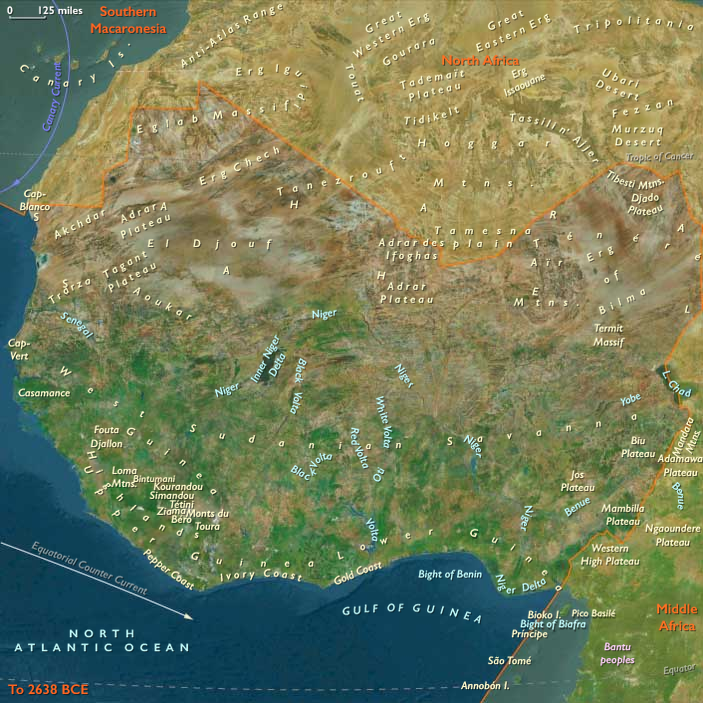
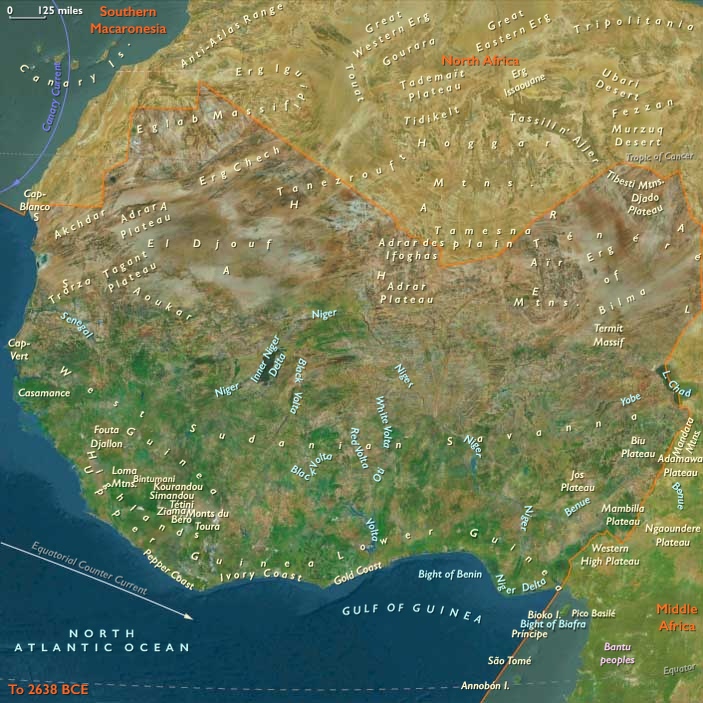
The Atlantic and inland belt from Senegal and Mauritania east through Mali, Niger, Burkina Faso, and Nigeria (western and central), plus the forest–savanna margins of Guinea, Sierra Leone, Liberia, Côte d’Ivoire, Ghana, Togo, and Benin.
Anchors: Senegal–Gambia valleys, Inland Niger Bend and Inland Delta (Timbuktu, Mopti, Gao), Middle Niger–Kainji basin, Jos Plateau, Hausaland (Kano, Katsina, Zaria), Upper Volta basin, Gold Coast forest margins, Futa Jallon highlands, Dahomey Gap.
-
LGM: Sahara hyper-arid; Lake Chad contracted.
-
Sahel savanna narrowed to thin strip.
-
Niger–Senegal–Volta valleys shrank but retained perennial water.
Climate & Environmental Shifts
-
Cooler, drier; dust storms frequent.
-
Seasonal streams ephemeral; only major rivers provided continuity.
Subsistence & Settlement
-
Foragers along Senegal–Gambia and Niger hunted antelope, aurochs, and hippo.
-
Fishing supplemented lean seasons.
-
Futa Jallon uplands provided refugia with springs.
Technology & Material Culture
-
Core–flake tools, quartz microliths.
-
Shell and bone ornaments.
Movement & Interaction Corridors
-
Senegal–Niger corridor carried movement between coastal and inland refugia.
-
Green Sahara corridors limited but provided episodic exchange.
Cultural & Symbolic Expressions
-
Ochre use and body ornamentation.
-
Rock shelters in Mali/Senegal show symbolic traces.
Environmental Adaptation & Resilience
-
Mobility between rivers and upland refugia buffered aridity.
Transition
By 28,578 BCE, West African foragers had stabilized around perennial river corridors.
Topics
Commodoties
- Fish and game
- Domestic animals
- Oils, gums, resins, and waxes
- Grains and produce
- Strategic metals
- Salt
Subjects
Regions
Subregions
Years: 49293BCE - 28578BCE
Topics
Commodoties
- Fish and game
- Domestic animals
- Oils, gums, resins, and waxes
- Grains and produce
- Strategic metals
- Salt
Subjects
Regions
Subregions